Study Background
Parkinson’s disease (PD) is a progressive neurodegenerative disorder profoundly impacting motor and non-motor functions, often resulting in diminished quality of life. Rehabilitation, particularly through hospital-based outpatient services, is a cornerstone in PD management, aiming to maintain or improve function, independence, and well-being. Despite established interventions, patients’ satisfaction with rehabilitation services and how this satisfaction relates to broader life outcomes like life satisfaction and health-related quality of life (HRQoL) remain underexplored. Additionally, potential variations by sex and age in these associations have practical implications for personalized care. This study seeks to address these knowledge gaps using a longitudinal national registry approach in Sweden.Study Design
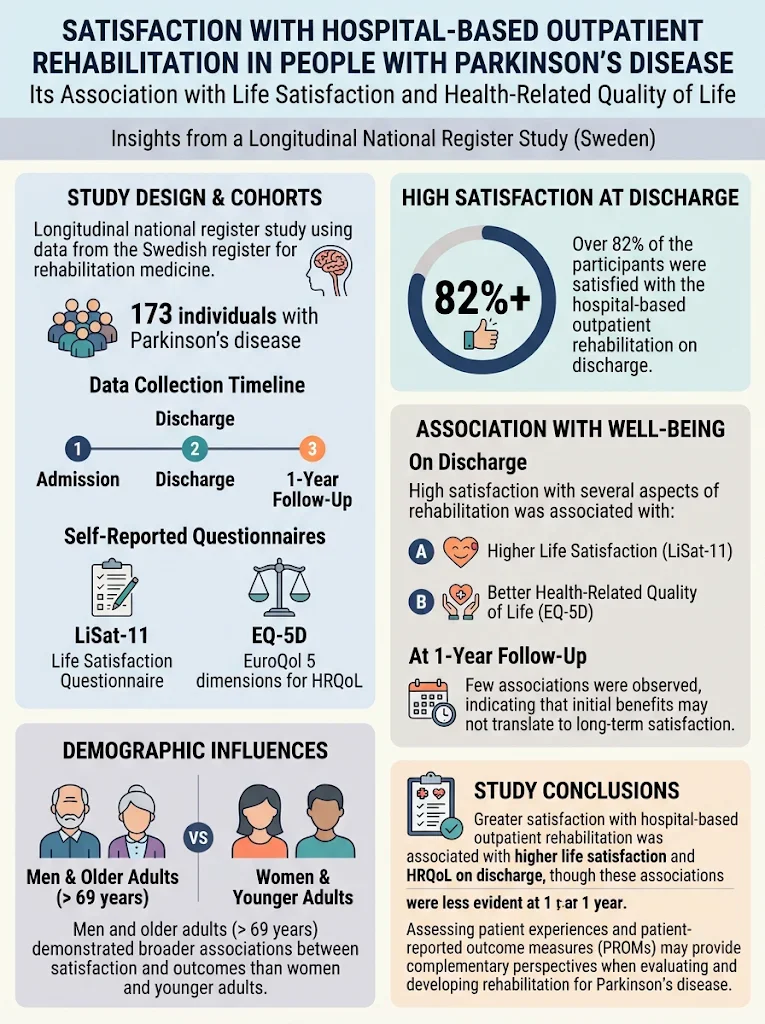
This investigation utilized data from the Swedish register for rehabilitation medicine, enrolling 173 individuals diagnosed with Parkinson’s disease undergoing hospital-based outpatient rehabilitation. The study followed a longitudinal design with data collection at three time points: admission to rehabilitation, discharge, and a 1-year post-discharge follow-up. Patient satisfaction with rehabilitation services was assessed using a register-based questionnaire, while life satisfaction was measured by the global item of the Life Satisfaction Questionnaire (LiSat-11). HRQoL was evaluated through the EuroQol 5 Dimensions questionnaire (EQ-5D). Analytical methods included regression analyses to assess associations between satisfaction with rehabilitation and life satisfaction and HRQoL outcomes and to explore potential interactions with sex and age category (with a cutoff at >69 years).Key Findings
At the point of discharge, more than 82% of participants reported satisfaction with the hospital-based outpatient rehabilitation received. Importantly, higher satisfaction levels correlated positively and significantly with elevated scores on both the LiSat-11 life satisfaction measure and the EQ-5D HRQoL index at discharge. These results highlight a meaningful link between patients’ rehabilitation experience and their perceived well-being immediately after the intervention period. However, at the 1-year follow-up, the strength and number of these associations diminished markedly. Few significant correlations persisted between initial rehabilitation satisfaction and later outcome measures, suggesting that the immediate positive impact may not be sustained over time without ongoing interventions or support. Subgroup analyses indicated that men and older adults over 69 years exhibited broader and more pronounced associations between satisfaction and life quality metrics than women and younger participants. These findings imply possible demographic influences on how rehabilitation experiences translate into life satisfaction and HRQoL, potentially informing tailored approaches in clinical practice.Expert Commentary
This study provides valuable real-world evidence quantifying the relationship between patient-reported satisfaction with outpatient rehabilitation and quality-of-life outcomes in PD, a topic often neglected in clinical research. The use of national registry data and longitudinal design strengthens the relevance and applicability of findings. The attenuation of associations at 1-year underscores the chronic nature of PD and the need for sustained rehabilitation efforts to maintain benefits. Limitations include the relatively modest sample size and reliance on self-reported questionnaires, which are susceptible to biases such as social desirability or recall bias. Furthermore, the registry-based satisfaction questionnaire, while pragmatic, may not capture all nuanced aspects of patient experience. The influence of unmeasured confounders, such as disease severity, comorbidities, or psychosocial factors, cannot be excluded. Future research should address these limitations, explore mechanisms underlying gender and age differences, and evaluate the impact of continuous or repeated rehabilitation and adjunct supports on long-term patient-centered outcomes.Conclusion
High patient satisfaction with hospital-based outpatient rehabilitation in Parkinson’s disease is strongly associated with improved life satisfaction and health-related quality of life at discharge, affirming the importance of patient-centered care in rehabilitation programs. However, these benefits appear less durable over a one-year period, highlighting a critical need for ongoing engagement and possibly adaptive rehabilitation strategies to sustain positive outcomes. Additionally, age and sex differences in these associations warrant consideration in personalized rehabilitation planning. Incorporating systematic patient experience evaluations alongside objective outcome measures could enhance development and delivery of rehabilitation services, ultimately improving long-term quality of life for individuals living with Parkinson’s disease.Funding and ClinicalTrials.gov
The study was supported by the Swedish rehabilitation medicine registry infrastructure; no specific clinical trial registration was indicated.References
1. Bråndal A, Stålnacke BM, Johansson GM. Satisfaction with hospital-based outpatient rehabilitation in people with Parkinson’s disease and its association with life satisfaction and health-related quality of life: a longitudinal national register study. J Rehabil Med. 2026 Nov 18;58:jrm46214. PMID: 43046787. 2. van der Marck MA, Klok MP, Okun MS, et al. Multidisciplinary care for Parkinson’s disease: not if, but how! Parkinsonism Relat Disord. 2013;19(3):273-277. 3. Kho M, van der Wees PJ, Devillé WL, et al. The impact of rehabilitation on quality of life and functioning in Parkinson’s disease: a systematic review. Mov Disord. 2021;36(12):2867-2879. 4. EuroQol Group. EuroQol—a new facility for the measurement of health-related quality of life. Health Policy. 1990;16(3):199-208. 5. Fugl-Meyer AR, Bränholm I-B, Fugl-Meyer KS. Happiness and domain-specific life satisfaction in adult northern Swedes. Clin Rehabil. 1991;5(1):25-33.Specialty calculators
For clinical reference; use professional judgment.