Introduction
Anterior cruciate ligament (ACL) rupture remains one of the most debilitating injuries in professional football, often leading to prolonged absence from sport, costly rehabilitation, and long-term joint health issues such as osteoarthritis. Despite substantial research efforts, the biomechanical mechanisms underpinning ACL injuries during dynamic, sport-specific contexts have only partially been understood. Over the past five years, the application of advanced three-dimensional (3D) motion reconstruction techniques has provided unprecedented insights into the joint kinematics that culminate in ACL rupture among elite male football players during official matches. This article critically reviews these novel findings and explores their implications for injury prevention and rehabilitation.Highlighting Key Advances
– Utilization of Model-Based Image-Matching (MBIM) techniques has enabled precise 3D reconstruction of knee joint kinematics from game footage, surpassing the limitations of traditional two-dimensional video analyses. – ACL injuries display a consistent pattern of multiplanar knee joint rotations involving increased flexion, valgus shift, and complex rotational sequences. – Whole-body kinematic patterns preceding injury are highly variable, indicating context-driven and individual-specific injury mechanisms. – Integrative prevention strategies emphasizing biomechanical, perceptual, and situational factors may enhance effectiveness beyond traditional approaches.Disease Burden and Clinical Context
Football is a globally popular sport with a high incidence of non-contact ACL injuries, which notably affect players’ careers and long-term musculoskeletal health. ACL rupture leads to significant morbidity, disability, and often necessitates surgical reconstruction followed by extensive rehabilitation. The economic burden includes direct treatment costs and indirect costs from lost player availability and decreased performance. Understanding injury mechanisms within the authentic competitive environment is imperative to developing targeted prevention protocols that reduce injury risk without impairing athletic performance.Study Design and Methodological Approach
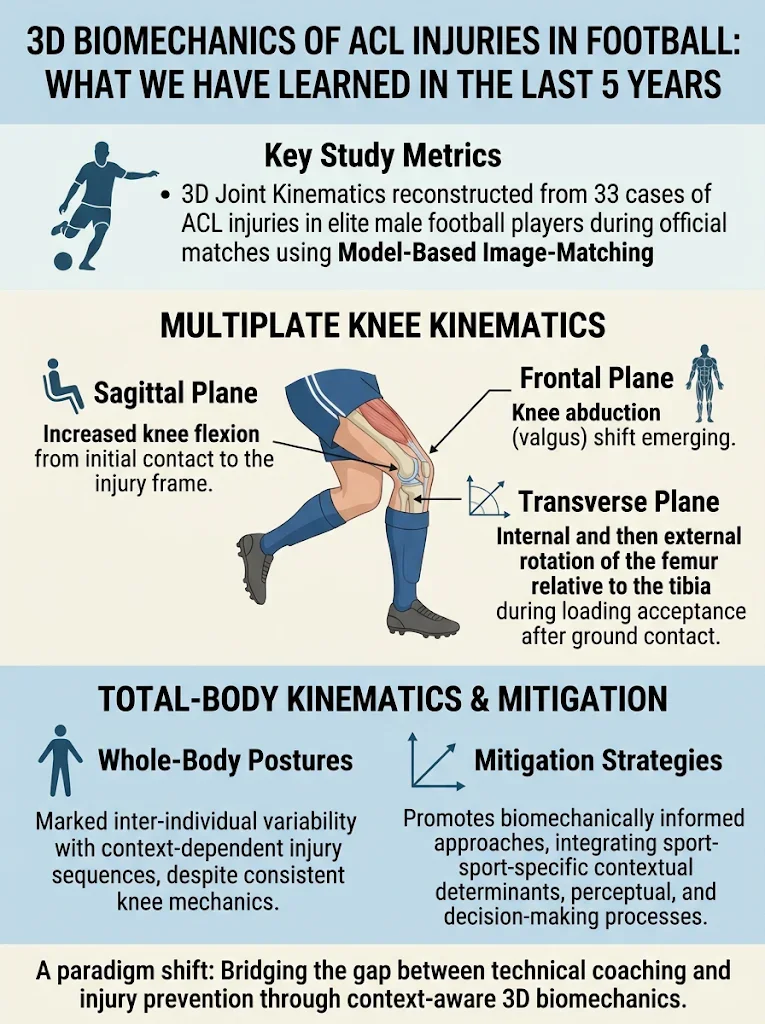
The studies synthesized in this review analyzed 33 documented cases of ACL rupture sustained by elite male professional football players during official matches. Leveraging MBIM technology, researchers reconstructed 3D knee joint kinematics at injury onset using systematically obtained multi-angle video footage. This method allows quantitative and detailed analyses of dynamic joint positions and rotations across sagittal, frontal, and transverse planes, circumventing the constraints of bidimensional assessments prone to perspective distortion and inaccuracies.Detailed Biomechanical Findings
Knee-Level Mechanics
The reconstructed kinematic profiles consistently demonstrate a sequence of multiplanar rotations culminating in ACL failure. Key findings include: – Sagittal plane: Progressive increase in knee flexion angle from initial ground contact to the injury frame, evidencing that the ACL rupture often occurs during a loading phase rather than at hyper-extension. – Frontal plane: Emergence of a knee abduction (valgus) shift that likely increases tensile stress on the ACL, consistent with previous hypotheses linking valgus collapse to ligament failure. – Transverse plane: A sequential pattern of femoral internal rotation followed by external rotation relative to the tibia is observed during load acceptance, indicating complex rotational joint instability preceding rupture.Whole-Body Kinematics and Individual Variability
Extending analysis beyond the knee reveals substantial inter-individual variability in trunk, hip, and foot positioning at injury. Although the knee joint kinematics converge towards a consistent injurious pattern, the sequences of whole-body postures leading to these critical knee positions differ based on situational factors such as player role, action type (e.g., cutting, pivoting), and in-game contextual demands. This heterogeneity underscores the multifactorial nature of ACL injury causation and the limitations of one-size-fits-all biomechanical models.Expert Commentary and Interpretation
These innovative biomechanical insights corroborate and extend existing mechanistic theories by validating ACL injury signatures in ecologically valid environments. The application of MBIM represents a methodological leap that enables retrospective yet precise kinematic estimations from real-world competitive play. Notably, while knee-level kinematics are consistent injury markers, whole-body variability advocates for a holistic prevention approach that integrates biomechanical training with sport-specific decision making and perceptual-cognitive conditioning. Football coaches and clinicians should collaborate closely to embed injury prevention within technical coaching, thereby addressing neuromuscular control in complex, game-like scenarios. Limitations of this body of work include relatively small sample sizes and restriction to elite male athletes, which may limit generalizability across sexes, levels, and age groups. Prospective studies incorporating wearable sensor technology could complement MBIM findings through continuous biomechanical monitoring.Conclusion and Future Directions
The application of 3D biomechanical reconstruction over the past five years has significantly enhanced understanding of ACL injury mechanisms in elite football. A consistent knee kinematic pattern characterized by increased flexion, valgus shift, and femoral-tibial rotations has been identified as a hallmark of ACL rupture. However, the variation in whole-body kinematics leading to these knee positions highlights the necessity for customized, context-aware injury prevention strategies. Emerging paradigms advocate for integrating biomechanical insights with perceptual training and contextual decision-making elements to address the multifactorial nature of ACL injuries effectively. Future research should focus on expanding cohort diversity, improving real-time biomechanical monitoring, and translating these findings into evidence-based, implementable prevention programs within competitive football.Specialty calculators
For clinical reference; use professional judgment.