Highlight
This article critically evaluates the novel global track concept—a combined glenoid and humeral measurement—as a predictive tool for anterior shoulder instability. Key findings include a moderate correlation of the glenoid angle with glenoid bone loss, a global track angle cutoff associated with off-track lesions, and the proposal of a critical glenoid angle threshold corresponding to 13.5% bone loss.
Study Background
Anterior shoulder instability represents a frequent orthopedic challenge, often complicated by bipolar bone loss involving the glenoid and the humeral head. The degree of bone loss critically influences the risk of recurrent dislocation and informs surgical management strategies. Traditional imaging metrics such as glenoid bone loss quantification, glenoid track width, Hill-Sachs interval (HSI), and occupancy ratio have been utilized to characterize instability risk. However, identifying critical thresholds that reliably predict engagement of Hill-Sachs lesions remains difficult and inconsistent.
Recently, the global track concept has been introduced as a unified, continuous measurement framework integrating the humeral and glenoid bone defects’ angular relationships. This method theoretically refines prediction of lesion engagement, potentially enhancing surgical planning and patient outcomes. Despite promising theoretical foundations, clinical validation against established instability metrics has been lacking.
Study Design
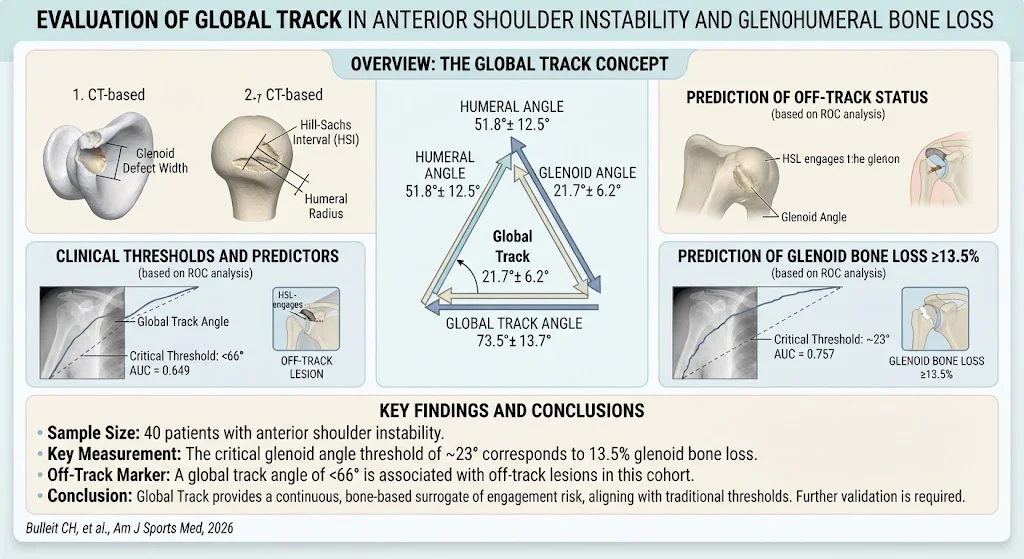
The study retrospectively identified 40 patients presenting with anterior shoulder instability who underwent three-dimensional computed tomography (3D CT) to measure glenoid and humeral bone loss. Inclusion criteria focused on documented anterior instability and adequate imaging data. The investigation measured global track parameters comprising the humeral angle (angular distance from the apex of the humeral articular surface to the medial edge of the Hill-Sachs lesion), the glenoid angle (angular distance from the glenoid articular surface to the glenoid defect edge), and the global track angle (the sum of the humeral and glenoid angles).
Traditional instability parameters recorded included quantified glenoid bone loss, glenoid track width, Hill-Sachs interval, distance to dislocation, and occupancy ratio (HSI/GT). A patient-specific critical humeral angle was calculated based on glenoid track width and humeral radius. The critical glenoid angle benchmark was anchored to a glenoid bone loss of 13.5%. Receiver operating characteristic (ROC) analyses were employed to assess predictive accuracy of global track angle for off-track lesions and of glenoid angle for significant bone loss.
Key Findings
The cohort demonstrated a mean humeral angle of 51.8° (±12.5°), a mean glenoid angle of 21.7° (±6.2°), and a mean global track angle of 73.5° (±13.7°). The critical humeral angle averaged 42.2° (±6.1°), while the derived critical glenoid angle threshold was 23.2° (95% confidence interval [CI]: 21.6°–24.8°). The mean critical global track angle was 65.5° (±6.1°).
Statistical analysis showed a moderate inverse correlation between glenoid angle and glenoid bone loss (coefficient of determination R2 = 0.43; P < .001), with each 10% increase in glenoid bone loss associated with a 4.5° decrease in glenoid angle. ROC curve analysis for the global track angle identified an area under the curve (AUC) of 0.649 (95% CI: 0.458–0.840) in predicting off-track lesions, demonstrating modest discriminative ability. In contrast, the glenoid angle as a predictor for bone loss ≥13.5% yielded an AUC of 0.757 (95% CI: 0.591–0.922), indicating respectable accuracy.
Importantly, a global track angle cutoff of less than 66° correlated with off-track lesions, suggesting a potential threshold for clinical decision-making. This continuous measurement may serve as a surrogate to the occupancy ratio, facilitating risk stratification of engagement in bipolar defects.
Expert Commentary
The global track concept represents a promising integrative metric that addresses limitations of isolated bone loss measures by combining the spatial angular measures of humeral and glenoid defects. Its theoretical rationale aligns with biomechanical principles governing lesion engagement in anterior instability. Nevertheless, the current evidence is restricted by retrospective design, a modest sample size, and lack of prospective clinical outcome correlation. The moderate AUC for global track angle highlights that, while promising, this metric should complement—not replace—established parameters until further validation.
Moreover, surgeon familiarity and operational standardization of angular measurements are required before routine clinical adoption. The critical glenoid angle approaching 23° as a surrogate for 13.5% bone loss offers a convenient imaging landmark potentially facilitating risk assessment. Future prospective studies with larger cohorts, clinical follow-up, and incorporation of dynamic functional data will be crucial to defining the global track’s role in surgical planning and prognosis.
Conclusion
This study substantiates the global track angle as a continuous, bone-based parameter aligning with traditional concepts of off-track lesions in anterior shoulder instability. The identified critical glenoid angle of approximately 23° may serve as a useful imaging correlate for clinically significant bone loss thresholds. However, the moderate predictive performance of global track angle and retrospective cohort design warrant cautious interpretation.
Further prospective investigations incorporating clinical outcomes and broader patient populations are essential to validate this measurement as a robust objective marker of bipolar bone defect severity and engagement risk. The integration of global track parameters could enhance personalized surgical decision-making and ultimately improve management of anterior shoulder instability.
Funding and Clinical Trials
The original study does not specify funding sources or clinical trial registration details.
References
- Di Giacomo G, Itoi E, Burkhart SS. Evolving concept of bipolar bone loss and the Hill-Sachs lesion: from ‘‘engaging/non-engaging’’ lesion to ‘‘on-track/off-track’’ lesion. Arthroscopy. 2014;30(1):90-98.
- Tingart M, Baums MH, Kohn D. Surgical treatment of anterior shoulder instability. Orthopade. 2011;40(10):872-880.
- Yamamoto N, Itoi E, Abe H, et al. Contact between the glenoid and the humeral head in abduction, external rotation, and horizontal extension: a new concept of glenoid track. J Shoulder Elbow Surg. 2007;16(5):649-656.
- Boutsiadis A, Marchat G, Plath JE, et al. Combined bone loss fixation technique in anterior shoulder instability: clinical outcomes and new insights. Am J Sports Med. 2021;49(6):1472-1479.
Specialty calculators
For clinical reference; use professional judgment.