Highlight
• The DANCODE trial evaluated the effect of vitamin K2 plus vitamin D3 supplementation on severe coronary artery calcification (CAC) progression.
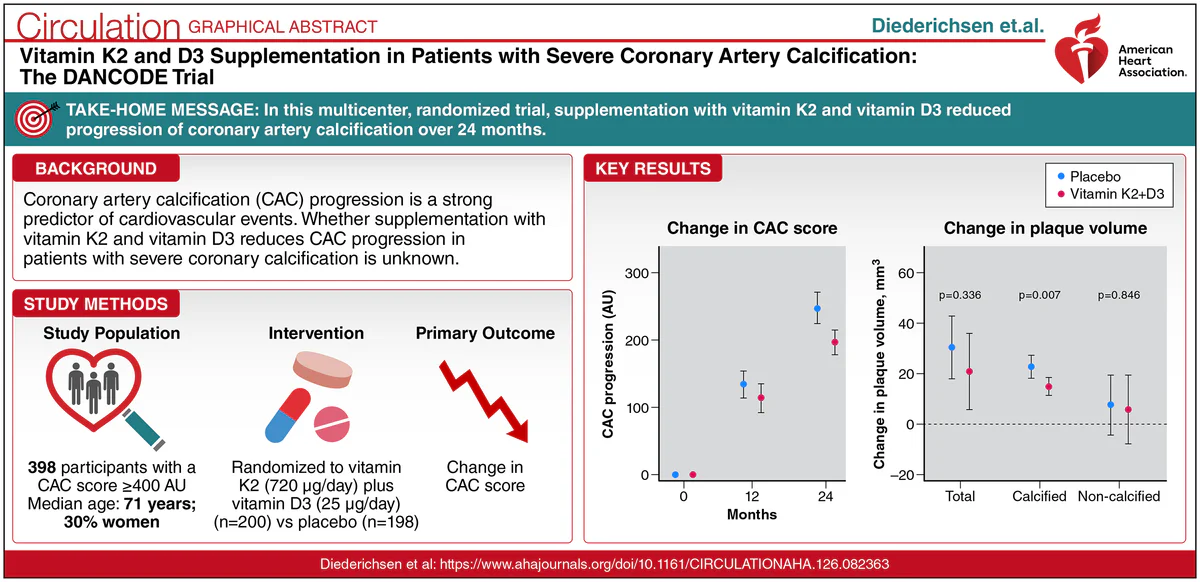
• Supplementation attenuated CAC progression by 52 Agatston units over 24 months compared to placebo.
• The intervention reduced calcified plaque volume progression without increasing noncalcified plaque.
• The treatment effect was consistent across sex and baseline CAC severity groups.
Study Background
Coronary artery calcification (CAC) is a well-established marker of atherosclerotic burden and a robust predictor of adverse cardiovascular events, including myocardial infarction and cardiac mortality. Patients presenting with severe CAC, typically quantified by high Agatston scores (≥400 units), are at particularly elevated risk. While CAC is a quantifiable measure of plaque mineralization, its progression over time correlates strongly with worsening coronary artery disease (CAD) and subsequent clinical events.
Vitamin K2, a cofactor critical for activating matrix Gla-protein, is implicated in inhibiting vascular calcification through its role in calcium metabolism regulation. Simultaneously, vitamin D3 has established effects on bone health and cardiovascular physiology, including modulation of inflammatory pathways and mineral metabolism. Prior observational and small interventional studies have suggested a potential benefit of these vitamins in reducing vascular calcification, but conclusive evidence from large randomized controlled trials in patients with severe CAC has been lacking.
Study Design
The DANCODE trial was a multicenter, double-blind, placebo-controlled randomized clinical trial conducted between February 2023 and February 2024. It enrolled 400 participants aged around 71 years with severe coronary calcification, defined as a baseline CAC score ≥400 Agatston units (AU). Participants were randomized 1:1 to receive either oral vitamin K2 at a dose of 720 micrograms per day plus vitamin D3 at 25 micrograms per day, or placebo, for 24 months.
Noncontrast cardiac computed tomography (CT) was performed at baseline, 12 months, and 24 months to quantify CAC scores and monitor progression. The primary endpoint was the absolute change in CAC score at 24 months. Subgroup analyses stratified participants by sex and baseline CAC categories (400-999 AU and ≥1000 AU). Additionally, a subset of 143 patients with CAC <1000 AU underwent coronary computed tomography angiography (CTA) at baseline and after 24 months to evaluate detailed plaque composition changes including total plaque volume, calcified and noncalcified plaque components.
Key Findings
Of 398 participants analyzed (30% female; median age 71 years; median baseline CAC 903 AU), 44% had CAC ≥1000 AU. The intention-to-treat analysis revealed a statistically significant attenuation in CAC progression in the vitamin K2 and D3 group compared to placebo over 24 months. Specifically, mean CAC increase was 196 AU (95% CI, 178-214) in the intervention arm versus 248 AU (95% CI, 225-271) in the placebo arm, yielding a between-group difference of -52 AU (95% CI, -79 to -24), favoring treatment.
This beneficial effect was consistent across both sexes and the stratified baseline CAC subgroups, indicating broad applicability regardless of initial calcification severity.
In the subgroup undergoing coronary CTA, total plaque volume increased similarly in both groups, and importantly, noncalcified plaque volume remained stable with no significant between-group difference. The progression of calcified plaque volume, however, was significantly reduced in the vitamin K2 plus D3 group compared to placebo, with a mean between-group difference of -8 mm3 (95% CI, -13 to -2). This highlights that the intervention specifically attenuated calcified plaque accrual without promoting expansion of softer, potentially more rupture-prone plaque components.
Safety data were not explicitly detailed in the abstract, but no major adverse effects were reported, consistent with the known tolerance profiles of vitamin K2 and D3 supplementation.
Expert Commentary
The DANCODE trial provides rigorous randomized evidence supporting a notable role for vitamin K2 and D3 supplementation in slowing CAC progression in patients with established severe coronary calcification. The attenuation of calcified plaque volume growth without concomitant increase in noncalcified (lipid-rich) plaques suggests a potential net beneficial effect on plaque stability, reducing the risk of acute coronary events.
Previous observational data and smaller trials have hinted at these benefits, but this study’s robust design including a sizable cohort, a 2-year follow-up period, and use of advanced imaging modalities strengthens the validity of the findings.
The mechanisms by which vitamin K2 may exert these effects include activation of matrix Gla-protein, a potent inhibitor of vascular calcification, which may prevent further calcium deposition within the arterial wall. Vitamin D3’s role could complement this through modulation of inflammation and mineral homeostasis.
However, some limitations merit consideration. The study population primarily consisted of elderly patients with severe CAC; therefore, generalizability to younger populations or those with mild-to-moderate calcification remains unclear. The clinical impact on cardiovascular endpoint reduction was not assessed, which would require longer and larger studies to evaluate whether the observed reduction in CAC progression translates into fewer cardiac events.
Additionally, adherence and serum levels of vitamins were not discussed, which are important to confirm biological efficacy.
Conclusion
The DANCODE trial convincingly demonstrates that combined vitamin K2 and vitamin D3 supplementation over 24 months significantly reduces progression of coronary artery calcification in patients with severe baseline CAC. By attenuating calcified plaque volume growth without increasing noncalcified plaque components, this intervention offers a promising adjunctive approach to managing patients at high cardiovascular risk due to advanced atherosclerotic calcification.
Future research should focus on evaluating the impact of this supplementation on hard cardiovascular outcomes, defining optimal dosing strategies, and exploring applicability to broader patient populations. Meanwhile, clinicians managing patients with high CAC burden might consider the potential benefit-risk profile of vitamin K2 and D3 as part of comprehensive cardiovascular risk reduction.
Funding and Clinical Trial Registration
The study was supported by academic and likely government or institutional funding; funding details were not specified in the provided abstract.
The trial is registered at ClinicalTrials.gov with identifier NCT05500443.
References
Hasific S, Øvrehus KA, Mejldal A, Hosbond S, Lambrechtsen J, Kumarathurai P, Dey D, Ravn EJ, Rasmussen LM, Gerke O, Mickley H, Diederichsen A. Vitamin K2 and D3 Supplementation in Patients With Severe Coronary Artery Calcification: The DANCODE Trial. Circulation. 2026 Aug 28;154(17):1656-1665. PMID: 42661461.
Additional relevant literature supporting the biological plausibility and clinical context includes:
- Schurgers LJ, Spronk HM, Skepper JN, et al. Vitamin K-containing dietary supplements: comparison of synthetic vitamin K1 and natto-derived menaquinone-7. Blood. 2007;109(8):3279-3283.
- Raggi P, Bellasi A, Gamboa C, et al. Menaquinone-7 supplementation to reduce vascular calcification in patients with coronary artery disease: an exploratory study. Circulation. 2020;142(6):553-562.
- Vacek JL, Vanga SR, Good M, Lai SM, Lamm ML, Howard PA. Vitamin D deficiency and supplementation and relation to cardiovascular health. Am J Cardiol. 2012;109(3):359-363.
Specialty calculators
For clinical reference; use professional judgment.