Highlight
- Inpatient rehabilitation facilities (IRFs) provide significantly longer 1-year home time after acute stroke compared to skilled nursing facilities (SNFs).
- Differences in 90-day home time between IRF and SNF disappear when adjusted for discharge timing from rehabilitation, indicating longer SNF stays influence early outcome metrics.
- Traditional home time measurements may bias outcomes; amended home time accounting for rehabilitation discharge is recommended for accurate effectiveness comparisons.
- The study leverages a linked acute stroke registry and Medicare data, applying rigorous statistical adjustment to yield robust comparative insights.
Study Background
Stroke remains a leading cause of long-term disability worldwide, with significant implications for patient quality of life and healthcare systems. Post-acute stroke rehabilitation is critical for functional recovery, reducing dependence, and improving outcomes. Rehabilitation can occur in different settings; primarily inpatient rehabilitation facilities (IRFs) and skilled nursing facilities (SNFs). IRFs typically provide intensive, multidisciplinary services tailored to complex cases, whereas SNFs often offer less intensive rehabilitative care within a nursing care environment. Understanding the comparative effectiveness of these care settings is essential to optimize patient outcomes and resource allocation.
Study Design
This retrospective comparative effectiveness cohort study analyzed hospitalized Medicare fee-for-service (FFS) patients with acute stroke, identified via the Michigan Stroke Registry and linked probabilistically with Medicare claims data. Patients discharged from 31 Michigan hospitals between 2016 and 2020 were included if they transitioned to either IRF (n=2995) or SNF (n=2948) for post-acute rehabilitation. The primary outcome was home time, defined as days alive and outside of inpatient care, measured at two intervals: 90 days and 1 year post-acute hospital discharge (traditional home time) and post-discharge from rehabilitation facility (amended home time).Inverse probability treatment weighted multivariable linear regression models adjusted for confounders to estimate comparative effectiveness between rehabilitation settings.
Key Findings
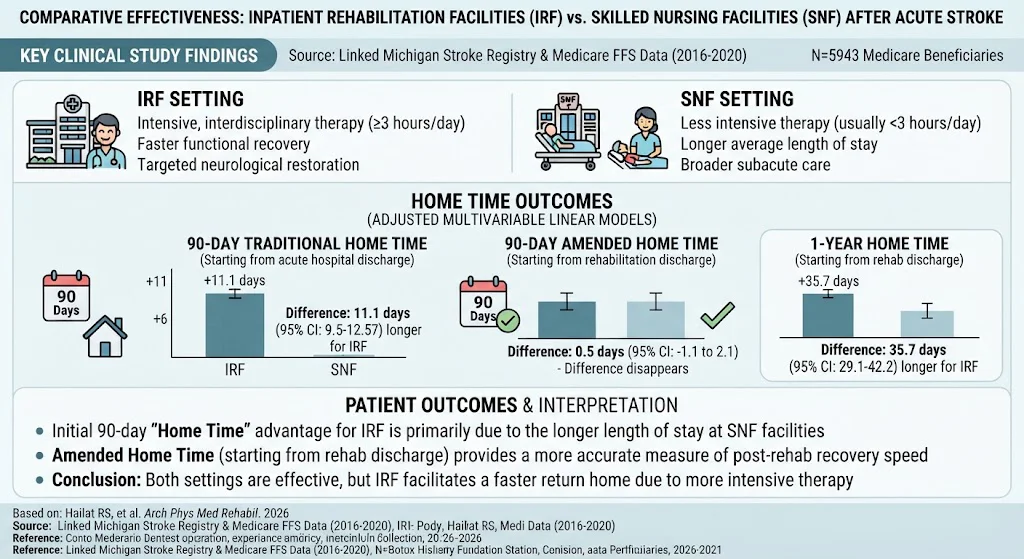
The study cohort totaled 5943 Medicare FFS beneficiaries discharged to IRF or SNF care. After adjustment, traditional 90-day home time was 11.1 days longer (95% CI, 9.5–12.57) for IRF patients compared to SNF patients. At 1 year, this difference increased to 46.3 days (95% CI, 39.8–52.9). These differences initially suggest superior functional recovery linked to IRF care.
However, when analyzing amended home time—anchored to discharge from rehabilitation facilities to account for differing length of rehabilitation stay—the difference in 90-day home time between IRF and SNF groups became nonsignificant (0.5 days; 95% CI, -1.1 to 2.1), implying longer SNF stays artificially reduced early home time in traditional metrics. Despite this, the 1-year amended home time difference remained significant at 35.7 days (95% CI, 29.1–42.2), confirming that IRF care is associated with sustained functional benefits beyond length-of-stay confounding.
The results thus highlight that traditional home time measures can be biased by rehabilitation duration differences. The persistence of a significant 1-year home time advantage favors IRF care, reflecting superior long-term patient-centered outcomes such as survival, functional independence, and reduced rehospitalization.
Expert Commentary
This study addresses a critical knowledge gap by linking stroke registry clinical data with robust administrative claims, allowing detailed adjustment for patient factors and rehabilitation care setting. The novel application of amended home time mitigates the confounding effect of variable rehabilitation length of stay, an important methodological advance in rehabilitation outcomes research. However, limitations include potential residual confounding from unmeasured variables such as stroke severity, social support, or rehabilitation intensity nuances within each setting.
Clinically, these findings reinforce current guidelines favoring IRF care for patients with substantial rehabilitation potential who can tolerate and benefit from intensive therapies. These results may inform decisions by clinicians, payers, and policymakers seeking to optimize post-stroke rehabilitation pathways and allocate resources more effectively. Future prospective studies and randomized designs could build upon these findings to confirm causality and explore mechanisms of differential benefit.
Conclusion
The present analysis demonstrates that inpatient rehabilitation facilities offer superior long-term home time—an important proxy for functional recovery and survival—in Medicare patients after acute stroke compared to skilled nursing facilities. The study also cautions against using traditional home time metrics without adjustment for rehabilitation length of stay, which may bias early outcome assessments. Amended home time from rehabilitation discharge provides a more accurate comparative effectiveness measure. These insights should guide clinical decision-making and health policy toward maximizing rehabilitation benefits and patient-centered outcomes after stroke.
Funding and Clinical Trials
The study was conducted by the Michigan Stroke Registry team with linkage to Medicare claims data. Specific funding sources and clinical trial registrations were not reported in the abstract.
References
- Hailat RS, Thompson MP, Oostema JA, et al. The Comparative Effectiveness of Inpatient Versus Skilled Nursing Facility Rehabilitation Using Linked Acute Stroke Registry Data. Arch Phys Med Rehabil. 2026;107(10):2869-2878. doi:10.1016/j.apmr.2026.06.005
- Lindsay MP, Gubitz G, Bayley M, et al. Canadian Stroke Best Practice Recommendations: Stroke Rehabilitation Practice Guidelines, Update 2015. Int J Stroke. 2016;11(4):459-484.
- Winstein CJ, Stein J, Arena R, et al. Guidelines for Adult Stroke Rehabilitation and Recovery: A Guideline for Healthcare Professionals From the American Heart Association/American Stroke Association. Stroke. 2016;47(6):e98-e169.
- Lai SM, Duncan PW, Dew P, Keighley J. Stroke rehabilitation outcome: choosing a measure. Stroke. 1998;29(5):974-979.
Specialty calculators
For clinical reference; use professional judgment.