Highlight
• Surgical reconstruction for oral cancer disrupts oral microbial diversity and composition, creating an unstable post-surgical oral environment.
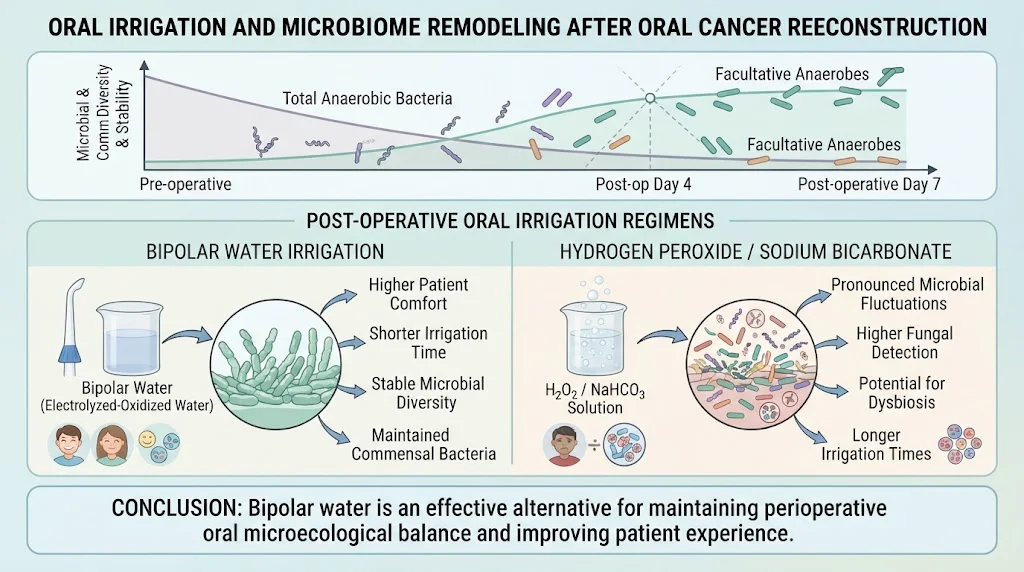
• Postoperative oral irrigation with bipolar water or hydrogen peroxide/sodium bicarbonate shifts microbiota toward a more stable community dominated by facultative anaerobes.
• Bipolar water irrigation offers better patient comfort, shorter irrigation times, and more stable microbial diversity with fewer fungal detections compared to hydrogen peroxide-based solutions.
• Regular oral irrigation plays a key role in preventing postoperative wound infection and maintaining oral microecological balance during healing.
Background: Surgical Impact on Oral Microbiome After Oral Cancer Reconstruction
Oral cancer treatment often necessitates free flap reconstruction following extensive surgical tumor excision. Despite improving functional and aesthetic outcomes, the procedure causes significant tissue trauma, disrupting the natural oral microenvironment. This disturbance can predispose patients to postoperative complications, primarily wound infections, which remain critical threats to recovery and overall prognosis.
The oral cavity hosts a complex microbiome that maintains mucosal immunity, inhibits pathogen colonization, and supports tissue healing. Surgical intervention and the associated changes in local conditions (e.g., oxygen tension, salivary flow, hygiene challenges) can alter microbial composition and reduce diversity. This microbial imbalance, or dysbiosis, may increase opportunistic pathogen burden and impede wound healing.
Perioperative oral care strategies, particularly irrigation protocols, aim to reduce pathogenic organisms and promote microbial homeostasis. However, evidence is limited on the optimal irrigation regimen and its effects on the oral microbiome remodeling dynamics after oral cancer reconstruction.
Study Design
Zhang et al. conducted an exploratory randomized controlled trial enrolling 60 patients undergoing free flap reconstruction for oral cancer. Participants were randomized to two oral irrigation regimens postoperatively: (1) bipolar water irrigation; or (2) a combination solution of hydrogen peroxide and sodium bicarbonate.
Saliva and oral irrigation samples were collected longitudinally at seven time points: preoperatively, and on postoperative days 1, 4, and 7—both before and five minutes after irrigation. Microbial assessments were performed using advanced sequencing techniques allowing detailed taxonomic profiling and diversity analysis.
Primary endpoints included changes in microbial community diversity and composition. Secondary endpoints involved clinical measures such as wound infection rates and patient-reported comfort during irrigation procedures.
Key Findings
Preoperative oral microbiomes were characterized by dominance of several potentially pathogenic taxa, predominantly anaerobes implicated in oral infections. Post-surgery, there was a marked decrease in microbial diversity alongside compositional shifts favoring oral resident microorganisms more adapted to the post-surgical environment.
Oral irrigation facilitated a microbial transition from an unstable, anaerobe-enriched state to a more stable community dominated by facultative anaerobes. This shift likely reflects improved oxygen availability and local conditions favorable for commensals over pathogens.
No significant difference in wound infection incidence was observed between the two irrigation groups, suggesting comparable antimicrobial effects of both regimens. Notably, the bipolar water group demonstrated superior patient comfort and required shorter irrigation times, an important factor for adherence and clinical practicality.
Microbial diversity in the bipolar water group remained more stable throughout the postoperative period, whereas the hydrogen peroxide group exhibited greater fluctuations and increased fungal presence, indicating potential over-disruption or fungal overgrowth risks with peroxide use.
Expert Commentary
This study underscores the critical role of perioperative oral hygiene interventions in modulating the oral microbiome landscape following reconstructive surgery for oral cancer. The authors provide convincing microbial and clinical data supporting oral irrigation as a non-invasive strategy to foster a balanced post-surgical microbiome, potentially mitigating infection risk.
Bipolar water irrigation emerges as a promising alternative to more chemically active solutions, balancing antimicrobial efficacy with microbiome preservation and patient comfort. However, the study’s sample size and short follow-up limit the generalizability and longer-term outcome assessment.
Future investigations with larger cohorts and extended monitoring are warranted to confirm benefits on clinical endpoints such as long-term wound healing, functional recovery, and quality of life. Mechanistic studies to clarify how irrigation modulates microbial interactions and host responses would further enhance translational impact.
Conclusion
In conclusion, oral cancer reconstructive surgery induces an early microbial imbalance characterized by reduced diversity and altered community composition. Regular staged oral irrigation supports a microbiome transition toward stability, dominated by beneficial facultative anaerobic species. Bipolar water irrigation offers comparable infection prevention efficacy, improves patient comfort, and maintains more consistent microbial community profiles versus traditional hydrogen peroxide-based irrigation.
These findings highlight the importance of integrating microbiome-conscious oral care protocols into perioperative management of oral cancer patients. Optimizing approaches to maintain microbial homeostasis may improve postoperative outcomes and broaden therapeutic frameworks for complex head and neck oncologic surgeries.
Funding and ClinicalTrials.gov Registration
The original publication by Zhang et al. does not explicitly state funding sources or clinical trial registration numbers. Verification from the full journal article is recommended for transparency and compliance with clinical research standards.
References
1. Zhang J, Li P, Wu H, et al. Oral Irrigation and Microbiome Remodeling after Oral Cancer Reconstruction. J Dent Res. 2026 Oct 26;220345261489246. PMID: 42934883.
2. Zaura E, Brandt BW, et al. Defining the healthy “core microbiome” of oral microbial communities. BMC Microbiol. 2009;9:259.
3. Weng X, Liu Z. Impact of oral microbiota on oral wound healing after cancer reconstruction surgery. Oral Oncol. 2021;115:105172.
4. Tomás I, Diz P, et al. Influence of supragingival plaque control on the composition of subgingival microbiota. J Periodontal Res. 2012;47(3):310-7.
5. Kolenbrander PE, et al. Communication among oral bacteria. Microbiol Mol Biol Rev. 2010;74(4):712-40.
Specialty calculators
For clinical reference; use professional judgment.