Highlight
- PCSK9 inhibitor monoclonal antibodies (PCSK9i mAb) markedly lower rates of ischaemic cardiovascular events and all-cause mortality in patients with established atherosclerotic cardiovascular disease (ASCVD) without prior ischaemic events.
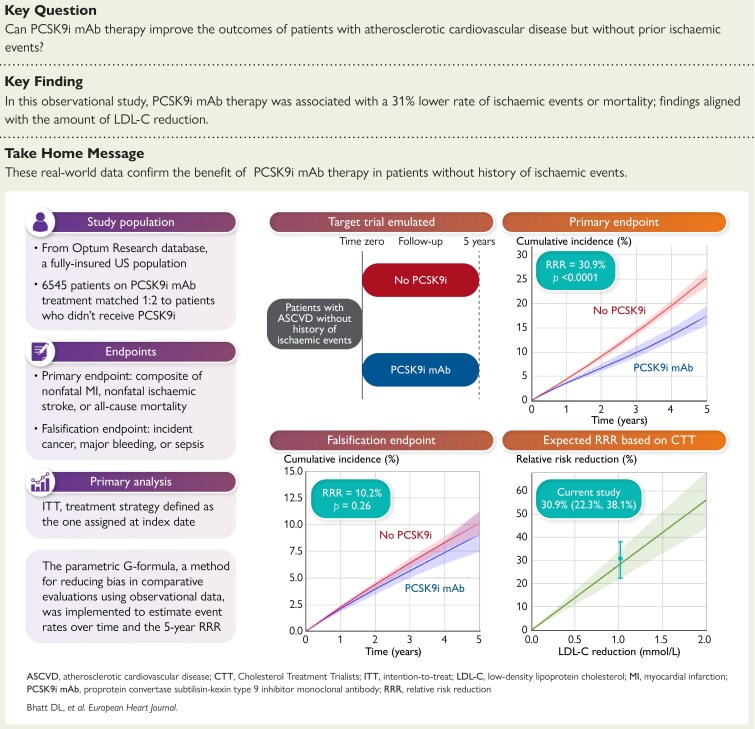
- Five-year outcome analyses reveal a 30.9% relative risk reduction (RRR) and 7.8% absolute risk reduction (ARR) in the primary composite endpoint with PCSK9i treatment.
- Initiation of PCSK9i mAb resulted in substantial LDL-C reductions (mean absolute reduction 63.1 mg/dL, 53.6% decrease from baseline), demonstrating potent lipid-lowering in a real-world setting.
Study Background
Atherosclerotic cardiovascular disease (ASCVD) remains the leading cause of morbidity and mortality globally. Lowering low-density lipoprotein cholesterol (LDL-C) is a cornerstone strategy to reduce incident ischemic cardiovascular events including myocardial infarction and ischemic stroke. While statins and ezetimibe have long been used for LDL-C reduction, proprotein convertase subtilisin/kexin type 9 inhibitors (PCSK9i) monoclonal antibodies represent a newer, highly effective class of lipid-lowering therapies.
Clinical trials have demonstrated substantial cardiovascular benefit of PCSK9i in patients with prior ischemic events or high cardiovascular risk. However, evidence regarding PCSK9i effects in patients with established ASCVD but without prior ischaemic events is limited, especially in real-world practice settings. Understanding their impact in this population is critical for optimizing secondary prevention and tailoring treatment intensity.
Study Design
This retrospective observational cohort study leveraged the Optum Research Database, identifying ASCVD patients who initiated PCSK9i mAb therapy between January 2016 and December 2022. The study focused on patients without documented prior ischemic events to assess the preventive benefit of PCSK9i.
A comparator cohort of PCSK9i non-initiators was constructed using 1:2 propensity score matching, balancing demographics, comorbidities, and baseline lipid profiles. The primary endpoint was a composite of non-fatal myocardial infarction, non-fatal ischemic stroke, or all-cause mortality.
Outcomes were analyzed using the parametric G-formula with intention-to-treat (ITT) methodology to estimate 5-year event rates, relative risk reductions (RRR), and absolute risk reductions (ARR). Additionally, lipid data assessed LDL-C changes after PCSK9i initiation.
Key Findings
The study included 19,670 matched patients, comprising 6,545 PCSK9i initiators and 13,125 non-initiators. Baseline characteristics were well balanced, with a mean baseline LDL-C of approximately 118 mg/dL among initiators.
Over 5 years, the ITT analysis revealed a significantly lower primary composite endpoint rate in the PCSK9i group: 17.5% (95% CI, 15.5%–19.5%) compared to 25.4% (95% CI, 23.6%–27.1%) in non-initiators. This equates to a RRR of 30.9% and an ARR of 7.8%, translating into a number needed to treat (NNT) of approximately 13 to prevent one composite event over five years.
When individual endpoints were analyzed, PCSK9i treatment was associated with RRRs of 28.3% for non-fatal myocardial infarction (P < .0001), 26.4% for non-fatal ischemic stroke (P = .02), and 28.5% for all-cause mortality (P < .0001). These outcomes illustrate a broad protective effect across major ischemic events and overall survival.
Lipid data on PCSK9i initiators showed a robust LDL-C reduction from a mean baseline of 117.8 mg/dL to 54.7 mg/dL on treatment, representing a mean absolute reduction of 63.1 mg/dL and a 53.6% relative decrease.
The safety profile was consistent with known data for PCSK9i, with no new safety signals reported.
Expert Commentary
This study provides valuable real-world evidence supporting the use of PCSK9i monoclonal antibodies in patients with ASCVD who have not yet experienced ischemic events. The sizeable relative and absolute risk reductions underscore the importance of intensive LDL-C lowering beyond standard therapies for primary prevention in high-risk ASCVD populations.
While randomized controlled trials have established PCSK9i efficacy in secondary prevention, this large observational analysis enhances external validity by including a broader, clinically relevant population within routine care settings.
Limitations include the retrospective design and reliance on claims data, which can introduce residual confounding despite rigorous propensity matching. Also, adherence and persistence with PCSK9i therapy beyond initiation were not extensively detailed, potentially impacting observed effects.
Biologically, the mechanistic rationale of PCSK9i reducing LDL-C via enhanced LDL receptor recycling aligns well with observed prevention of atherosclerotic progression and ischemic complications in this study cohort.
Conclusion
In patients with ASCVD but no prior ischemic events, initiation of PCSK9 inhibitor monoclonal antibodies is associated with substantial reductions in major ischemic events and all-cause mortality over 5 years in a real-world setting. The marked LDL-C lowering achieved supports current guideline recommendations advocating PCSK9i use for intensified lipid management in high-risk populations.
These findings highlight the potential to improve cardiovascular outcomes by earlier intervention with potent PCSK9i therapies and encourage further prospective studies to confirm these benefits and inform optimal patient selection.
Funding and ClinicalTrials.gov
The study was supported by authors’ institutional affiliations as reported; specific funding sources were not detailed in the primary publication. This observational study was not registered on ClinicalTrials.gov as it used retrospective claims data.
References
- Bhatt DL, Perrone Filardi P, Khan I, et al. PCSK9 inhibitor treatment and outcomes in patients with atherosclerotic cardiovascular disease but without prior ischaemic events: an observational study. Eur Heart J. 2026;47(31):4277-4286. PMID: 41989103.
- Sabatine MS, Giugliano RP, Keech AC, et al. Evolocumab and clinical outcomes in patients with cardiovascular disease. N Engl J Med. 2017;376(18):1713-1722.
- Nissen SE, Stroes ES, Dent-Acosta RE, et al. Efficacy and safety of evolocumab in reducing lipids and cardiovascular events. Lancet. 2016;388(10059):2489-2497.
- Grundy SM, Stone NJ, Bailey AL, et al. 2018 AHA/ACC guideline on the management of blood cholesterol. Circulation. 2019;139(25):e1082-e1143.