Highlight
A recent multicenter randomized controlled trial investigated whether targeted outpatient computed tomographic (CT) coronary angiography could reduce cardiovascular events in patients presenting with acute chest pain after myocardial infarction was ruled out. Despite high uptake and safety of CT coronary angiography, no significant reduction in myocardial infarction or cardiac death was observed over a median of 3 years when compared to standard care.
CT coronary angiography-guided management showed feasibility and minimal adverse events but did not improve long-term cardiac outcomes in intermediate-risk chest pain patients without initial myocardial infarction diagnosis.
Study Background
Chest pain is a common and challenging presentation in emergency departments worldwide, often prompting evaluation for acute coronary syndrome (ACS). The population of patients in whom myocardial infarction (MI) has been ruled out but who retain an intermediate cardiovascular risk represents an unmet clinical need, as they remain at risk of subsequent cardiac events. Current standard care post-MI rule-out varies and includes clinical assessment, risk factor control, and selective use of further testing.
Computed tomographic coronary angiography (CTCA) offers a noninvasive method to visualize coronary anatomy and detect obstructive coronary artery disease, potentially identifying patients who may benefit from intensified management. Whether routine, targeted outpatient CTCA in such patients improves clinical outcomes was previously unknown.
Study Design
This was a multicenter, randomized, controlled trial conducted across 14 hospitals in the United Kingdom, enrolling adults who presented with suspected ACS but in whom MI was ruled out using high-sensitivity cardiac troponin assays. Eligible patients had intermediate risk, defined by maximum troponin I or T concentration >5 ng per liter, a threshold suggesting increased risk of cardiovascular events.
Participants were randomized 1:1 to receive either outpatient CT coronary angiography-guided care or standard care. CTCA was performed predominantly within 90 days of enrollment. The primary endpoint was a composite of myocardial infarction or cardiac death over follow-up. Safety of the CTCA procedure was also assessed.
Key Findings
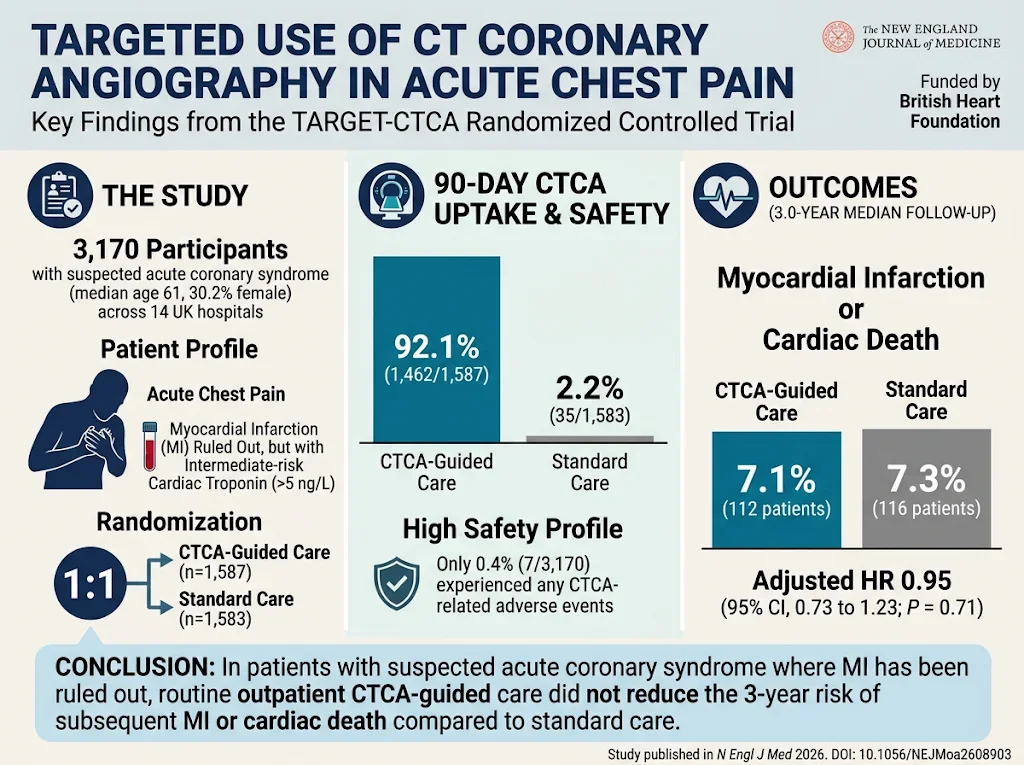
Between September 2019 and May 2023, 3170 participants were randomized (1587 to CTCA, 1583 to standard care), with a median age of 61 years and 30.2% female representation.
CTCA was successfully conducted in 92.1% of those assigned to the intervention and in only 2.2% within the standard-care group.
CTCA-related adverse events were rare, affecting 0.4% of participants undergoing the scan, demonstrating procedural safety.
After a median of 3 years follow-up, the primary outcome occurred in 7.1% of patients in the CTCA group and 7.3% in the standard-care group (adjusted hazard ratio 0.95; 95% confidence interval 0.73–1.23; P=0.71), showing no statistically significant difference.
This indicates that routine outpatient CTCA-guided management did not lower the incidence of myocardial infarction or cardiac death compared with standard care in this intermediate-risk cohort post-MI rule-out.
Expert Commentary
The TARGET-CTCA trial provides important clarity regarding the role of CTCA in evaluating patients with chest pain after MI has been excluded. While CTCA can accurately detect coronary artery disease and guide individualized therapy, this study highlights that routine use in an intermediate-risk population does not translate into improved hard clinical endpoints over standard management.
Potential factors include the efficacy already achieved by current standard care, the relatively modest event rates, and that identification of coronary disease does not automatically improve outcomes without changes in treatment or adherence. These results reinforce existing guidelines that recommend selective rather than routine CTCA in post-ACS evaluation.
Despite the neutral outcome, CTCA’s excellent safety profile and diagnostic capabilities affirm its potential utility in selected cases, especially when the clinical probability of coronary artery disease remains uncertain after initial assessment.
Conclusion
This robust randomized trial shows that for patients presenting with suspected acute coronary syndrome in whom myocardial infarction is ruled out, routine outpatient CT coronary angiography does not reduce subsequent myocardial infarction or cardiac death compared to usual care. Clinicians should consider CTCA on a case-by-case basis rather than as a broad post-MI rule-out strategy.
Future research could explore subgroups who might benefit or alternative imaging and biomarker strategies to better stratify risk and target interventions in this challenging clinical group.
Funding and Registration
The study was funded by the British Heart Foundation. The trial is registered at ClinicalTrials.gov under number NCT03952351.
References
- Lee KK, et al. Targeted Use of Computed Tomographic Coronary Angiography in Acute Chest Pain. N Engl J Med. 2026;395(18):1794-1804. PMID: 42670980.
- Task Force Members. 2020 ESC Guidelines for the diagnosis and management of acute coronary syndromes in patients presenting without persistent ST-segment elevation. Eur Heart J. 2020;41(3):267-315.
- Cheng VY, et al. Noninvasive Cardiac Imaging in the Evaluation of Patients with Chest Pain. J Am Coll Cardiol. 2018;71(15):1765-1776.
Specialty calculators
For clinical reference; use professional judgment.