Highlight
- Early specialist palliative care did not improve mortality or end-of-life quality metrics in patients undergoing curative surgery for abdominal cancers.
- Outcomes assessed included chemotherapy near end-of-life, hospice length of stay, days at home without emergency visits, place of death, and caregiver perceptions.
- The study suggests that routine specialist palliative care for such surgical patients may not be warranted; resource allocation should be individualized.
Study Background
In patients with advanced cancers, early integration of palliative care has demonstrated benefits including enhanced quality of life, reduced caregiver burden, better resource use, and even prolonged survival. However, the role of early palliative care in patients undergoing potentially curative cancer surgery remains uncertain. Two recent clinical trials showed no significant benefit at 90 days postoperatively in this population, raising questions about the value of routine specialist palliative involvement. Understanding palliative care’s impact on end-of-life (EOL) outcomes beyond the immediate postoperative period is crucial for optimizing care pathways and resource allocation.
Study Design
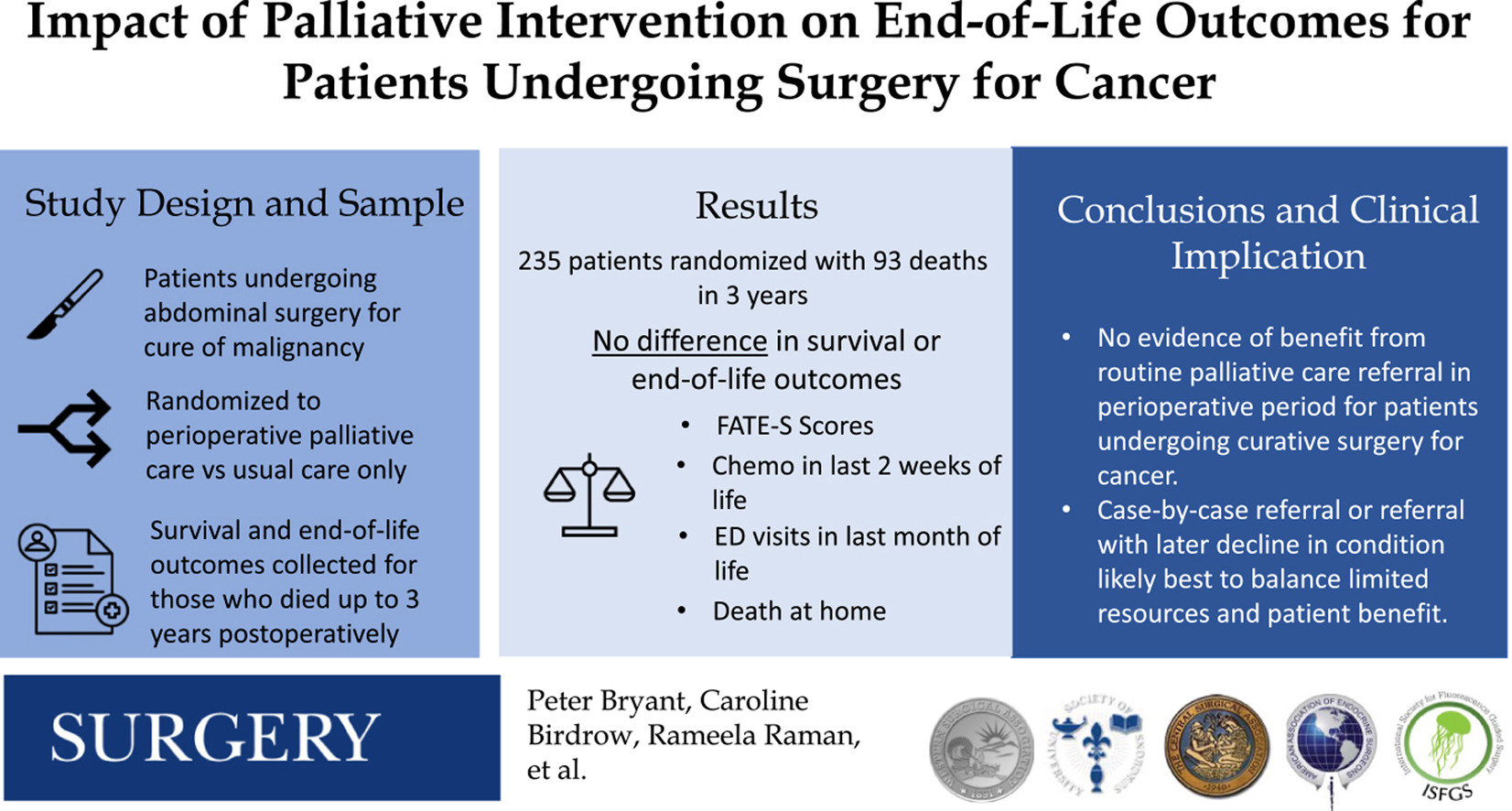
The Surgery with Option of Palliative Care Expert (SOPE) trial was a randomized, assessor-blind controlled trial conducted at a large urban academic center. It enrolled 235 patients undergoing curative-intent surgery for one of eight abdominal cancer types. Participants were randomized to either usual surgical care or early involvement of a specialist palliative care provider. The intervention aimed to provide early symptom management, psychosocial support, and advanced care planning. Patients were followed for three years postoperatively. For patients who died during follow-up, caregivers were surveyed to assess EOL outcomes.
Key outcomes included:
- Three-year mortality (analyzed using a Cox proportional hazards model adjusted for cancer type)
- Chemotherapy use within the last two weeks of life
- Length of hospice stay
- Number of days spent at home without emergency department (ED) visits during the last 30 days of life
- Death outside a healthcare facility
- Caregivers’ perception of EOL care quality, measured by the Family Assessment of Treatment at End of Life-Short Version (FATE-S) survey
For continuous outcomes, unadjusted proportional odds logistic regression was used; for binary outcomes, unadjusted logistic regression was applied.
Key Findings
Out of 235 randomized patients (117 intervention, 118 usual care), 93 deaths (40%) were recorded at three years. Caregiver data were completed for 61 deceased patients (32 intervention, 29 usual care), representing 66% response rate among deaths.
Regarding mortality, no significant difference was observed between groups (hazard ratio [HR] 1.14, 95% confidence interval [CI] 0.85-1.51, P = .39). The intervention group did not show statistically significant improvements in other EOL metrics:
- Chemotherapy in the last 2 weeks of life: odds ratio (OR) 5.19, 95% CI 0.57-47.32, P = .14 (higher point estimate but wide CI indicating uncertainty)
- Hospice length of stay: OR 0.67, 95% CI 0.27-1.66, P = .38
- Days at home without an ED visit: OR 0.96, 95% CI 0.39-2.36, P = .93
- Death outside a healthcare facility: OR 0.82, 95% CI 0.30-2.25, P = .71
- FATE-S caregiver scores: OR 0.81, 95% CI 0.32-2.03, P = .65
Thus, across survival, clinical, and subjective outcomes, early palliative care in the surgical context did not demonstrate measurable benefit in this trial.
Expert Commentary
This exploratory analysis aligns with prior findings from the SOPE trial and related studies, underscoring the complexity of integrating palliative care in curative surgical oncology. The typical advantages seen with early palliative input in metastatic or non-surgical advanced cancer settings may not translate to patients undergoing major surgery with curative intent. Several factors may contribute, including the heterogeneous prognosis of surgical cancer patients and variable trajectories of symptom burden and distress postoperatively.
Limitations include modest sample size and incomplete caregiver follow-up, which may reduce power to detect subtle effects. The wide confidence intervals, especially for chemotherapy near EOL, indicate uncertainty and potential variability. Additionally, specific palliative intervention components and timing may influence efficacy, suggesting a need for precision in identifying which surgical patients could benefit most.
Current clinical guidelines recommend early palliative care for patients with advanced cancers experiencing significant symptoms or psychosocial needs. This study informs clinicians and health systems to consider selective rather than routine specialist palliative referrals for patients undergoing curative abdominal cancer resections, enabling better allocation of limited palliative resources.
Conclusion
In a randomized controlled trial setting, early specialist palliative care did not improve three-year mortality or several important EOL quality metrics among patients undergoing curative surgery for abdominal cancers. These findings challenge routine early palliative integration in this population and support a tailored, case-by-case approach based on patient needs and symptom burden. Further research is warranted to optimize palliative care delivery strategies that maximize benefit for surgical cancer patients without compromising resource efficiency.
Funding and Trial Registration
The SOPE trial was conducted at an urban academic hospital; details of funding and trial registration were not disclosed in the abstract.
References
- Bryant PA, Birdrow CI, Raman R, Shinall MC. Impact of palliative intervention on end-of-life outcomes for patients undergoing surgery for cancer. Surgery. 2026 Jul 16;198:110456. PMID: 42575042.
- Temel JS, Greer JA, Muzikansky A, et al. Early palliative care for patients with metastatic non–small-cell lung cancer. N Engl J Med. 2010;363(8):733-742.
- Smith TJ, Temin S, Alesi ER, et al. American Society of Clinical Oncology provisional clinical opinion: the integration of palliative care into standard oncology care. J Clin Oncol. 2012;30(8):880-887.