Introduction and Context
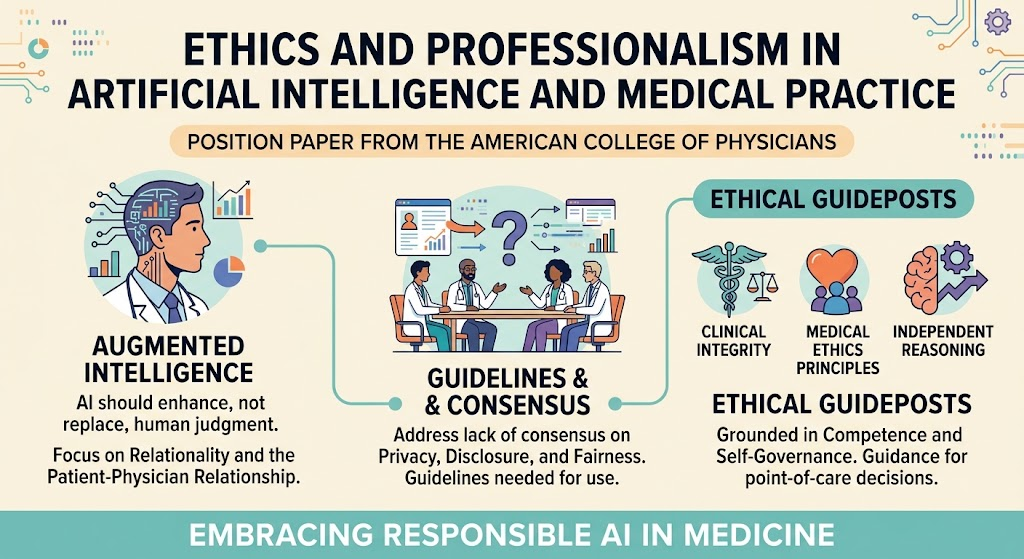
Artificial intelligence (AI) — more precisely described in clinical settings as augmented intelligence — has rapidly moved from research to routine clinical tools for diagnosis, risk prediction, imaging interpretation, triage, and administrative tasks. The American College of Physicians (ACP) Ethics, Professionalism and Human Rights Committee published a position paper in September 2026 that confronts the ethical and professional challenges of AI at the point of care (DeCamp et al., 2026). Rather than offering technical regulatory rules, the ACP centers the patient–physician relationship and professional obligations as the foundation for ethically deploying AI in clinical practice.
Why this paper matters now
– Rapid adoption of AI tools across care settings has outpaced consensus on how clinicians should integrate them ethically and professionally.
– Prior frameworks (WHO, AMA, FDA) provide governance and implementation guidance, but clinicians still need actionable principles for bedside decisions, disclosure, and maintaining clinical integrity.
– The ACP paper responds to gaps in patient-centered guidance: when to disclose AI use, how to preserve professional judgment, how to manage fairness and privacy concerns, and how clinicians should steward AI for equitable care.
Key supporting sources
– DeCamp M, Snyder Sulmasy L, Karches KE, et al. Ethics and Professionalism in Artificial Intelligence and Medical Practice: A Position Paper From the American College of Physicians. Ann Intern Med. 2026 Sep 1. PMID: 42673596.
– World Health Organization. Ethics and Governance of Artificial Intelligence for Health (2021).
– U.S. Food and Drug Administration. Artificial Intelligence/Machine Learning (AI/ML)-Based Software as a Medical Device Action Plan (2021).
– American Medical Association. Policy H-480.940: Augmented Intelligence in Health Care (2019).
– Char DS, Shah NH, Magnus D. Implementing machine learning in health care — addressing ethical challenges. N Engl J Med. 2018.
– Topol E. High-performance medicine: the convergence of human and artificial intelligence. N Engl J Med. 2019.
– CONSORT-AI and SPIRIT-AI reporting guidance (extensions published 2020–2021) for clinical trials involving AI.
New Guideline Highlights
The ACP paper articulates three patient–relationship–rooted guideposts to inform ethical use of AI at the point of care:
– Relationality: Prioritize the therapeutic relationship — AI must support, not supplant, the interpersonal goods of medicine.
– Self-governance: Physicians must preserve independent professional judgment and be accountable for decisions that involve AI.
– Competence: Clinicians must attain and maintain competence in AI-relevant knowledge and skills necessary for safe use.
Major practical recommendations (summary)
– Transparency and disclosure: Clinicians should inform patients when AI materially informs diagnosis or management and be ready to explain how the AI influenced care in comprehensible terms.
– Informed consent: When AI use has material risk, uncertainty, or is experimental, obtain informed consent that addresses purpose, benefits, limitations, and data use/sharing.
– Clinical oversight: Physicians must validate that an AI tool is fit for purpose in their setting, understand its performance characteristics and limitations, and supervise its outputs.
– Equity and fairness: Identify and mitigate biases in datasets and models; prioritize monitoring for disparate impacts on historically marginalized groups.
– Privacy and data stewardship: Use de-identification and secure data governance; be transparent about secondary uses of patient data and opt-out pathways where appropriate.
– Documentation and auditability: Document AI use and rationale in the medical record; support mechanisms for post-deployment surveillance and adverse-event reporting.
– Professional development: Medical education and continuing professional development should include AI literacy, model interpretation, and ethical use.
Updated Recommendations and Key Changes (Compared with Prior Guidance)
How the 2026 ACP position adds to existing frameworks
– Patient-centric framing: Unlike some regulatory documents that focus on safety, performance, or governance, ACP centers the physician–patient relationship as the primary ethical lens.
– Actionable clinician responsibilities: The paper specifies physician duties (disclosure, competence, stewardship) rather than only institutional obligations.
– Emphasis on self-governance: The paper affirms that physicians retain independent practical reasoning and must resist uncritical automation bias.
Comparative snapshot: ACP 2026 vs. earlier major statements
– AMA (2019): Advocated principles for augmentation and patient safety; ACP (2026) builds on this with specific obligations around disclosure, documentation, and relational ethics.
– WHO (2021): Offered global governance and ethical principles; ACP translates such principles into bedside practice for U.S. clinicians, stressing informed consent and relationality.
– FDA (2021 Action Plan): Focused on premarket and postmarket oversight of AI/ML-based medical devices; ACP complements this with clinician-level duties for validating tools in local contexts.
Topic-by-Topic Recommendations
Recommendation categories used in this summary
– Strong recommendation: Recommended in almost all cases for clinicians.
– Conditional recommendation: Recommended in most cases but subject to context, resource constraints, or patient preference.
– Best practice statement: Action strongly encouraged though not amenable to the usual evidence grading.
1) Diagnostic and therapeutic decision support
– Strong recommendation: Clinicians should verify that any AI diagnostic or treatment-support tool is validated for the patient population served and understand the tool’s intended use, performance metrics (sensitivity, specificity, calibration), and failure modes before relying on it for clinical decisions.
– Conditional recommendation: When an AI model provides a high-stakes recommendation (e.g., triage to ICU), clinicians should obtain second-opinion processes and consider documenting the rationale for following or departing from the AI suggestion.
2) Disclosure and informed consent
– Conditional recommendation: Disclose AI use to patients when it materially affects diagnosis, prognosis, or therapy selection. “Materially affects” includes situations where AI output changes treatment options or where significant uncertainty remains.
– Strong recommendation (best practice): When AI is experimental or part of a research deployment, obtain formal informed consent describing purpose, risks, benefits, and data use.
3) Privacy, data use, and secondary uses
– Strong recommendation: Maintain robust data governance; de-identify data where feasible, limit sharing to necessary purposes, and inform patients about secondary uses and re-identification risks.
4) Fairness, bias mitigation, and equity
– Strong recommendation: Implement bias assessment before deployment, monitor outcomes stratified by race, ethnicity, sex, socioeconomic status, and adapt models or limits of use to prevent disparate harms.
– Conditional recommendation: Use model recalibration, local data augmentation, or restricted deployment when performance is inferior in subpopulations.
5) Clinical competence and training
– Strong recommendation: Health systems and clinicians should commit to ongoing training in AI literacy — including understanding metrics, interpretability limitations, and safe use practices.
6) Documentation, auditability, and reporting
– Best practice statement: Document that an AI tool was used and why; maintain audit trails; report harms or near-misses related to AI to institutional safety systems and to regulators when appropriate.
7) Liability and accountability
– Conditional recommendation: While institutions and vendors share responsibility for tool safety, clinicians must not abdicate professional judgment. Clinicians should know institutional policies regarding vendor responsibility, credentialing of AI tools, and malpractice implications.
8) Special populations (children, cognitively impaired, marginalized groups)
– Strong recommendation: Exercise heightened scrutiny when deploying AI for vulnerable populations; default to more conservative use and higher thresholds for validation.
Expert Commentary and Insights
Committee rationale
– Relationality: The committee argues that medical ethics are fundamentally relational — trust, empathy, and shared decision-making — and AI must be judged by how it affects those goods. For example, an AI that speeds up diagnosis but reduces meaningful patient contact could be ethically problematic even if accurate.
– Self-governance: Clinicians are the final decision-makers. The committee emphasizes resisting automation bias (overreliance on AI) and preserving moral agency.
– Competence: The committee recognizes that clinician competence now includes knowing when AI is appropriate, reading performance metrics, and interpreting outputs honestly.
Key controversies and points of debate
– Disclosure thresholds: How material must AI influence be to require disclosure? The committee recommends a pragmatic standard: disclose when AI meaningfully informs care decisions or when patients would reasonably want to know.
– Transparency vs. proprietary models: Many high-performing AI models are proprietary and nontransparent. The committee urges vendors and institutions to provide sufficient explanatory information for clinicians to understand limitations, even if full model details remain proprietary.
– Liability: Legal standards for malpractice related to AI remain unsettled. The committee calls for shared responsibility frameworks, but leaves legal reform to policymakers.
Future trends and research needs highlighted by the panel
– Methods for prospective equity testing and monitoring of AI in real-world deployment.
– Practical communication strategies for explaining AI contributions to lay patients.
– Education curricula and credentialing standards for AI competence in medical training.
Practical Implications for Clinicians and Health Systems
How to operationalize the ACP recommendations
– Before deployment: Require a local validation study or review by clinical informatics to confirm model performance on local data; define scopes of use and contraindications.
– At the point of care: Inform patients when AI materially influences decisions; explain in plain language and offer opportunity for questions.
– Documentation: Note AI use in the chart, summarize why it was used, and record clinician reasoning when following or overriding AI output.
– Monitoring: Track performance metrics continuously and stratify outcomes by demographic subgroups to detect biases.
– Training: Integrate AI literacy into CME and residency programs; include ethical use cases and role-play for disclosure conversations.
– Vendor contracts: Require transparency on training data sources, performance metrics, and commitments for post-deployment monitoring and updates.
A brief patient vignette
– Maria Johnson, a 67-year-old woman with chronic obstructive pulmonary disease (COPD), presents with worsening shortness of breath. The emergency department uses an AI triage tool that flags her risk for deterioration and suggests admission. The physician verifies the model’s applicability to the local COPD population, considers Maria’s clinical exam and test results, explains to Maria that an AI-supported risk assessment is one reason they recommend admission, and documents the AI’s role and the clinical judgment applied. The physician also notes that the AI’s local validation showed lower sensitivity in patients over 80 years in their institution and thus exercised increased vigilance for older patients.
References
– DeCamp M, Snyder Sulmasy L, Karches KE; Ethics, Professionalism and Human Rights Committee of the American College of Physicians. Ethics and Professionalism in Artificial Intelligence and Medical Practice: A Position Paper From the American College of Physicians. Ann Intern Med. 2026 Sep 1. PMID: 42673596. https://pubmed.ncbi.nlm.nih.gov/42673596/
– World Health Organization. Ethics and Governance of Artificial Intelligence for Health: WHO Guidance. 2021. https://www.who.int/publications/i/item/9789240029200
– U.S. Food and Drug Administration. Artificial Intelligence and Machine Learning (AI/ML)-Based Software as a Medical Device Action Plan. 2021. https://www.fda.gov/medical-devices/software-medical-device-samd/artificial-intelligence-and-machine-learning-software-medical-device
– American Medical Association. Augmented Intelligence in Health Care (Policy H-480.940). 2019. https://www.ama-assn.org/delivering-care/ethics/augmented-intelligence-health-care
– Char DS, Shah NH, Magnus D. Implementing Machine Learning in Health Care — Addressing Ethical Challenges. N Engl J Med. 2018;378:981–983. https://www.nejm.org/doi/full/10.1056/NEJMp1714229
– Topol EJ. High-Performance Medicine: The Convergence of Human and Artificial Intelligence. N Engl J Med. 2019;375:1218–1220. https://www.nejm.org/doi/full/10.1056/NEJMp1716845
– CONSORT-AI and SPIRIT-AI extensions for clinical trials and study protocols involving artificial intelligence, Nature Medicine/ BMJ publications (2020–2021).
Closing
The ACP 2026 position paper is a timely, clinically oriented ethical roadmap that demands clinicians treat AI as an instrument under professional stewardship rather than a black-box replacement for judgment. By foregrounding relationality, self-governance, and competence, the ACP reframes the conversation: the central question is not only whether AI improves accuracy, but whether its use preserves trust, equity, and the essential ethical goods of medicine.