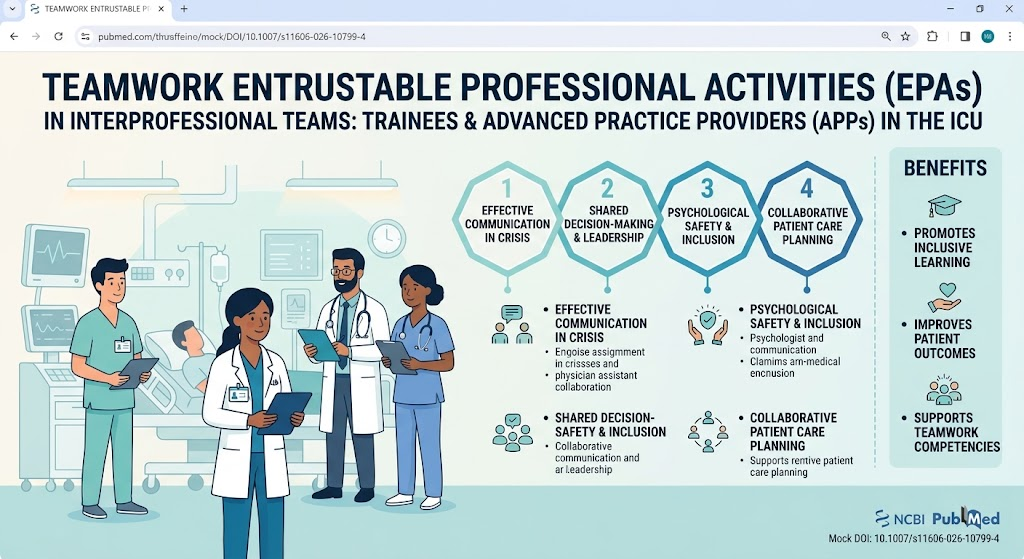
Highlight
This article details the development of teamwork-focused Entrustable Professional Activities (EPAs) aimed at improving collaboration between trainees and Advanced Practice Providers (APPs) in the Medical Intensive Care Unit (MICU). Key highlights include the use of a modified Delphi methodology to ensure consensus and alignment with Team FIRST competencies, promotion of psychological safety in high-stakes environments, and the groundwork laid for future educational and systems-based advances.
Study Background
In academic medical centers, patient care in intensive care units (ICUs) is increasingly delivered by mixed teams comprising medical trainees (residents and fellows) and Advanced Practice Providers (APPs), such as nurse practitioners and physician assistants. These teams are critical for maintaining continuous, high-quality care. While APPs and trainees often work side by side, structured guidance on how they should collaborate effectively remains lacking. Interprofessional teamwork skills are essential due to the complexity and critical nature of ICU care, where communication failures can jeopardize patient safety.
Psychological safety, the shared belief that the team is safe for interpersonal risk-taking, is particularly important in such high-stakes environments. Promoting psychological safety fosters openness, reduces errors, and enhances learning. Entrustable Professional Activities (EPAs) have emerged as a practical framework to translate competencies into observable, assessable clinical tasks. However, EPAs focusing on interprofessional teamwork that includes both trainees and APPs are rare.
Study Design
This project was implemented within a Medical Intensive Care Unit planning to blend teams composed of trainees and APPs. A multidisciplinary team of professionals undertook a structured process using a modified Delphi approach to develop EPAs specifically addressing teamwork and psychological safety. The Delphi method involved rounds of anonymous survey feedback and consensus building among stakeholders to draft and refine the EPAs.
The newly developed teamwork EPAs were aligned with the Team FIRST competencies—a validated framework emphasizing key teamwork behaviors and attitudes in clinical settings. The EPAs were meticulously evaluated using best practice guidelines from the literature on EPA development to ensure clarity, relevance, feasibility, and validity.
Key Findings
The study successfully produced a set of teamwork EPAs that define clear, entrustable tasks relevant to interprofessional collaboration between trainees and APPs in the ICU setting. These EPAs incorporate essential elements of psychological safety, encouraging inclusive communication, mutual respect, and shared decision-making.
By engaging a diverse professional team, including physicians, nurses, and educational experts, the development process ensured that the EPAs were comprehensive and reflective of real-world ICU dynamics. The alignment with Team FIRST competencies provided a strong theoretical foundation for the EPAs, facilitating their integration into existing competency frameworks.
Importantly, the process demonstrated that typical EPA authoring methods can be successfully adapted to interprofessional teamwork contexts when guided by principles of psychological safety and diversity. This contributes to a learning environment where both trainees and APPs can enhance collaborative skills, thereby potentially improving patient outcomes.
These EPAs offer practical tools for educators and clinical leadership to implement assessments, guide feedback, and structure targeted teamwork curricula. Furthermore, they provide a foundation for quality improvement efforts that address systemic factors influencing teamwork.
Expert Commentary
Interprofessional collaboration is a recognized pillar of safe and effective ICU care. The inclusion of trainees and APPs as peers within interprofessional teams necessitates deliberate educational strategies to foster teamwork competency. The initiative to develop EPAs specifically for teamwork represents an innovative step toward operationalizing interprofessional education and practice.
EPAs traditionally focus on individual tasks; incorporating them into team-based competencies reflects progressive thinking aligned with modern healthcare delivery models. Psychological safety is increasingly seen as essential to clinical learning environments, and embedding this concept within EPAs broadens their impact beyond task execution to encompass team culture.
While this study’s approach is commendable, a limitation is that it was conducted within a single MICU, which may limit generalizability. Future validation studies in diverse ICUs and other clinical settings are warranted. Additionally, empirical data demonstrating the impact of these EPAs on teamwork behaviors, educational outcomes, and patient safety are needed to further substantiate their clinical utility.
Conclusion
The development of teamwork EPAs for interprofessional teams involving trainees and APPs addresses a critical gap in ICU education and practice. By fostering psychological safety and clearly defining collaborative behaviors, these EPAs have the potential to enhance team function and patient care in high-risk environments. This work lays an important foundation for integrating teamwork competencies into clinical education and assessment frameworks and ultimately improving healthcare delivery in intensive care settings.
Adoption of these EPAs can support curriculum development, facilitate convenient and objective assessments of teamwork skills, and spur system-level interventions to optimize interprofessional collaboration. Ongoing research should focus on implementation strategies and measuring their effect on educational outcomes and patient safety metrics.
Funding and ClinicalTrials.gov
The original publication did not specify funding sources or clinical trial registration details.
References
Munyon R, Madara J, Simkins S, Thoryk J, Haag A, Bucher D, Dimmock A, Janczewski S, Haidet P, Chisty A. Teamwork Entrustable Professional Activities in Interprofessional Teams Involving Trainees and Advanced Practice Providers in the Intensive Care Unit. Journal of General Internal Medicine. 2026 Sep 15; PMID: 42745152. Available at: https://pubmed.ncbi.nlm.nih.gov/42745152/
Salas E, Shuffler ML, Thayer AL, Bedwell WL, Lazzara EH. Understanding and improving teamwork in organizations: A scientifically based practical guide. Human Resource Management. 2015;54(4):599-622.
Meyer EC, Santen SA. Entrustable professional activities: A practical gateway for team-based competency assessment. Academic Medicine. 2021;96(10):1413-1419.
Edmondson AC. Psychological safety and learning behavior in work teams. Administrative Science Quarterly. 1999;44(2):350-383.