Highlight
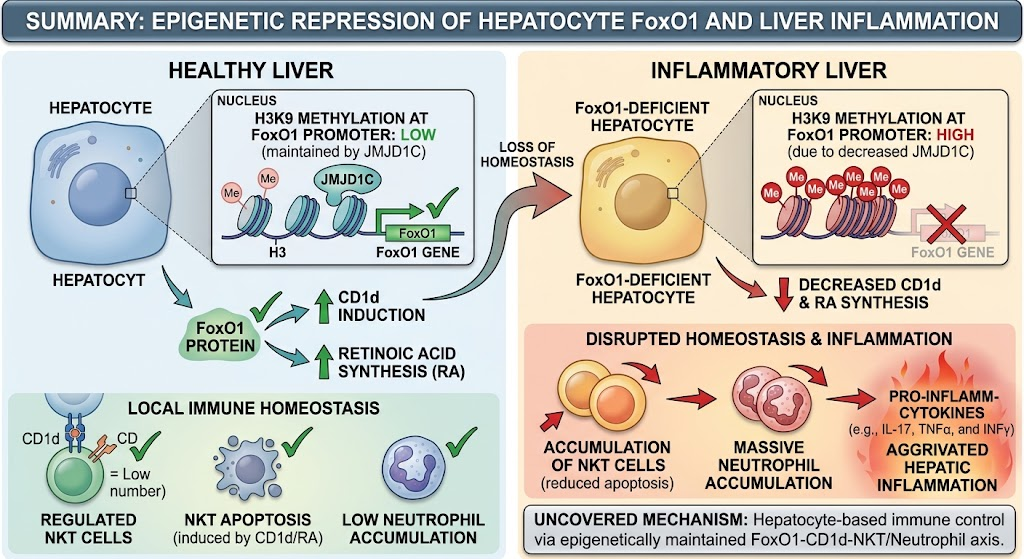
- Hepatocyte FoxO1 expression is epigenetically repressed via JMJD1C-regulated histone H3K9 dimethylation during liver inflammation.
- Loss of FoxO1 in hepatocytes disrupts local immune homeostasis by altering NKT cell apoptosis and promoting neutrophil accumulation.
- FoxO1 induces hepatocyte CD1d expression through retinoic acid synthesis, a critical pathway for controlling NKT cells.
- Targeting the FoxO1-JMJD1C-CD1d axis offers a novel therapeutic avenue for inflammatory liver diseases such as alcoholic hepatitis and hepatic schistosomiasis.
Study Background
Disruption of immune homeostasis in the liver underpins the pathogenesis of various inflammatory liver diseases, including alcoholic hepatitis and schistosomiasis-related hepatic inflammation. While immune cells have long been implicated in liver inflammation, recent insights attribute a central immunoregulatory role to hepatocytes, the predominant liver parenchymal cells. FoxO1, a transcription factor extensively studied for roles in metabolism and cellular homeostasis, has an unclear function in maintaining liver immune stability. Understanding the mechanisms by which hepatocyte FoxO1 influences immune cell dynamics is critical to expanding therapeutic strategies for hepatic inflammation, a condition associated with high morbidity and progressive fibrosis.
Study Design and Methods
The study conducted a comprehensive translational investigation combining human liver tissue analysis and multiple murine models. Liver samples from patients with diverse inflammation-related liver diseases were analyzed for FoxO1 expression and correlation with clinical features of inflammation and fibrosis. A hepatocyte-specific Foxo1 knockout mouse model (FoxO1 △hepa) was engineered to evaluate the in vivo impact on immune homeostasis and inflammation. Functional studies incorporated alcohol-induced hepatitis and schistosomiasis murine models employing targeted hepatocyte gene interference. Multi-omics approaches—bulk transcriptomics, single-cell RNA sequencing, and CUT&Tag epigenomic profiling—were utilized to delineate molecular mechanisms, focusing on FoxO1 regulation and downstream pathways.
Key Findings
Analysis of human liver tissues revealed a predominant downregulation of FoxO1 expression in inflamed livers, inversely correlating with inflammation severity and fibrosis extent. In murine FoxO1 △hepa models, spontaneous mild hepatic inflammation developed by 15 to 18 weeks of age, marked by increased infiltration of natural killer T (NKT) cells and neutrophils. Selective depletion of NKT cells in FoxO1-deficient hepatocyte mice ameliorated neutrophil accumulation and significantly reduced liver inflammation and tissue damage in both alcoholic hepatitis and hepatic schistosomiasis models.
Mechanistically, FoxO1 controls the synthesis of retinoic acid in hepatocytes, which is essential for inducing the expression of CD1d, a molecule pivotal for presenting lipid antigens to NKT cells. This hepatocyte CD1d induction is necessary for regulating NKT cell apoptosis and maintaining immune balance. The study innovatively identified that loss of JMJD1C—an epigenetic regulator—in hepatocytes leads to accumulation of repressive histone H3 lysine 9 dimethylation (H3K9me2) at the Foxo1 promoter, suppressing its transcriptional activity. This epigenetic repression disrupts the FoxO1-mediated regulation of immune homeostasis, facilitating pathological liver inflammation.
Expert Commentary
These findings significantly advance our understanding of hepatocyte-driven immune regulation in liver inflammation. By elucidating the FoxO1-JMJD1C-CD1d axis, this study highlights a novel crosstalk between epigenetic modification and immune cell regulation in hepatic pathology. The identification of hepatocyte FoxO1 as a key homeostatic brake on NKT and neutrophil-mediated inflammation opens potential avenues to modulate this pathway therapeutically. However, further investigation is necessary to translate these findings into clinical interventions, including validation in broader human cohorts and safety evaluation of targeting FoxO1-regulated pathways. In addition, dissecting upstream factors that regulate JMJD1C expression may provide more comprehensive targets to mitigate the epigenetic repression that disrupts liver immune homeostasis.
Conclusion
This study reveals a previously unrecognized mechanism by which hepatocyte FoxO1, maintained by JMJD1C, suppresses liver inflammation through retinoic acid-mediated CD1d expression that regulates NKT cell apoptosis and neutrophil infiltration. Epigenetic repression of FoxO1 disrupts this axis, promoting hepatic immune dysregulation and inflammation. These insights establish hepatocyte FoxO1 as a critical immunoregulatory node and nominate the FoxO1-JMJD1C-CD1d pathway as a promising therapeutic target for diverse inflammatory liver diseases including alcoholic hepatitis and hepatic schistosomiasis.
Funding and Clinical Trials
Funding sources and any related clinical trial registrations were not detailed in the published abstract for this study. Future work to explore therapeutic targeting and clinical validation would benefit from funded translational programs.
References
Lei Z, Wu Y, Xue W, Zhu D, Shen J, Mao C, Wang Z, Huang C, Zhang Y, Zhu J, Xu L, Li Y, Zhang X, Liu S, Chen X, Ye C, Zhou S, Su C. Epigenetic repression of hepatocyte FoxO1 disrupts local immune homeostasis and promotes liver inflammation. Hepatology (Baltimore, Md.). 2025 Nov 4;84(2):469-486. PMID: 41190981.