Highlight
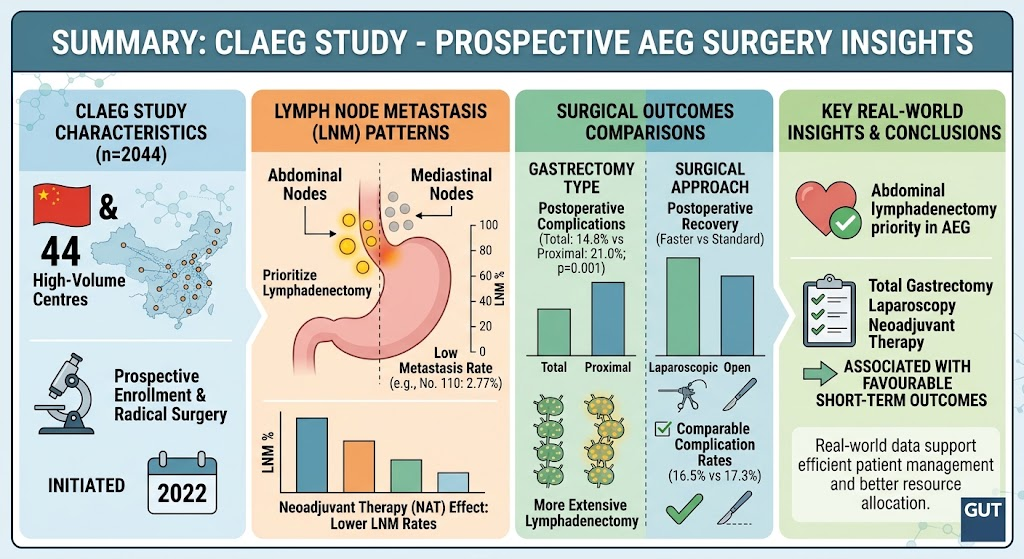
• The CLAEG study prospectively assessed 2044 radical resections for adenocarcinoma of the oesophagogastric junction (AEG) across 44 high-volume centers in China.
• Abdominal lymph node metastasis (LNM) predominates over mediastinal involvement, emphasizing the importance of abdominal lymphadenectomy.
• Neoadjuvant therapy significantly reduces lymph node metastasis rates, supporting its role in nodal downstaging.
• Total gastrectomy is associated with lower postoperative complications and more extensive lymphadenectomy compared to proximal gastrectomy.
• Laparoscopic surgery offers faster postoperative recovery without increased complication rates relative to open surgery.
Study Background
Adenocarcinoma of the oesophagogastric junction (AEG) is a malignancy arising at the anatomical junction of the esophagus and stomach, often presenting surgical challenges due to its location and complex lymphatic drainage. Treatment strategies vary widely, particularly regarding the extent of lymphadenectomy, choice between total versus proximal gastrectomy, and surgical approach (open versus laparoscopic). Real-world, prospective evidence guiding these decisions remains limited, leading to ongoing debate and practice variability. The Chinese League of Adenocarcinoma of Esophagogastric Junction (CLAEG) study aims to fill this knowledge gap by providing multicenter prospective data on patterns of lymph node metastasis and surgical outcomes in AEG patients undergoing radical resection.
Study Design
The CLAEG registry was initiated in 2022, enrolling patients with histologically confirmed AEG from 44 high-volume Chinese medical centers. The analysis reported includes 2044 patients who underwent radical surgical resection. Tumors were categorized by Siewert classification (type I, II, III), and lymph node metastasis was mapped by individual anatomical stations, including both abdominal and mediastinal nodes. Subgroup analyses were performed based on neoadjuvant therapy status and tumor subtype. Surgical interventions were compared between total gastrectomy and proximal gastrectomy, as well as laparoscopic versus open surgical approaches. Primary endpoints included lymph node metastasis rates by station, postoperative complication rates, lymphadenectomy extent, and perioperative mortality.
Key Findings
Tumor Characteristics and Lymph Node Metastasis
The majority of tumors were Siewert type II (64.6%) and type III (33.4%). Analysis of lymph node involvement revealed markedly higher metastasis in abdominal stations compared to mediastinal nodes. Specifically, category-1 lymph nodes with metastasis rates exceeding 10% involved stations 1, 2, 3, 4, 7, 8a, 9, and 11p. Mediastinal stations Nos. 110, 111, and 112 showed notably low LNM rates of 2.77%, 0.71%, and 0.68%, respectively. This highlights the predominance of abdominal node involvement in AEG, underscoring the clinical importance of extensive abdominal lymphadenectomy during surgical treatment.
Impact of Neoadjuvant Therapy
Patients who underwent neoadjuvant therapy demonstrated significantly reduced lymph node metastasis rates, suggesting effective nodal downstaging prior to surgery. This finding supports incorporate neoadjuvant chemotherapy or chemoradiotherapy into treatment plans for AEG to improve local control and potentially decrease surgical morbidity.
Surgical Approaches and Outcomes
Among patients undergoing gastrectomy, total gastrectomy was associated with a lower postoperative complication rate compared to proximal gastrectomy (14.8% vs 21.0%; p=0.001). Total gastrectomy also allowed for a more extensive lymphadenectomy, which may contribute to improved oncological outcomes. Laparoscopic surgery was associated with faster postoperative recovery, including earlier oral intake and shorter hospital stay, without an increase in complication rates (16.5% vs 17.3% for open surgery). Importantly, no perioperative mortality was observed across all surgical groups, indicating excellent short-term safety in experienced centers.
Safety
Postoperative complications were statistically lower in total gastrectomy patients, and the overall complication rates between laparoscopic and open approaches were comparable. The absence of perioperative mortality emphasizes the safety of radical surgery in high-volume specialized centers. This real-world data supports laparoscopic approaches where surgical expertise exists.
Expert Commentary
The CLAEG study provides robust, prospective evidence from a large real-world cohort, addressing key controversies in AEG surgical management. It corroborates the concept that the predominant lymphatic spread in AEG is abdominal, thus prioritizing abdominal lymphadenectomy over extensive mediastinal dissection. The observed benefit of neoadjuvant therapy in inducing nodal downstaging aligns with evolving multimodal treatment guidelines in this disease.
Interestingly, the finding that total gastrectomy results in fewer complications compared to proximal gastrectomy contrasts with some earlier retrospective analyses but may reflect better lymphadenectomy and oncologic clearance leading to lower recurrence-related morbidity. Laparoscopic approaches demonstrating equivalent safety with enhanced recovery further advocate for minimally invasive surgery in adequately equipped centers.
Limitations include potential heterogeneity in neoadjuvant regimens and surgical techniques across centers, and lack of long-term oncological outcomes, which are needed to confirm survival benefits. Nevertheless, these data provide important guidance and help standardize surgical strategies for AEG.
Conclusion
The prospective CLAEG study provides pivotal insights into surgical management of adenocarcinoma of the oesophagogastric junction. The findings emphasize prioritizing abdominal lymphadenectomy given the predominant nodal spread pattern and support neoadjuvant therapy to improve nodal status before surgery. Total gastrectomy is associated with lower postoperative complication rates and more comprehensive lymphadenectomy compared to proximal gastrectomy. Laparoscopic resection offers favorable short-term recovery without compromising safety. These real-world data inform current surgical decision-making and highlight areas for future research, including long-term outcomes and optimal integration of multimodal therapies.
Funding and Clinical Trials Registration
The CLAEG study was conducted by the Chinese League of Adenocarcinoma of Esophagogastric Junction investigators, with support from affiliated institutions. Details regarding funding and clinicaltrials.gov registration were not provided in the original report.
References
1. Zheng J, Li Y, Fan L, et al. Prospective evaluation of radical surgery for adenocarcinoma of oesophagogastric junction: real-world insights from the CLAEG study. Gut. 2026 Aug 6;75(9):1726-1738. PMID: 41611521.
2. Siewert JR, Stein HJ. Classification of adenocarcinoma of the oesophagogastric junction. Br J Surg. 1998;85(11):1457-1459.
3. National Comprehensive Cancer Network. NCCN Clinical Practice Guidelines in Oncology: Esophageal and Esophagogastric Junction Cancers. Version 4.2024.
4. Ajani JA, D’amico TA, Almhanna K, et al. Esophageal and Esophagogastric Junction Cancers, Version 3.2023, NCCN Clinical Practice Guidelines in Oncology. J Natl Compr Canc Netw. 2023;21(9):1161-1189.
5. Mariette C, Dahan L, Mornex F, et al. Surgery alone versus chemoradiotherapy followed by surgery for adenocarcinoma of the oesophagogastric junction: long-term results of a phase 3 randomized trial. J Clin Oncol. 2020;38(20):2314-2322.