Highlight
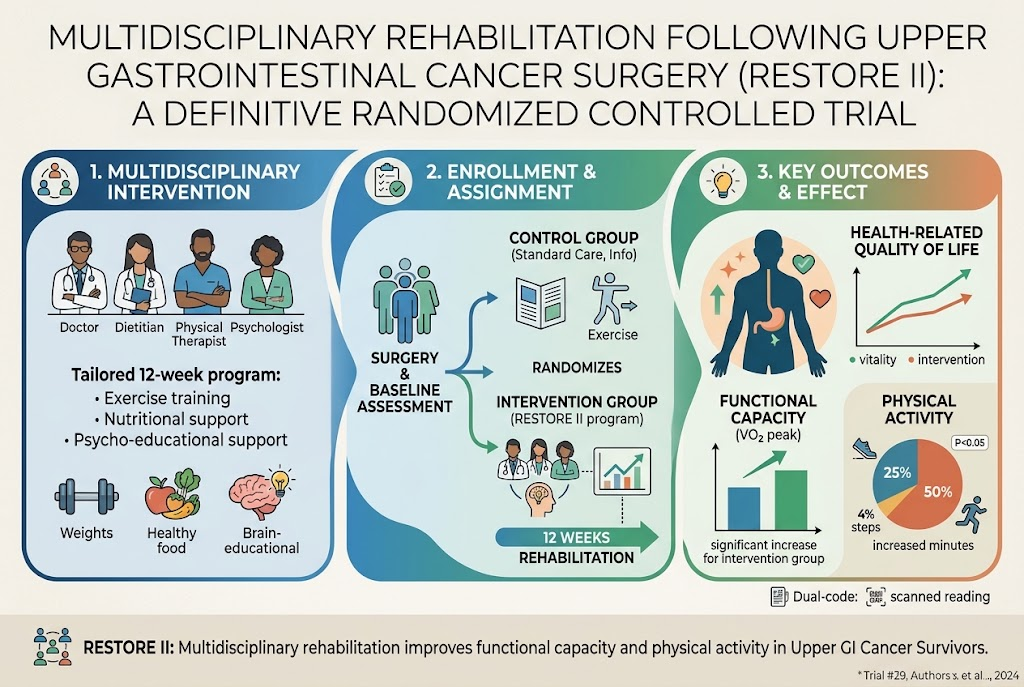
- RESTORE II is a definitive randomized controlled trial evaluating multidisciplinary rehabilitation after upper gastrointestinal (UGI) cancer surgery.
- A 12-week rehabilitation program, including physiotherapy-led aerobic and resistance exercise, dietary counselling, and psychosocial support, significantly improved cardiorespiratory fitness (VO2peak) compared to standard care.
- Secondary outcomes such as muscle strength, body composition, functional performance, and health-related quality of life remained stable with no significant group differences.
- The findings provide Level I evidence supporting targeted rehabilitation to enhance physical fitness in UGI cancer survivors, with sustained benefits at 3-month follow-up.
Study Background
Upper gastrointestinal (UGI) cancers—including esophageal, gastric, and pancreatic malignancies—are associated with significant physiological and functional impairment both from the disease and the often extensive surgical treatments involved. Advances in oncologic therapies have improved survival, resulting in a growing population of cancer survivors facing long-term morbidity. These burdens include diminished cardiorespiratory fitness, muscle weakness, impaired physical function, and reduced quality of life, which negatively impact recovery, independence, and overall survivorship outcomes.
Despite the recognized importance of rehabilitation in cancer care, evidence specifically addressing multidisciplinary interventions in UGI cancer survivors remains limited and inconclusive. The multifactorial nature of post-UGI surgery morbidity suggests rehabilitation programs combining physical exercise, nutritional support, and psychosocial interventions may be beneficial, but definitive high-quality randomized data have been lacking.
Study Design
RESTORE II was a prospective, parallel-group, randomized controlled trial conducted to evaluate the efficacy of a 12-week multidisciplinary rehabilitation program versus standard care (SC) in improving cardiorespiratory fitness and functional outcomes in disease-free UGI cancer survivors, post-surgical resection.
Eligible participants were adults aged ≥18 years, at least 3 months post-UGI oncologic surgery, verified disease-free, and medically stable to engage in exercise. Participants (n=88) were randomized equally to either the RESTORE intervention or SC groups.
The RESTORE multidisciplinary program included:
– Physiotherapy-led supervised aerobic and resistance training tailored to individual baseline fitness
– Dietary counselling targeting nutritional optimization and recovery
– Psychosocial support addressing emotional well-being and coping strategies
Primary outcome:
– Cardiorespiratory fitness measured as peak oxygen uptake (VO2peak, mL/min/kg) via cardiopulmonary exercise testing
Secondary outcomes:
– Body composition assessed through anthropometry and bioimpedance analysis
– Muscle strength evaluated by hand grip strength and leg-press one-repetition maximum
– Functional performance via Short Physical Performance Battery
– Physical activity measured with accelerometry
– Health-related quality of life assessed with the EORTC-QLQ-C30 questionnaire
Assessments were performed at baseline (T0), immediately post-intervention (T1), and three months post-intervention (T2).
Key Findings
Of the 88 participants randomized, 44 received standard care and 44 participated in RESTORE. The median age was 67.5 years (range 43–86), predominantly male (68.2%), with a median postoperative duration of 33 months (range 3.5–145).
Primary outcome:
– VO2peak remained stable in the SC group across timepoints.
– RESTORE participants demonstrated significant improvements in VO2peak compared to SC, with a mean increase of 1.5 mL/min/kg from baseline to immediately post-intervention (95% CI 0.52–2.48; P=0.003).
– This improvement was sustained at 3-month follow-up with a mean increase of 1.23 mL/min/kg (95% CI 0.18–2.27; P=0.02).
Secondary outcomes:
– Measures of muscle strength, body composition, functional performance, physical activity levels, and quality of life remained stable with no significant intergroup differences.
Safety and adherence:
– The intervention was well tolerated with no major adverse events reported.
– High levels of adherence to the rehabilitation program were noted, underscoring feasibility.
Expert Commentary
The RESTORE II trial provides robust Level I evidence confirming the capacity to improve cardiorespiratory fitness through a multidisciplinary rehabilitation strategy in UGI cancer survivors, a population historically underrepresented in rehabilitation research. The observed VO2peak improvement, although modest, is clinically meaningful as cardiorespiratory fitness is a critical determinant of functional independence, cancer prognosis, and all-cause mortality.
The stability of secondary outcomes suggests that while cardiorespiratory fitness can be targeted effectively, a longer or more intensive rehabilitation protocol might be necessary to achieve significant changes in muscle strength, body composition, or quality of life. Additionally, the absence of deterioration in these parameters in the control group indicates relative stability in long-term survivors, but also highlights a window of opportunity to improve fitness.
Notably, the multidisciplinary nature of the intervention reflects real-world survivorship care needs, blending physical, nutritional, and psychological support, addressing the complex sequelae of UGI cancer treatment. The study’s pragmatic design and inclusion of a mature survivorship cohort enhance generalizability.
Limitations include the single-center design, relatively small sample size, and variability in postsurgical duration among participants, which might affect responsiveness and baseline function. Future research could explore tailoring rehabilitation intensity and duration, psychosocial endpoints, and cost-effectiveness analyses to optimize clinical implementation.
Guidelines increasingly recognize rehabilitation as integral to cancer survivorship care. RESTORE II strengthens the evidence base, supporting incorporation of structured rehabilitation programs into routine post-UGI cancer surgery management to enhance patient-centered outcomes.
Conclusion
RESTORE II establishes that multidisciplinary rehabilitation significantly improves cardiorespiratory fitness in survivors of upper gastrointestinal cancer surgery. This finding underscores the potential for targeted rehabilitation interventions to enhance physical capacity, a key determinant of long-term recovery and quality of life in this vulnerable population. Further studies should elucidate strategies to augment broader functional outcomes and integrate rehabilitation seamlessly into survivorship care pathways.
Funding and Clinical Trials Registration
The trial was supported by institutional and grant funding as detailed in the original publication by O’Neill et al. The study details are available via PubMed (PMID: 42681576). Specific trial registration information is recommended to be reviewed through clinical trial databases as presented by the authors.
References
1. O’Neill LM, Smyth E, Kearney N, et al. Multidisciplinary Rehabilitation Following Upper Gastrointestinal Cancer Surgery (RESTORE II): A Definitive Randomized Controlled Trial. Ann Surg. 2026 Sep 2. PMID: 42681576.
2. Scott JM, Jones LW. Cardiorespiratory fitness and cancer: prognostic and therapeutic implications. J Clin Oncol. 2020;38(26):3048-3054.
3. Stout NL, Silver JK, Raj VS, et al. Physical Rehabilitation for Cancer Patients. CA Cancer J Clin. 2021;71(2):134-152.
4. Van Vulpen JK, Peeters PHM, Velthuis MJ, et al. Effects of Physical Exercise during Adjuvant Chemotherapy on Physical Fitness and Body Composition: A Randomized Controlled Trial. Integr Cancer Ther. 2020;19:1534735420918935.