Highlight
- Bimodal biofeedback integrating accelerometer and nasal airflow sensors enhances supraglottic swallowing maneuver efficacy in post-stroke dysphagia patients.
- Randomized controlled trial with 30 patients shows significant improvement in Functional Oral Intake Scale (FOIS) and Penetration-Aspiration Scale (PAS) scores versus conventional therapy.
- Effects were sustained at one month post-intervention, supporting durability of functional swallowing improvement.
Study Background
Dysphagia, or difficulty swallowing, is a common and serious complication following stroke, impacting up to 65% of stroke survivors. It increases the risk of aspiration pneumonia, malnutrition, and prolonged hospitalization, thereby elevating morbidity and mortality. Effective swallowing rehabilitation remains a clinical priority to improve outcomes and reduce complications. The supraglottic swallowing maneuver is a well-established technique designed to protect the airway during swallowing by voluntary breath holding and airway closure. However, adherence and proper execution can be challenging for patients with neurological impairments.
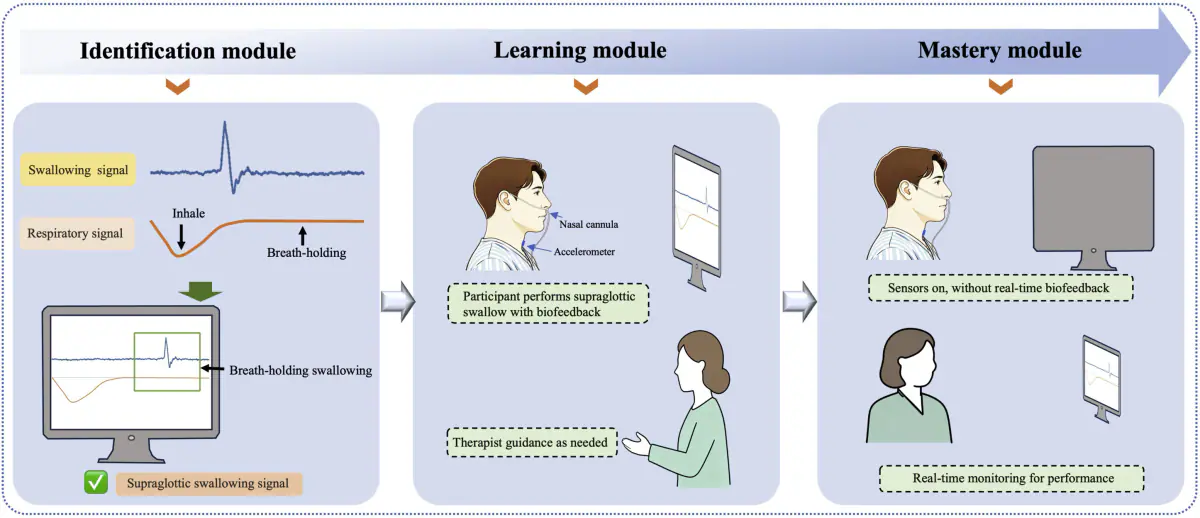
Biofeedback methods have been investigated to enhance neuromuscular re-education in swallowing therapy. While single modality feedback (e.g., surface electromyography) is commonly used, multimodal or bimodal biofeedback combining different physiological signals may provide richer information, improving motor learning and swallowing safety. This study explored the clinical effectiveness of a novel bimodal biofeedback system integrating accelerometer and nasal airflow sensors to assist the supraglottic swallowing maneuver in patients with post-stroke dysphagia.
Study Design
The investigation was a prospective, randomized controlled trial conducted at a single rehabilitation hospital. Thirty patients diagnosed with post-stroke dysphagia were randomized equally into two groups: a control group receiving conventional swallowing rehabilitation including supraglottic swallowing training and an experimental group receiving the same regimen augmented with bimodal biofeedback.
The intervention period lasted two weeks, with 30-minute daily training sessions, six days per week. The bimodal biofeedback combined an accelerometer to detect laryngeal elevation and a nasal airflow sensor to monitor respiratory patterns during swallowing. These realtime biofeedback signals aimed to guide patients to optimally perform the supraglottic maneuver, enhancing airway protection.
Outcome measures included the Functional Oral Intake Scale (FOIS), assessing level of oral intake; the Penetration-Aspiration Scale (PAS), quantifying airway invasion severity; and detailed temporal and kinematic parameters obtained from videofluoroscopic swallowing studies (VFSS), serving as objective swallowing function indicators. Assessments were conducted at baseline, immediately post-intervention, and at one-month follow-up.
Key Findings
The study enrolled 30 patients with no dropouts, ensuring complete data. At both immediate post-treatment and one-month follow-up, the experimental group demonstrated significantly higher FOIS scores compared to the control group (p < 0.001), indicating improved functional oral intake. This improvement reflects enhanced ability and safety in swallowing, facilitating oral nutrition.
Furthermore, the experimental group had a significantly lower incidence of severe airway invasion with PAS scores ≥ 6 after the intervention (p = 0.026), suggesting better airway protection during swallowing and potentially reduced aspiration risk.
While detailed VFSS-derived kinematic and temporal parameters were measured, the study primarily reported improvements correlating with clinical scales. The sustained benefits at one month highlight the potential for bimodal biofeedback to induce durable motor learning and functional recovery in swallowing physiology.
Importantly, no adverse effects or safety concerns were reported, supporting the feasibility and tolerability of this augmented rehabilitation approach in this patient population.
Expert Commentary
The integration of accelerometer and nasal airflow sensors in a biofeedback paradigm provides complementary information on both structural movement and respiratory coordination, critical for safe swallowing. This multimodal approach addresses limitations of unimodal feedback by offering richer sensory input, which may enhance patient engagement and precision in performing the supraglottic maneuver.
Given that stroke survivors often experience impaired sensory and motor control, enhanced feedback mechanisms can improve motor relearning and reduce erroneous swallowing attempts that increase aspiration risk. The use of VFSS as an objective assessment tool strengthens confidence in the functional gains documented.
Limitations include the single-center design and modest sample size, which may affect generalizability. Additional larger, multicenter trials with longer follow-up would be beneficial to confirm reproducibility and long-term outcomes. Furthermore, detailed analysis of VFSS kinematic improvements would provide mechanistic insights.
Conclusion
This randomized controlled trial demonstrates that supraglottic swallowing maneuver training supported by bimodal biofeedback significantly improves swallowing function in post-stroke dysphagia patients beyond conventional rehabilitation alone. The combination of accelerometer and nasal airflow signals facilitates safer and more effective swallowing, potentially reducing aspiration-related complications and improving oral intake. This approach represents an innovative and practical adjunct to post-stroke swallowing rehabilitation with promising clinical impact.
Future studies should explore integration of multimodal biofeedback into routine clinical practice, investigate cost-effectiveness, and evaluate patient-centered outcomes such as quality of life.
Funding and Clinical Trials
The study publication did not specify funding sources or clinical trial registration details. Confirmation of trial registration and funding disclosures is recommended for comprehensive evaluation.
References
- Martino R, Foley N, Bhogal S, et al. Dysphagia after stroke: incidence, diagnosis, and pulmonary complications. Stroke. 2005;36(12):2756-2763.
- Logemann JA. Evaluation and treatment of swallowing disorders. 2nd ed. PRO-ED; 1998.
- Malandraki GA, Kotsis G, Duff MC. The elbow (accelerometric) and nose (nasal airflow) signals in swallowing: physiological significance and clinical applications. Dysphagia. 2020;35(1):71-80.
- Crary MA, Carnaby-Mann GD, Groher ME. Functional oral intake scale for dysphagia in stroke patients: scale development and validation. Arch Phys Med Rehabil. 2005;86(8):1516-1520.
- Rosenbek JC, Robbins JA, Roecker EB, Coyle JL, Wood JL. A penetration–aspiration scale. Dysphagia. 1996;11(2):93-98.
- Clavé P, Shaker R. Dysphagia: current reality and scope of the problem. Nat Rev Gastroenterol Hepatol. 2015;12(5):259-270.