Highlight
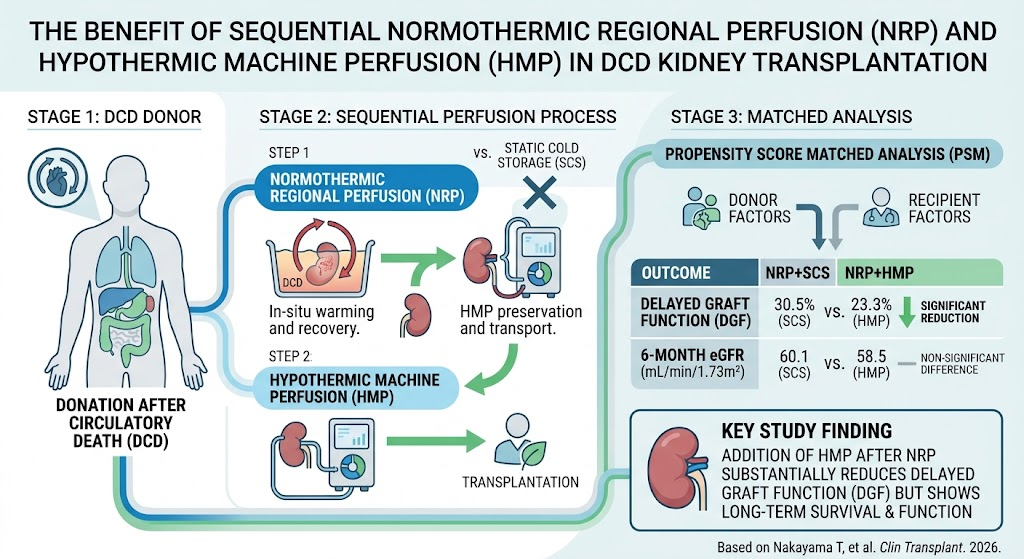
- Normothermic regional perfusion (NRP) improves outcomes in donation after circulatory death (DCD) kidney transplantation.
- Hypothermic machine perfusion (HMP) after NRP further reduces delayed graft function (DGF) compared with static cold storage (SCS).
- HMP adoption increased nationally and is associated with consistent benefits across donor kidney quality and ischemia categories.
- No significant difference was found in length of hospital stay, 6-month renal function, or 1-year graft and patient survival between preservation methods.
Study Background
Kidney transplantation remains the optimal treatment for end-stage renal disease, offering improved survival and quality of life compared to dialysis. A significant proportion of donor kidneys come from donation after circulatory death (DCD), a donor source that historically associates with higher rates of complications like delayed graft function (DGF) due to warm ischemic injury occurring between circulatory arrest and organ procurement. Normothermic regional perfusion (NRP) has emerged as an innovative approach to mitigate ischemic injury by restoring oxygenated blood flow to abdominal organs at near-physiologic temperature in situ after death declaration, thereby potentially improving graft viability.
While NRP is increasingly adopted to optimize DCD kidneys, the subsequent preservation method during organ transport remains controversial. Static cold storage (SCS), the traditional method of hypothermic preservation by cooling organs on ice, is simple and widely used but cannot maintain continuous perfusion. Hypothermic machine perfusion (HMP), which circulates cold oxygenated perfusate through the kidney, allows ongoing metabolic support and removal of waste products, theoretically reducing ischemia-reperfusion injury and improving graft outcomes. However, the additive benefit of HMP following NRP compared to SCS was uncertain.
Study Design
This retrospective cohort study analyzed all adult kidney-only transplantations from DCD donors procured with NRP reported in the OPTN database from October 1, 2020, through June 30, 2025. The primary exposure was the method of organ preservation during transport: NRP combined with hypothermic machine perfusion (NRP+HMP) versus NRP followed by static cold storage (NRP+SCS).
The study employed one-to-two propensity score matching to balance fifteen donor and recipient covariates, thereby minimizing confounding bias in comparing outcomes between groups. Key donor factors included Kidney Donor Profile Index (KDPI), warm ischemia time, and heart recovery status. Primary outcomes were delayed graft function (DGF), posttransplant length of hospital stay (LOS), and kidney function measured by estimated glomerular filtration rate (eGFR) at 6 months posttransplant. Secondary outcomes comprised one-year graft survival and patient survival.
Key Findings
From a total of 4792 kidney transplants with NRP, a majority (85.1%) utilized HMP as the preservation technique during transport, with usage increasing over the study period. After propensity matching (685 NRP+SCS patients matched to 1262 NRP+HMP patients), the analysis revealed that sequential use of NRP followed by HMP was associated with a statistically significant reduction in delayed graft function—23.3% versus 30.5% in the NRP+SCS group (p < 0.01). This suggests a meaningful clinical benefit in using hypothermic machine perfusion after the initial normothermic reperfusion step.
Interestingly, there was no statistically significant difference between groups regarding median length of hospital stay (both 4.0 days, p = 0.07), 6-month eGFR (58.5 vs. 60.1 mL/min/1.73m2, p = 0.46), one-year graft survival, and one-year patient survival. The reduced incidence of DGF with HMP persisted across different KDPI segments, heart recovery statuses, and cold ischemia time strata, with no significant interaction effects detected, implying the benefit of HMP is broadly applicable regardless of donor risk profile or transport duration.
Expert Commentary
The findings of this study align with growing literature supporting the benefits of active perfusion strategies in organ preservation. Normothermic regional perfusion effectively reverses warm ischemic injury by reestablishing physiological conditions prior to procurement, while HMP maintains controlled hypothermia and continuous perfusion during transport, potentially mitigating secondary ischemia-reperfusion injury before transplantation.
The reduction in DGF is clinically significant because DGF is associated with increased risk of acute rejection, reduced long-term graft survival, and heightened healthcare costs due to prolonged dialysis and hospital stays. Although this study did not detect improvements in 6-month renal function or survival outcomes, the short-term benefit of reduced DGF may have downstream impact beyond the study’s follow-up window.
Notably, this research utilized a robust propensity matched design, enhancing internal validity; however, as an observational study, unmeasured confounding cannot be excluded. The lack of survival benefit may reflect relatively short follow-up or limited sample size for these endpoints. Additionally, cost-effectiveness analyses comparing the higher logistical and financial demands of HMP versus SCS after NRP warrant further investigation.
Conclusion
This large, contemporary analysis of DCD kidney transplantation demonstrates that the routine use of hypothermic machine perfusion following normothermic regional perfusion is associated with a significant reduction in delayed graft function, without adverse impact on hospital stay, mid-term renal function, or early survival outcomes. These data support integrating sequential NRP and HMP as a standard organ preservation protocol to optimize graft quality and transplant outcomes in DCD kidney transplantation.
Further prospective studies and cost-benefit evaluations may refine patient selection and preservation strategies. Meanwhile, transplant centers should consider adopting HMP following NRP to enhance organ utilization and recipient outcomes.
Funding and Clinicaltrials.gov
This study was based on an analysis of the OPTN registry database and did not report specific funding sources or clinical trial registration.
References
-
- Nakayama T, Fu SJ, Attia AM, et al. The Benefit of Sequential Normothermic Regional Perfusion and Hypothermic Machine Perfusion in Kidney Transplantation From Donation After Circulatory Death Donors. Clin Transplant. 2026 Aug;40(8):e70641. PMID: 42599744.
<li.Mannon RB. Preservation of kidney grafts: cold and warm perfusion strategies. Current Opinion in Organ Transplantation. 2022;27(2):109–115.
<li.O’Neill S, Asbury N, Jassem W. Machine perfusion in kidney transplantation: current status and future prospects. Nephrology Dialysis Transplantation. 2021;36(6):1060–1069.
<li.Knowles SC, Callaghan CJ, Allen J, et al. Normothermic regional perfusion in donation after circulatory death transplantation: The UK experience. American Journal of Transplantation. 2021;21(4):1561–1571.