Highlight
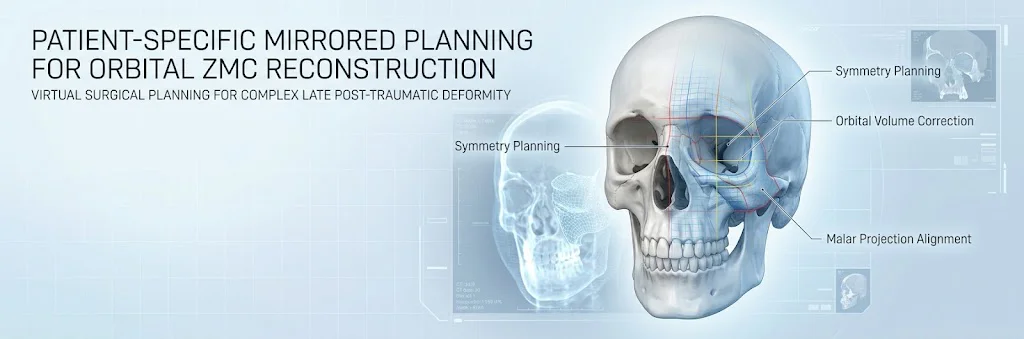
- Patient-specific virtual mirrored-image planning (VSP) leads to superior postoperative symmetry compared to traditional intraoperative visual estimation in late-phase orbital zygomatic maxillary complex (ZMC) fracture reconstruction.
- VSP provides more consistent orbital volume correction and improved globe position, critical for both functional and aesthetic outcomes.
- Malar projection and soft-tissue volume are more accurately restored with VSP, reducing postoperative asymmetries and improving facial contour.
- Patient-reported outcomes related to anxiety and depression are significantly better following VSP-guided surgery, indicating psychosocial benefits beyond physical reconstruction.
Study Background
Post-traumatic deformities involving the orbital zygomatic maxillary complex represent a challenging clinical problem in reconstructive surgery. These fractures often result in complex anatomical distortions, with soft tissue contracture and loss of bony landmarks especially complicating late reconstruction efforts. Achieving optimal orbital volume, globe position, and malar contour symmetry is crucial to restore both function—such as preventing enophthalmos and diplopia—and aesthetics, which in turn impacts patient quality of life and psychosocial well-being. Traditional intraoperative repositioning techniques rely heavily on surgeon’s visual estimation (colloquially known as the ‘eyeball test’), which can introduce variability and suboptimal outcomes. The advent of computerized virtual surgical planning utilizing mirrored imaging from the unaffected side offers a patient-specific blueprint for more precise restoration. However, robust evidence comparing these approaches in late reconstruction of ZMC fractures has been limited. This study addresses this critical gap by evaluating objective and patient-reported outcomes over a twelve-year period.Study Design
This comparative cohort study enrolled 32 patients who underwent late reconstruction for post-traumatic orbital ZMC deformities, evenly divided into two groups. The first group underwent traditional intraoperative repositioning guided by visual estimation, while the second group received surgery planned with virtual mirrored-image surgical planning (VSP). Demographics, mechanism of injury (including falls, motor vehicle collisions, and assault), time from injury to reconstruction, and follow-up duration were comparable between groups, minimizing confounding variables. Primary endpoints included quantitative assessments of orbital volume, globe position, malar projection, and malar soft-tissue volume measured via imaging studies. Secondary endpoints incorporated patient-reported outcome measures using the well-validated Patient-Reported Outcomes Measurement Information System (PROMIS) focusing on domains of anxiety and depression.Key Findings
The study yielded compelling evidence favoring virtual surgical planning.- Orbital Volume Consistency: Although mean postoperative orbital volumes were similar (VSP: 25.5 cc ±1.7; traditional: 26.1 cc ±5.1), the variability was significantly reduced in the VSP group, indicating more reliable anatomical restoration and less over- or under-correction. This consistency is vital, given the orbital cavity’s critical functional role in accommodating the globe.
- Globe Positioning: The traditional group exhibited greater deviation in globe positioning postoperatively compared to the VSP group, which had more precise alignment, potentially reducing complications such as diplopia or enophthalmos.
- Malar Projection Accuracy: The distance from ideal malar coordinates postoperatively was markedly closer in VSP patients (1.6 mm ± 0.4) compared to the traditional group (4.3 mm ± 3.1). This improvement underscores the capability of VSP to restore facial symmetry critical for aesthetic outcomes.
- Malar Soft-Tissue Volume: Both groups showed volumetric improvement post-surgery; however, the VSP group had significantly lower variability and greater predictability (102.2 cc ± 2.8 vs 98.2 cc ± 8.1), indicative of more consistent soft-tissue restoration correlating with improved malar contour.
- Psychosocial Outcomes: PROMIS assessments revealed superior scores in the VSP cohort, with statistically significant reductions in anxiety (score 56 ± 2.4 vs 61 ± 2.8) and depression (54 ± 2.2 vs 59 ± 2.3). These data highlight the psychosocial benefit of achieving better anatomical and cosmetic results, which may improve overall patient satisfaction and quality of life.
Expert Commentary
This study provides strong clinical evidence supporting the use of patient-specific virtual mirrored-image surgical planning in complex late reconstructions after orbital ZMC fractures. The reduction in anatomical variability and enhancement of symmetry likely translate into functional and aesthetic benefits that are substantial for this challenging patient population. Considering that orbital volume and malar projection are critical determinants of postoperative outcomes, integrating advanced imaging and computer-assisted planning should be a standard part of reconstructive protocols. Limitations include the relatively small sample size and single-center study design, potentially affecting generalizability. Further multicenter randomized trials with longer follow-up could consolidate these findings. Additionally, cost-effectiveness analyses may guide broader implementation given the resource intensiveness of virtual surgical planning technology. Biologically, correcting orbital volume and bony architecture precisely helps avoid soft tissue compromise and ocular sequelae by maintaining correct globe position and orbital soft-tissue dynamics. The psychosocial improvements underscore the holistic benefits of precision surgery beyond structural repair.Conclusion
In summary, virtual mirrored-image planning provides clinicians with a powerful tool to enhance surgical precision in late post-traumatic orbital ZMC reconstruction. Its superiority over traditional visual estimation is demonstrated by improved symmetry, globe alignment, malar projection, and patient-reported psychosocial outcomes. Adoption of VSP can bridge the gap between anatomical restoration and patient quality of life in complex craniofacial trauma management, marking a significant advance in reconstructive surgery standards. Future research should focus on refining technology accessibility and evaluating long-term functional and aesthetic durability.Funding and ClinicalTrials.gov
The published study did not disclose specific funding sources or clinical trial registry information.References
1. Miller MN, Sjoenell B, Albert J, Park YJ, Kawamoto HK, Bradley JP. Patient-Specific Mirrored Planning Leads to Superior Symmetry for Late Post-Traumatic Deformity After Orbital Zygomatic Maxillary Complex Fractures. Plastic and Reconstructive Surgery. 2026 Oct 14. PMID: 42872973. 2. Manson PN, Grant MP. Orbital fractures and orbital reconstruction. Plast Reconstr Surg. 2012 May;129(5):1145-55. 3. Zingg M, Laedrach K, Chen J, Chowdhury K, Roy D, Sutter F. Fractures of the zygomatic complex: a review of 1337 cases. J Oral Maxillofac Surg. 1992 Oct;50(10):778-90. 4. PROMIS Health Organization. Patient-Reported Outcomes Measurement Information System. NIH. https://www.healthmeasures.net/explore-measurement-systems/promis (Additional references consulted for contextual understanding are standard craniofacial and reconstructive surgery texts and guidelines.)Specialty calculators
For clinical reference; use professional judgment.