Highlight
- This meta-epidemiological study compared cluster-randomized clinical trials (cRCTs) and individually randomized clinical trials (iRCTs) in prehospital, emergency, and critical care settings.
- No significant difference in mortality effect estimates was detected between cRCTs and iRCTs.
- Significant differences were found in secondary outcomes—length-of-stay or days-alive metrics—with cRCTs reporting smaller effect sizes.
- Less than half of meta-analyses transparently reported randomization type, underscoring the need for improved reporting and consideration of randomization methods in emergency and critical care research.
Study Background
Randomized clinical trials (RCTs) are the cornerstone of evidence-based medicine, providing high-quality data on intervention efficacy and safety. In acute clinical settings such as prehospital care, emergency departments, and intensive care units, rapid enrollment and time-sensitive interventions pose distinct methodological challenges. Here, the choice of randomization strategy—cluster versus individual—can have profound impacts on trial execution and results interpretation.
Cluster-randomized clinical trials (cRCTs) allocate groups (e.g., hospitals, ambulance services) to interventions, whereas individually randomized clinical trials (iRCTs) randomize patients individually. While cRCTs can facilitate logistics and reduce contamination risk, they carry potential biases such as recruitment time differences and intracluster correlation, which might affect effect estimates systematically.
Pooling cRCTs with iRCTs in meta-analyses without adjusting for these differences could lead to erroneous conclusions about treatment benefits or harms, particularly in emergency and critical care where rapid inclusion and outcome ascertainment are crucial. The clinical burden of critical illnesses and emergencies demands precise evidence synthesis tailored to study design nuances.
Study Design
The authors conducted a meta-epidemiological study addressing this knowledge gap. They systematically selected meta-analyses published over the past decade in PubMed and Embase databases that focused on prehospital, emergency, or critical care interventions and included both cRCTs and iRCTs.
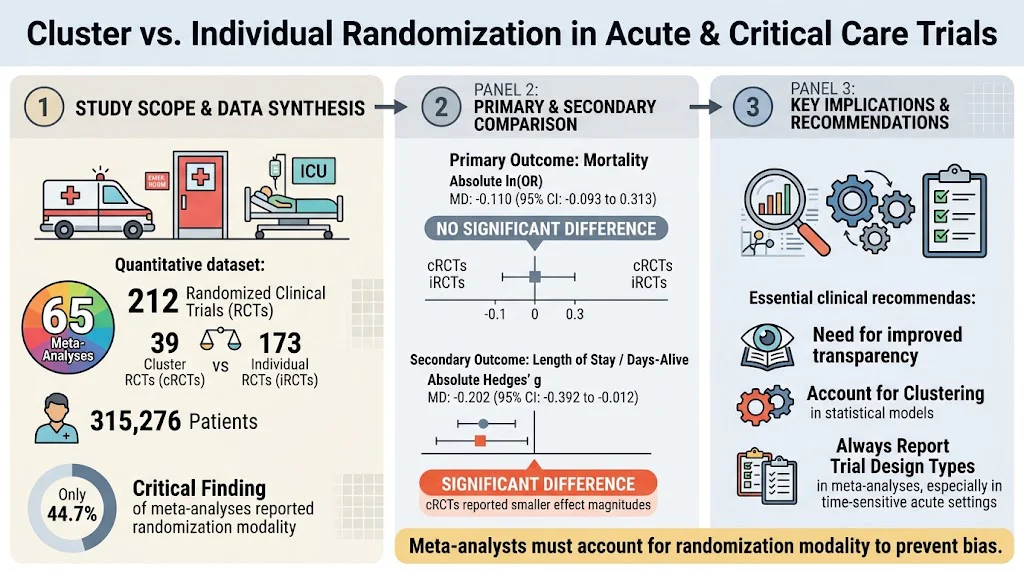
A total of 94 eligible meta-analyses were identified, with 44.7% reporting randomization type explicitly. For quantitative analysis, 65 meta-analyses comprising 39 cRCTs and 173 iRCTs were included, covering 315,276 patients overall.
Primary outcomes were mortality assessed via odds ratios (OR) transformed to ln(OR). Secondary outcomes involved length-of-stay and days-alive metrics expressed as standardized mean differences (Hedges’ g). Data extraction was performed in duplicate for accuracy. Mixed regression models compared absolute effect sizes between randomization types with 95% confidence intervals (CIs).
Key Findings
The analysis revealed no statistically significant difference in the absolute ln(OR) for mortality between cRCTs and iRCTs (mean difference [MD] -0.110; 95% CI, -0.093 to 0.313). This suggests that mortality effect estimates are comparable regardless of randomization unit in acute care trials.
Conversely, a statistically significant difference was found in length-of-stay or days-alive outcomes between cRCTs and iRCTs (MD in absolute Hedges’ g, -0.202; 95% CI, -0.392 to -0.012). The negative mean difference indicates that cRCTs tended to report smaller effect sizes for these secondary outcomes than iRCTs.
This pattern may reflect systematic biases inherent in cluster randomization such as selection bias due to time-pressured inclusion or intracluster correlation effects diminishing observed treatment contrasts. The smaller effect sizes in cRCTs caution against uncritical pooling with iRCTs in meta-analyses, especially for functional or patient-centered endpoints.
Importantly, the study also highlights a transparency gap—fewer than half of meta-analyses documented randomization modality—potentially limiting reproducibility and accurate bias assessment in evidence syntheses.
Expert Commentary
The findings provide critical methodological insights for clinical trialists and systematic reviewers in emergency and critical care research. While mortality is an objective and hard endpoint less susceptible to biases from cluster design, more nuanced outcomes such as length of hospitalization or days alive may be affected by confounding factors related to patient recruitment timing, cluster effects, and care delivery heterogeneity.
Experts argue that meta-analyses combining cRCTs and iRCTs without statistical adjustment or subgroup analysis risk misleading estimates that affect clinical guidelines and policy. As noted by Lønstrup et al., improving transparency around trial randomization strategies is essential to mitigate interpretative errors.
Limitations of the study include reliance on published meta-analyses which may underreport randomization modalities and lack of granular individual patient data to explore mechanistic pathways of observed discrepancies. Nonetheless, the large sample size across diverse acute care interventions enhances generalizability.
Conclusion
This meta-epidemiological evaluation indicates that cluster and individual randomization methodologies produce comparable mortality effect sizes but diverge significantly for secondary outcomes related to hospitalization duration and patient survival days. Given these findings, researchers and guideline panels should carefully consider the influence of randomization strategy on outcome estimates when designing, analyzing, and synthesizing prehospital, emergency, and critical care trials.
Enhanced reporting standards mandating explicit declaration of randomization type and appropriate statistical adjustments for cluster effects in meta-analyses are needed. Such measures will improve the reliability of evidence that informs acute care interventions, ultimately optimizing patient outcomes where time and precision are critical.
Funding and ClinicalTrials.gov
The original study does not indicate specific funding sources or clinical trial registrations.
References
1. Lønstrup S, Petersen PL, Bruun NH, Klitgaard TL, Schjørring OL. Cluster Versus Individual Randomization in Prehospital, Emergency and Critical Care Trials: A Meta-Epidemiological Study. Crit Care Med. 2026 Oct 21. PMID: 42904944.
2. Campbell MK, Piaggio G, Elbourne DR, Altman DG; CONSORT Group. Consort 2010 statement: extension to cluster randomised trials. BMJ. 2012 Sep 4;345:e5661.
3. Kahan BC, Morris TP. Analysis of cluster randomized trials with continuous outcomes: a comparison of methods. Stat Med. 2013 May 20;32(11):1950-66.
4. Eldridge SM, Kerry S. A practical guide to cluster randomised trials in health services research. John Wiley & Sons; 2012.
5. Higgins JP, Thomas J, Chandler J, et al., editors. Cochrane Handbook for Systematic Reviews of Interventions version 6.2. Cochrane; 2021.
Specialty calculators
For clinical reference; use professional judgment.