Highlights
- Semaglutide significantly reduces major cardiovascular events in adults with established cardiovascular disease and overweight/obesity irrespective of frailty status.
- Health-related quality of life improvements with semaglutide are more pronounced in individuals with higher baseline frailty.
- The safety profile of semaglutide appears favorable even in the most frail participants, with lower rates of adverse events leading to treatment discontinuation.
- Frailty status can improve under semaglutide treatment, indicating potential broader benefits beyond cardiovascular risk reduction.
Background
Cardiovascular disease (CVD) remains the leading cause of morbidity and mortality globally, especially among individuals with overweight or obesity. The glucagon-like peptide-1 receptor agonist (GLP-1 RA) semaglutide has emerged as a powerful agent to reduce cardiovascular events and promote weight loss. However, the impact of patient frailty — a multidimensional syndrome characterized by decreased physiological reserve and increased vulnerability to adverse outcomes — on the efficacy and safety of semaglutide is not well delineated. Frailty affects prognosis and therapeutic tolerance in cardiovascular patients, necessitating clinical evidence to guide individualized treatment strategies.
Key Content
Study Design and Population
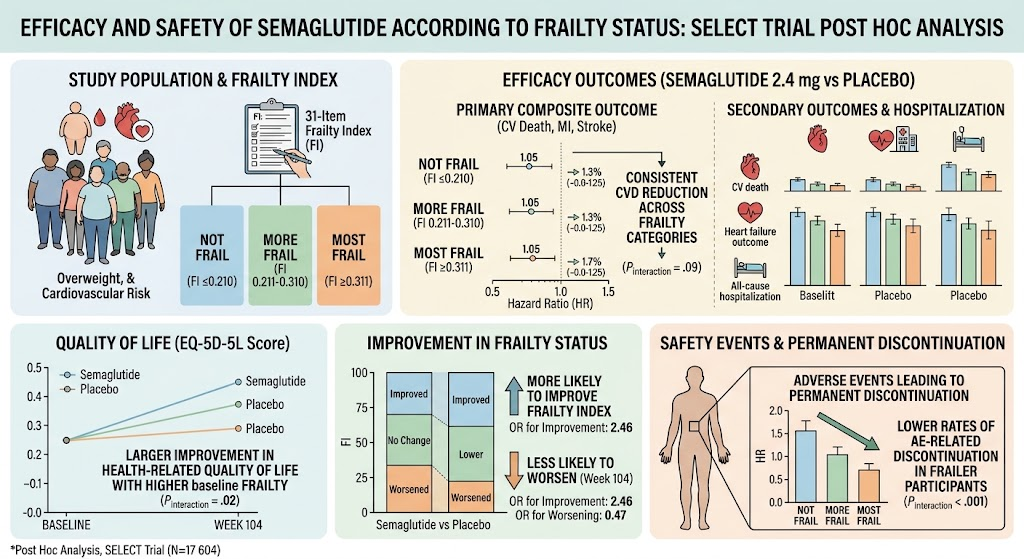
The SELECT trial was a multinational, randomized, placebo-controlled clinical trial enrolling 17,604 adults with overweight or obesity (body mass index ≥27 kg/m2) and established cardiovascular disease but without diabetes. This post hoc secondary analysis employed the Rockwood cumulative deficit approach to categorize frailty using a 31-item frailty index (FI), stratifying patients into three groups: not frail (FI ≤0.210), more frail (FI 0.211-0.310), and most frail (FI ≥0.311).
Participants were randomized to receive weekly subcutaneous semaglutide 2.4 mg or placebo and followed longitudinally for cardiovascular outcomes, health-related quality of life (HRQoL), and safety events. The primary composite outcome included cardiovascular death, nonfatal myocardial infarction, and nonfatal stroke. Secondary endpoints encompassed heart failure hospitalization, all-cause mortality, and hospitalization rates. HRQoL was assessed by the validated EuroQol 5-Dimension 5-Level (EQ-5D-5L) instrument.
Cardiovascular Efficacy Across Frailty Categories
Event rates for the primary composite outcome naturally increased with greater baseline frailty, consistent with known prognostic implications of frailty. Semaglutide reduced the hazard of the primary outcome compared to placebo with hazard ratios (HRs) approximating 0.70 across frailty strata, with no statistically significant interaction (P=0.09 for categorical FI and P=0.30 for continuous FI), indicating consistent effectiveness irrespective of frailty.
Similarly, semaglutide significantly lowered the risk of composite heart failure outcomes (P=0.82 for interaction), all-cause hospitalizations (P=0.71), and all-cause mortality (P=0.28) without heterogeneity by frailty level. These data reinforce semaglutide’s broad cardioprotective effects across a frailty spectrum.
Quality of Life and Frailty Modification
Improvements in EQ-5D-5L scores with semaglutide were more substantial in participants with higher frailty (P=0.02 for interaction), suggesting potential greater gains in perceived health status among more vulnerable individuals.
Moreover, the analysis demonstrated that from baseline to week 104, participants treated with semaglutide were more than twice as likely to improve their frailty category and less than half as likely to experience worsening frailty compared with placebo (OR 2.46 and 0.47, respectively). These findings signal a possible role of semaglutide in modifying frailty trajectories, likely mediated by improved metabolic, functional, and cardiovascular parameters.
Safety Profile by Frailty Status
Adverse event rates leading to permanent discontinuation were notably lower among semaglutide-treated participants with higher FI scores compared to placebo, with a statistically significant interaction (P<0.001). This counterintuitive finding may reflect enhanced tolerability or selective adherence in frailer subpopulations. Gastrointestinal side effects remain the most common but did not translate into increased treatment cessation in frail individuals.
Importantly, no new safety signals emerged in frail patients, supporting semaglutide’s favorable risk-benefit ratio in this historically underrepresented and clinically challenging group.
Comparative and Mechanistic Context
Previous trials of GLP-1 RAs have established cardiovascular benefits predominantly in patients with type 2 diabetes. The SELECT trial uniquely extends these benefits to non-diabetic populations with overweight/obesity and cardiovascular disease. Mechanistically, GLP-1 RAs may improve endothelial function, reduce inflammation, and facilitate weight loss, collectively mitigating cardiovascular risk and possibly reversing components of frailty related to metabolic dysfunction.
Emerging mechanistic studies suggest potential direct effects of semaglutide on muscle metabolism and mitochondrial function, which may underpin frailty improvements. However, dedicated mechanistic studies in frail populations remain warranted.
Expert Commentary
This post hoc analysis of the robust SELECT trial addresses a critical gap in clinical evidence: the efficacy and safety of semaglutide across frailty strata in patients at high cardiovascular risk. The absence of significant heterogeneity in cardiovascular outcomes underscores that frailty should not preclude semaglutide use. Indeed, the enhanced quality-of-life gains and frailty improvement observed in more frail individuals highlight an opportunity for meaningful clinical benefit in this vulnerable population.
However, as a secondary analysis, findings should be interpreted cautiously, acknowledging potential residual confounding and selection biases intrinsic to trial populations. Frailty assessment relied on a cumulative deficit model applied retrospectively, which, while validated, may differ from clinical frailty scales used in practice.
Current cardiovascular guidelines increasingly emphasize individualized risk assessment and multimorbidity considerations. These findings advocate for integration of frailty evaluation in clinical decision-making to optimize GLP-1 RA therapy.
Future research directions include prospective frailty-targeted trials, exploration of biological mechanisms linking GLP-1 RA effects and frailty biology, and real-world studies addressing diverse populations with multimorbidity.
Conclusion
The post hoc SELECT trial analysis compellingly supports the efficacy and safety of semaglutide in reducing major cardiovascular events, improving quality of life, and favorably modifying frailty status in adults with established cardiovascular disease and overweight/obesity regardless of baseline frailty. These results advocate for proactive consideration of semaglutide therapy across frailty spectrums to optimize cardiovascular outcomes and holistic health.
References
- Ostrominski JW, Plutzky J, Scirica BM, et al. Efficacy and Safety of Semaglutide According to Frailty Status: A Post Hoc Analysis of the SELECT Randomized Clinical Trial. JAMA Cardiol. 2026 Sep 16. PMID: 42747817; https://pubmed.ncbi.nlm.nih.gov/42747817/
- Gerstein HC, Colhoun HM, Dagenais GR, et al. Dulaglutide and cardiovascular outcomes in type 2 diabetes (REWIND): a double-blind, randomized placebo-controlled trial. Lancet. 2019;394(10193):121–130. doi:10.1016/S0140-6736(19)31149-3
- Kirkman MS, Briscoe VJ, Clark N, et al. Diabetes in older adults: A consensus report. J Am Geriatr Soc. 2012;60(12):2342-2356. doi: 10.1111/jgs.12035
- Rockwood K, Mitnitski A. Frailty in relation to the accumulation of deficits. J Gerontol A Biol Sci Med Sci. 2007;62(7):722-727. doi:10.1093/gerona/62.7.722