Introduction
Whole grains are cereal grains that contain all three parts of the kernel — the bran, germ, and endosperm — in contrast to refined grains, which have the bran and germ removed. Common whole grains include brown rice, oats, barley, and whole wheat. Epidemiological evidence has linked higher consumption of whole grains to lower risks of cardiometabolic diseases such as heart disease, stroke, type 2 diabetes, and metabolic syndrome. However, the biological mechanisms underlying these associations and the dose-response relationship of whole-grain intake have been less clear. This knowledge gap complicates clinical and public health guidance on optimal consumption levels.
To address this, researchers conducted a comprehensive meta-analysis of randomized controlled trials (RCTs) evaluating the effects of whole-grain intake on various cardiometabolic risk factors. By aggregating and analyzing data from multiple trials, a clearer understanding of how whole grains influence measurable risk markers such as body weight, cholesterol, blood pressure, and inflammation can be achieved.
Methods
A systematic search selected randomized trials that investigated whole-grain consumption compared to control diets on cardiometabolic risk markers. The meta-analysis included 87 trials from 101 publications, covering a diverse population across different geographical locations and baseline health statuses. Evidence was pooled using random-effects models to account for variation between studies.
Outcomes assessed included body weight, waist circumference, serum lipid profiles (total cholesterol, LDL cholesterol, triglycerides), fasting plasma glucose, blood pressure, and inflammatory markers such as interleukin-6 (IL-6). Estimates were reported per 48 grams per day increasing intake of whole grains measured on a dry weight basis, equivalent roughly to three servings of whole grains or about 90 grams of fresh weight.
Non-linear dose-response analyses identified the intake range associated with the most significant effects, while grading certainty of evidence was graded for each outcome using established evaluation criteria.
Results
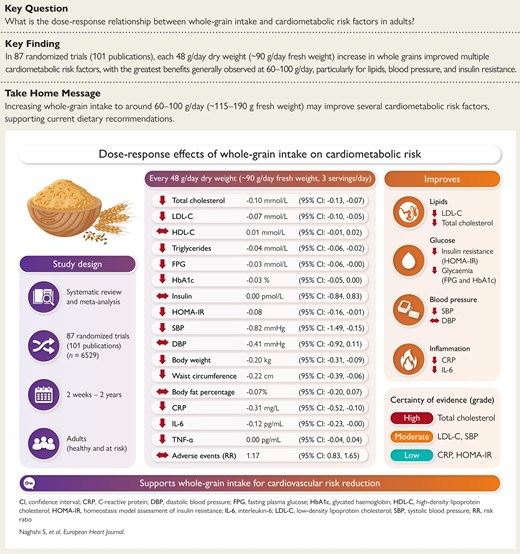
The analysis revealed that for each 48 g/day increment in whole-grain consumption, there were statistically significant, clinically relevant improvements in multiple cardiometabolic risk factors:
– Body weight decreased by 0.20 kg on average (95% CI: -0.31 to -0.09 kg) across 41 studies.
– Waist circumference was reduced by 0.22 cm (95% CI: -0.39 to -0.06 cm) across 27 studies.
– Total cholesterol dropped by 0.10 mmol/L (95% CI: -0.13 to -0.07 mmol/L) across 54 studies.
– Interleukin-6, a marker of systemic inflammation, showed a reduction by 0.12 pg/mL (95% CI: -0.23 to 0.00 pg/mL) across 12 studies.
Moderate certainty evidence indicated modest but consistent reductions in:
– Low-density lipoprotein (LDL) cholesterol by 0.07 mmol/L (95% CI: -0.10 to -0.05 mmol/L).
– Triglycerides by 0.04 mmol/L (95% CI: -0.06 to -0.02 mmol/L).
– Fasting plasma glucose by 0.03 mmol/L (95% CI: -0.06 to 0.00 mmol/L).
– Systolic blood pressure by 0.82 mmHg (95% CI: -1.49 to -0.15 mmHg).
Non-linear analyses suggested that most cardiometabolic benefits plateaued around 60 to 100 g/day of whole grains. A few endpoints showed continued benefits at higher intakes, up to 180-220 g/day, but evidence was limited due to fewer data points at these consumption levels.
Discussion
This meta-analysis reinforces the growing body of evidence that incorporating whole grains into the diet has measurable benefits on important indicators of cardiometabolic health. Small yet consistent reductions in body weight, cholesterol levels, blood pressure, and inflammatory markers translate into meaningful risk reductions for cardiovascular disease and diabetes over time.
The physiological mechanisms likely involve increased fiber and nutrient intake, improved glycemic control, modulation of lipid metabolism, and attenuation of systemic inflammation. Whole grains’ richer micronutrient profile—including vitamins, minerals, antioxidants, and phytonutrients—may contribute synergistically to these effects.
Importantly, larger benefits appear when adults consume about 60 to 100 g of whole grains daily, which could be achieved through three to five servings such as brown rice, oats, whole wheat bread, or barley. Despite these findings, the evidence base at very high intake levels remains sparse. Limited data prevent establishing firm upper thresholds or safety guidelines for excessive consumption, though no adverse effects were reported.
Clinicians and nutrition professionals can use these insights to recommend achievable dietary goals promoting whole-grain foods, aligning with current guidelines from health authorities worldwide. Increased whole-grain intake is a practical, accessible lifestyle intervention with potential to improve population cardiometabolic health substantially.
Limitations and Future Research
While the meta-analysis included a large number of trials, heterogeneity in study design, populations, types of whole grains studied, and outcome definitions remains a limitation. Some biomarkers had fewer supporting studies, contributing to moderate or low certainty ratings. More high-quality, long-term RCTs are needed to confirm findings, particularly on inflammation and glucose metabolism.
Future research should also aim to clarify the effects of specific whole-grain types and processing methods, interactions with other dietary components, and benefits in various demographic and clinical subgroups. Understanding mechanisms at molecular and metabolic levels will further enhance dietary recommendations.
Conclusions
Whole-grain consumption is associated with improvements in body weight, cholesterol profiles, blood pressure, and inflammatory status—key factors underlying cardiometabolic disease risk. The most notable benefits are observed with daily intakes around 60 to 100 grams, supporting current public health messages to increase whole-grain intake for cardiovascular and metabolic disease prevention. Although evidence certainty varies by outcome and data at very high intake levels remain limited, emphasizing whole grains in the diet remains a safe and effective strategy to improve cardiometabolic health in diverse populations.