Highlight
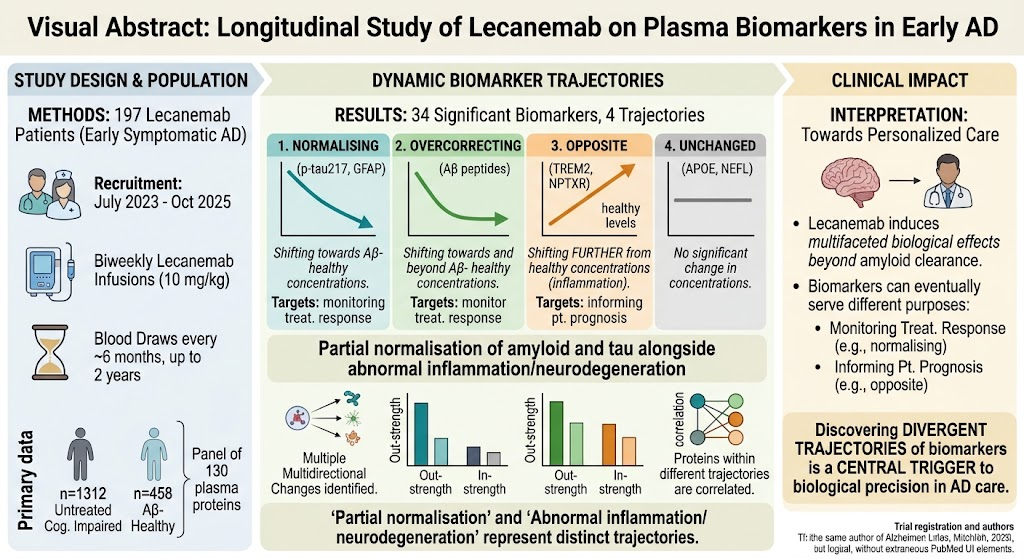
1. Lecanemab treatment in early symptomatic Alzheimer’s patients leads to significant changes in 34 plasma biomarkers out of 130 measured.
2. Biomarkers follow four distinct dynamic trajectories: normalising, overcorrecting, opposite, and unchanged, reflecting complex biological responses beyond amyloid clearance.
3. Partial normalization of phosphorylated tau (p-tau217), MAPT, and GFAP suggests impact on tau pathology and glial activation.
4. Divergent biomarker changes involving inflammatory markers like TREM2 may indicate immune modulation distinct from amyloid removal.
Study Background
Alzheimer’s disease (AD), the leading cause of dementia worldwide, is characterized pathologically by accumulation of amyloid β (Aβ) plaques, tau neurofibrillary tangles, neurodegeneration, and neuroinflammation. While anti-amyloid therapies such as lecanemab have demonstrated efficacy in slowing cognitive and functional decline in early symptomatic AD, the biological effects of treatment on neurodegeneration and inflammation remain incompletely understood. Plasma biomarkers are emerging as minimally invasive tools to track disease pathology and treatment response. Understanding how plasma biomarkers change dynamically during anti-amyloid intervention could enhance clinical monitoring, elucidate disease mechanisms, and refine prognostic assessments. This study addresses the knowledge gap regarding longitudinal plasma proteomic changes in AD patients undergoing lecanemab therapy in real-world clinical settings.
Study Design
This longitudinal cohort study prospectively enrolled patients with early symptomatic Alzheimer’s disease documented by positive amyloid biomarkers, treated with biweekly intravenous lecanemab infusions (10 mg/kg). Recruitment occurred at Washington University Memory Diagnostic Center from July 17, 2023, to October 10, 2025. Clinical assessment and plasma sampling were conducted approximately every six months for up to two years. The study analyzed 130 plasma proteins implicated in AD pathology employing advanced proteomics. Control groups included an amyloid-negative cognitively normal (Aβ-) cohort and a cognitively impaired untreated cohort derived from the Knight Alzheimer Disease Research Center (Knight ADRC) cohort. Statistical analyses utilized regression and mixed-effects models adjusted for age, sex, and other demographics to assess associations between lecanemab infusion number and biomarker trajectories.
Key Findings
A total of 197 treated patients composed the lecanemab group; 1312 cognitively impaired patients without anti-amyloid therapy and 458 Aβ- cognitively normal individuals served as controls. The median age in the treatment group was 73 years; 53% female and 98% White. Plasma biomarkers stratified into four distinctive trajectory patterns during treatment:
1. Normalising Trajectory
Thirty-four biomarkers exhibited significant changes (false discovery rate <0.05) trending towards levels typical of amyloid-negative individuals without cognitive impairment. Notably, phosphorylated tau (p-tau217), microtubule-associated protein tau (MAPT), and glial fibrillary acidic protein (GFAP) concentrations declined, suggesting partial reversal or amelioration of tau pathology and astroglial activation with lecanemab.
2. Overcorrecting Trajectory
Amyloid β peptides showed reductions beyond typical levels found in Aβ- controls, consistent with potent amyloid clearance effects. This overshoot may reflect active plaque removal induced by immunotherapy.
3. Opposite Trajectory
Several biomarkers, including neuronal pentraxin receptor (NPTXR), neurogranin (NRGN), and triggering receptor expressed on myeloid cells 2 (TREM2), exhibited shifts away from normal levels, implying persistent or enhanced inflammatory, synaptic, and neurodegenerative processes despite amyloid clearance.
4. Unchanged Trajectory
Some key neurodegeneration-related proteins such as neurofilament light chain (NEFL) and apolipoprotein E (APOE) remained stable, indicating that certain pathways may be unaffected by lecanemab or require longer treatment duration for alteration.
These multidirectional changes illustrate that lecanemab impacts multiple pathological cascades beyond amyloid, with implications for understanding the complexity of AD progression under therapy. Importantly, biomarker shifts correlated with number of lecanemab infusions, reinforcing their potential value in treatment monitoring.
Expert Commentary
This study significantly advances knowledge on the plasma proteomic landscape modulated by anti-amyloid therapy. The distinct biomarker trajectories highlight the heterogeneity of biological responses to lecanemab and underscore the need for multiplex biomarker panels in clinical trials and practice. The normalization of tau and glial biomarkers aligns with emerging evidence that amyloid clearance may secondarily attenuate tauopathies and neuroinflammation. Conversely, increases in inflammatory molecules such as TREM2 might correspond to microglial activation associated with amyloid plaque resolution or immune-related adverse effects that require close monitoring.
Limitations include demographic homogeneity with predominantly White, non-Hispanic participants, limiting immediate generalizability. The observational design also constrains causal inference. Longer follow-up will be critical to determine whether plasma biomarker normalization predicts sustained clinical benefit or disease modification. Independent validation cohorts and mechanistic studies could elucidate the pathophysiologic significance of opposite and unchanged biomarker patterns.
Conclusion
Lecanemab treatment in early symptomatic Alzheimer’s disease induces dynamic and multidirectional changes in plasma biomarkers reflecting amyloid clearance, modulation of tau pathology, and complex inflammatory responses. These findings provide a nuanced biological framework for interpreting therapeutic effects and support the development of biomarker-guided management paradigms in AD. Future studies should validate these biomarker trajectories and explore their prognostic and therapeutic utility to optimize patient outcomes.
Funding and Clinical Trials Registry
This research was funded by the National Institute on Aging, Cure Alzheimer’s Fund, and Washington University. Clinical assessments adhered to protocols approved by institutional review boards and conducted in accordance with relevant ethical standards.
Reference
Mu R, Hofmann A, Gong K, Liu M, Roussak A, Lowery J, Chen Y, Paczynski M, Posey Z, Cheng Y, Xu Y, Xie Y, Powell WJB, Oh I, Gupta A, Sykora N, Budde J, Funk S, Benzinger TLS, Holtzman DM, Morris JC, Snider BJ, Bateman RJ, Schindler SE, Cruchaga C. Dynamic changes in plasma biomarkers of Alzheimer’s disease in patients treated with lecanemab: a longitudinal cohort study. Lancet Neurol. 2026 Sep 24:S1474-4422(26)00284-X. doi: 10.1016/S1474-4422(26)00284-X. Epub ahead of print. PMID: 42785333.