Highlight
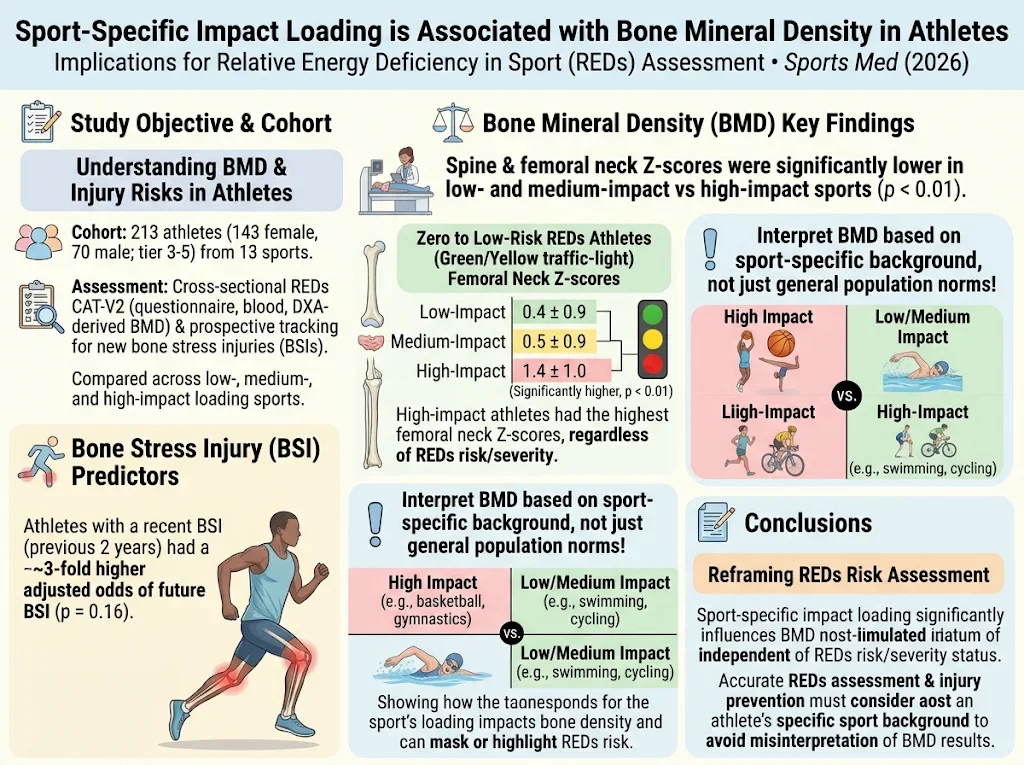
Sport-specific impact loading significantly influences bone mineral density (BMD) in athletes, with high-impact sports showing higher BMD compared to low- and medium-impact sports. This relationship holds true independent of the Relative Energy Deficiency in Sport (REDs) severity or risk classification. Clinicians evaluating bone health in athletes should contextualize BMD results based on the athlete’s sport type rather than applying general population norms. Additionally, athletes with prior bone stress injuries demonstrate increased risk for future injuries, underscoring the need for targeted prevention strategies.
Study Background
Bone health is a crucial determinant of athlete performance and injury risk. Bone mineral density (BMD) reflects bone strength, with deficits predisposing to bone stress injuries (BSIs), common in both male and female athletes. Relative Energy Deficiency in Sport (REDs) is a syndrome characterized by insufficient energy availability affecting multiple physiological systems, including bone metabolism, often culminating in compromised BMD and increased BSI risk.
While both sport-specific mechanical loading and REDs affect bone health, their combined effects and interplay are not fully understood. Impact loading from certain sports leads to adaptive bone remodeling, resulting in higher BMD, whereas REDs-related energy deficiency typically diminishes bone integrity. Understanding how the mechanical loading profile of different sports modulates BMD can refine REDs risk assessment and guide prevention of BSIs.
Study Design
This cross-sectional and prospective study assessed 213 athletes (143 female and 70 male), competing at performance tiers 3 to 5, spanning 13 different sports classified according to low-, medium-, or high-impact loading characteristics. Participants underwent the International Olympic Committee’s Relative Energy Deficiency in Sport Clinical Assessment Tool-Version 2 (REDs CAT-V2), including a detailed questionnaire, blood sampling, and dual-energy X-ray absorptiometry (DXA) for BMD measurement at the spine and femoral neck.
Following initial assessment, athletes were monitored prospectively for new bone stress injuries (BSIs). REDs risk status was categorized using a traffic-light system (green, yellow, red) indicative of energy deficiency severity and associated clinical risk.
Key Findings
Significant differences in bone mineral density were observed across impact loading groups. Athletes engaged in high-impact sports had significantly higher spine and femoral neck BMD Z-scores compared to those in low- or medium-impact sports (p < 0.01). Specifically, femoral neck Z-scores averaged 1.4 ± 1.0 in high-impact sport athletes with low/no REDs risk (green/yellow traffic-light) compared to 0.5 ± 0.9 and 0.4 ± 0.9 in medium- and low-impact groups respectively (p < 0.01).
Notably, these differences persisted regardless of REDs risk status, indicating an independent contribution of sport-specific mechanical loading to bone health.
Regarding injury outcomes, athletes with a history of bone stress injury within the previous two years exhibited an approximate three-fold increase in the adjusted odds of sustaining new BSIs, although this observation did not reach conventional statistical significance (p = 0.16), likely due to study power limitations or variation in injury definitions.
Expert Commentary
The findings align with mechanostat theory, wherein bone adapts its structure to the magnitude and frequency of mechanical loading. High-impact sports such as gymnastics, volleyball, and athletics generate beneficial osteogenic stimuli that enhance BMD. In contrast, endurance or non-impact sports yield less stimulus, resulting in lower BMD benchmarks for those athletes, independent of energy status.
Traditionally, clinicians interpret DXA scans against general population norms, risking misclassification of bone health in athletes from low- or medium-impact sports who may naturally have lower BMD. This study supports contextualization based on sport-specific loading, minimizing overdiagnosis of low bone mass and inappropriate REDs risk elevations.
Limitations include the cross-sectional design for baseline BMD assessment and the relatively small sample size when stratified by sport, sex, and injury history. Prospective monitored injury outcomes offer insights, though longer follow-up would better elucidate causal relationships.
Conclusion
This study underscores the significant and independent role of sport-specific impact loading in shaping bone mineral density in athletes. Incorporating knowledge of an athlete’s sporting background when interpreting BMD assessments enhances the accuracy of REDs severity classification and informs individualized injury-prevention strategies. Future research should develop sport-specific BMD reference standards and explore longitudinal trajectories of bone health in relation to energy availability and training load dynamics.
Funding and ClinicalTrials.gov
The study was funded by research grants acknowledged in the original publication. No ClinicalTrials.gov identifier was provided.
References
1. Stellingwerff T, Tsai MC, McCluskey WTP, et al. Sport-Specific Impact Loading is Associated with Bone Mineral Density in Athletes: Implications for Relative Energy Deficiency in Sport (REDs) Assessment. Sports Med. 2026 Jun 13;56(11):2893-2907. PMID: 42287559.
2. Mountjoy M, Sundgot-Borgen J, Burke L, et al. IOC consensus statement on relative energy deficiency in sport (RED-S): 2018 update. Br J Sports Med. 2018 Nov;52(11):687-697.
3. Frost HM. Bone “mass” and the “mechanostat”: a proposal. Anat Rec. 1987 Apr;219(1):1-9.
Specialty calculators
For clinical reference; use professional judgment.