Highlight
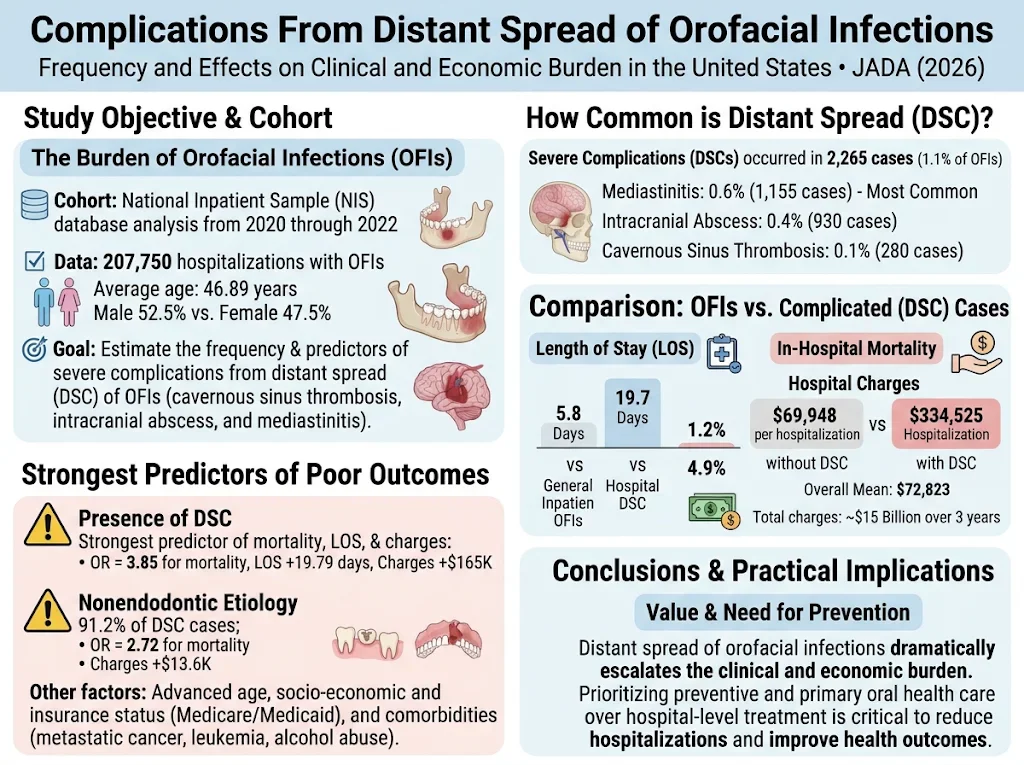
– Severe distant spread complications (DSCs) occur in 1.1% of orofacial infection (OFI) hospitalizations in the U.S.
– Mediastinitis is the most common DSC, followed by intracranial abscess and cavernous sinus thrombosis.
– DSCs are associated with higher mortality (4.9%), prolonged hospital stay (mean 19.7 days), and increased hospital charges (average $72,823).
– Nonendodontic etiologies and socioeconomic factors significantly influence outcomes and healthcare costs.
Study Background
Orofacial infections (OFIs), encompassing infections of the oral cavity, face, and associated anatomical spaces, are common and often manageable. However, their potential to disseminate beyond local tissues resulting in severe complications can impose significant clinical challenges. Such distant spread complications (DSCs)—including cavernous sinus thrombosis, intracranial abscess, and mediastinitis—carry elevated morbidity and mortality risks. Despite clinical recognition, comprehensive epidemiological and economic analyses of DSCs within the United States have been limited. Understanding the frequency of these complications, their impact on patient outcomes, and the contributing clinical and sociodemographic factors is vital for guiding clinical management and healthcare resource allocation.
Study Design
This retrospective cross-sectional analysis utilized data from the National Inpatient Sample (NIS) database, encompassing U.S. hospitalized patient encounters related to OFIs between 2020 and 2022. The primary exposure was the presence of DSC, defined as any of cavernous sinus thrombosis, intracranial abscess, or mediastinitis diagnosed during hospitalization. Key variables included age, sex, insurance status, infection etiology (endodontic versus nonendodontic), comorbidity profiles, and hospital characteristics. The primary endpoints were in-hospital mortality, length of stay (LOS), and total hospital charges. Multivariable regression models assessed the independent effects of DSC and other covariates on these outcomes.
Key Findings
Over the three-year study period, 207,750 hospitalizations for OFIs were identified, with DSCs documented in 2,265 cases (1.1%). Among DSCs, mediastinitis was the most prevalent complication, followed by intracranial abscess and cavernous sinus thrombosis. Key comparative outcomes included:
- Mortality: Patients with DSC exhibited a mortality rate of 4.9%, markedly higher than 1.2% in uncomplicated OFIs (P < .05).
- Length of Stay (LOS): Mean LOS was substantially longer with DSCs, averaging 19.7 days versus 5.8 days without complications (P < .05).
- Hospital charges: Mean hospitalization charges were significantly elevated in DSC cases, with an average of $72,823 compared to those without DSC.
Multivariable regression identified the presence of DSC and nonendodontic infection etiology as the strongest predictors of increased mortality, LOS, and hospital charges (P < .05). Additional factors such as patient demographics and hospital setting also contributed but to a lesser degree.
Expert Commentary
This study highlights the critical yet underappreciated burden of distant spread complications in orofacial infections. The findings underscore mediastinitis as the predominant severe manifestation, reflecting the anatomical potential for fascial plane infections to descend into the mediastinum. The elevated mortality aligns with prior smaller cohort studies emphasizing the life-threatening nature of such dissemination.
Nonendodontic etiologies—often involving deeper soft tissue or odontogenic infections—may be inherently more aggressive or present later, contributing to poorer outcomes. Socioeconomic variables and insurance status likely reflect access to timely care and comorbidity management, meriting further exploration.
Limitations include the retrospective design and reliance on administrative coding, which may underreport complications or miss clinical nuance. Nonetheless, the large, nationally representative dataset lends strong external validity. Future prospective studies could clarify mechanistic pathways and optimal intervention strategies.
Conclusion
Distant spread complications in orofacial infections, while rare, have a profound impact on mortality, hospital length of stay, and economic costs in the United States. Recognition of the predominant role of mediastinitis and the influence of infection etiology and sociodemographic factors provides actionable insight for clinicians and health systems. Early identification, targeted management, and addressing disparities in care may mitigate the substantial clinical and economic burden posed by these severe complications.
Funding and ClinicalTrials.gov
This retrospective study analyzed publicly available Nationwide Inpatient Sample data and did not receive specific external funding. It was not registered as a clinical trial.
References
- Han M, Lee MK, Ahn G, et al. Complications from distant spread of orofacial infections: Frequency and effects on clinical and economic burden in the United States. J Am Dent Assoc. 2026;157(11):1253-1265.e2. PMID: 42262288.
- Brook I. Microbiology and management of deep facial infections and inflammation. Int J Infect Dis. 2010;14(5):e377–e382.
- Packiri S, Thangaraj WR, Kumar PS. Mediastinitis: a life threatening complication of odontogenic infections – A systematic review. Oral Surg Oral Med Oral Pathol Oral Radiol. 2020;130(2):124-132.
- Marra F, Parisi D, Bava P, et al. Clinical implications of cavernous sinus thrombosis in orofacial infections: A literature review. J Stomatol Oral Maxillofac Surg. 2022;123(5):e233-e239.
- O’Neill C, Marjoram D, Chandra RV. Intracranial abscess following odontogenic infections: Review of pathogenesis and management. Neurosurg Rev. 2019;42(4):817-825.
Specialty calculators
For clinical reference; use professional judgment.