Highlight
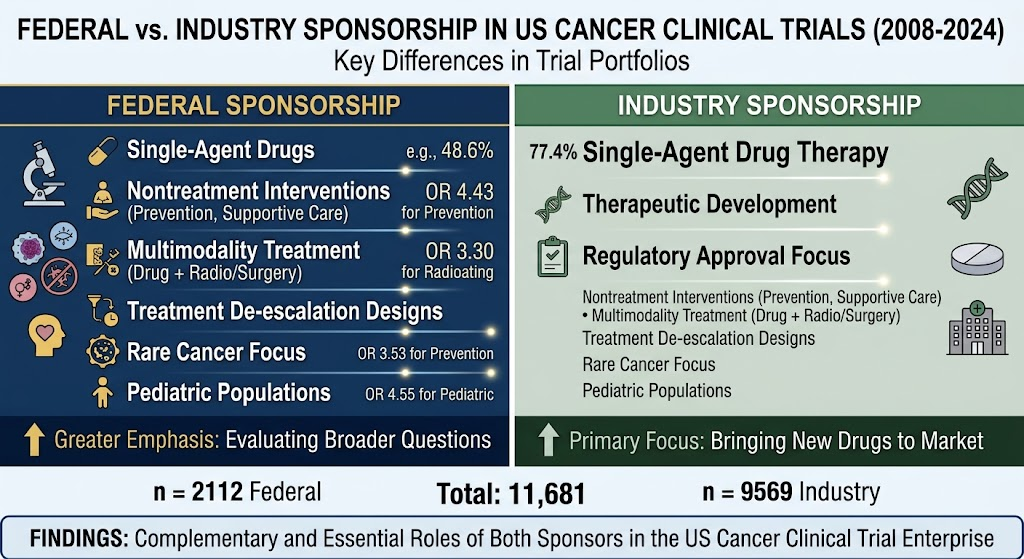
This comparative study of 11,681 federally sponsored and 9,569 industry-sponsored US cancer clinical trials reveals key differences in design and focus. Industry-sponsored trials predominantly evaluate single-agent drug therapies aimed at treatment, while federally sponsored trials more frequently explore nontreatment interventions, multimodality regimens, treatment deescalation, rare cancers, and pediatric populations.
Study Background
Clinical trials are a cornerstone of advancing cancer care, supported largely by industrial pharmaceutical companies and federal agencies like the National Cancer Institute. Industry trials traditionally focus on therapeutic development and regulatory approval pathways, primarily investigating novel drugs for cancer treatment. Federal-sponsored trials are thought to address broader clinical and public health questions, including supportive care, prevention, rare tumor types, and special populations such as children. However, until now, systematic quantification of these differences has been limited. Given the growing complexity of cancer therapeutics and diverse patient needs, delineating the distinct and complementary roles of these sponsors provides essential insight to optimize clinical research strategies.
Study Design
This is a comparative portfolio study of interventional cancer clinical trials registered in the US on ClinicalTrials.gov, initiated during 2008–2024. The analysis included both treatment and nontreatment interventions with lead sponsors classified as either federal or industry. Trial characteristics studied were the purpose of the trial (treatment, prevention, supportive care, etc.), phase (early to late), intervention types (single-agent drug, biological agents, combinations, radiotherapy, surgery), deescalation design use, focus on rare cancers, and patient age categories (adults versus children). Statistical differences between federally and industry sponsored trials were assessed through chi-square tests and odds ratios with 95% confidence intervals.
Key Findings
The study analyzed a total of 11,681 federally sponsored trials (18.1%) and 9,569 industry-sponsored trials (81.9%). The principal differences observed were:
- Purpose and Design: Industry-sponsored trials favored single-agent drug trials for cancer treatment (77.4% vs 48.6%; OR 0.28), reflecting their focus on drug development and regulation. In contrast, federally sponsored trials were significantly more likely to evaluate nontreatment interventions including prevention (4.7% vs 1.1%; OR 4.43) and supportive care approaches (2.5% vs 0.9%; OR 2.92).
- Intervention Complexity: Among treatment-focused trials, federally sponsored studies frequently investigated multimodality regimens combining drugs with biologic agents (19.1% vs 7.4%; OR 2.98), as well as combined modalities involving radiotherapy (10.5% vs 1.4%; OR 8.22) or surgery (2.5% vs 0.2%; OR 14.09). This indicates a more holistic approach to cancer therapy integration.
- Deescalation Trials: Federal sponsors were more inclined to conduct deescalation studies, which aim to reduce treatment intensity and adverse effects without compromising efficacy (3.1% vs 0.4%; OR 8.38). This reflects a focus on optimizing patient quality of life.
- Rare Cancers and Pediatric Focus: Federally sponsored trials more frequently targeted rare cancers (17.5% vs 12.1%; OR 1.54) and pediatric populations (16.1% vs 5.3%; OR 3.43), populations often underserved by industry research due to smaller market incentives.
These findings collectively articulate distinct, yet complementary, roles in advancing cancer care: industry drives novel drug development via streamlined single-agent trials, while federal funding emphasizes broad scientific and clinical questions across diverse populations and treatment paradigms.
Expert Commentary
This comprehensive portfolio analysis validates longstanding assumptions about the roles of federal and industry sponsorship. The heavy industry focus on single-agent drug trials aligns with expedited regulatory pathways, while the federal emphasis on multimodality and supportive care addresses gaps not prioritized commercially. Furthermore, federally sponsored deescalation studies are crucial for refining treatment tolerability, and focus on rare and pediatric cancers supports equity in research investments.
However, there are limitations inherent to registry-based analyses, including potential under-registration of some trials, sponsorship misclassification, and lack of outcome data. Future work will benefit from integration of trial results and cost-effectiveness analyses to fully understand the impact of these sponsorship patterns.
Conclusion
The United States cancer clinical trial ecosystem is sustained through complementary contributions from industry and federal sponsors. Industry-led cancer trials predominantly concentrate on single-agent therapeutic development aimed at regulatory approval. Meanwhile, federally sponsored trials embrace a broader scope encompassing nontreatment interventions, combination therapies, treatment deescalation, and vulnerable patient groups, such as children and rare cancer patients.
Policymakers and clinical stakeholders should ensure balanced support mechanisms to maintain this synergy, facilitating innovation and addressing the comprehensive needs of the cancer patient population. These findings also underscore the importance of diverse trial portfolios to advance precision oncology and patient-centered care.
Funding and ClinicalTrials.gov
The study data derives from ClinicalTrials.gov registrations, ensuring a comprehensive overview of US cancer trials during the study period (2008–2024). The original research was supported by federal and institutional funds as reported in the cited publication.
References
Unger JM, Xiao H, LeBlanc ML, Hershman DL. Federal and Industry Sponsorship in US Cancer Clinical Trials. JAMA Oncol. 2026 Aug 20. PMID: 42623089. DOI: 10.1001/jamaoncol.2026.4567.
Additional literature on clinical trial portfolios and cancer research sponsorship includes:
- Kim ES, et al. The impact of industry sponsorship on the outcomes of cancer clinical trials. J Clin Oncol. 2011;
- National Cancer Institute. Cancer clinical trials: An overview. NCI.gov;
- Sullivan R, et al. Delivering affordable cancer care in high-income countries. Lancet Oncol. 2011;
- FDA. Guidance for Industry: Cancer Drug Development. FDA.gov.