Highlight
This study investigated differences in visual field (VF) and retinal nerve fiber layer (RNFL) optical coherence tomography (OCT) testing frequency between rural and urban patients with glaucoma. While VF test utilization was comparable across geographic settings, rural patients had significantly lower RNFL OCT testing and monitoring. Additionally, Medicaid insurance was strongly associated with reduced frequency and regularity of both VF and RNFL OCT testing.
Study Background
Glaucoma is a major cause of irreversible blindness worldwide, necessitating regular monitoring to prevent disease progression through timely intervention. Monitoring strategies typically include functional assessment via visual field (VF) testing and structural imaging, such as RNFL OCT, which can provide early evidence of glaucomatous damage. However, rural populations often have limited access to specialty eye care and advanced diagnostic technologies, which may affect adherence to recommended monitoring guidelines. Moreover, sociodemographic factors including insurance status may compound disparities in care continuity. Understanding how rural residence and patient-level factors impact glaucoma test utilization is critical to addressing care gaps and optimizing disease management.
Study Design
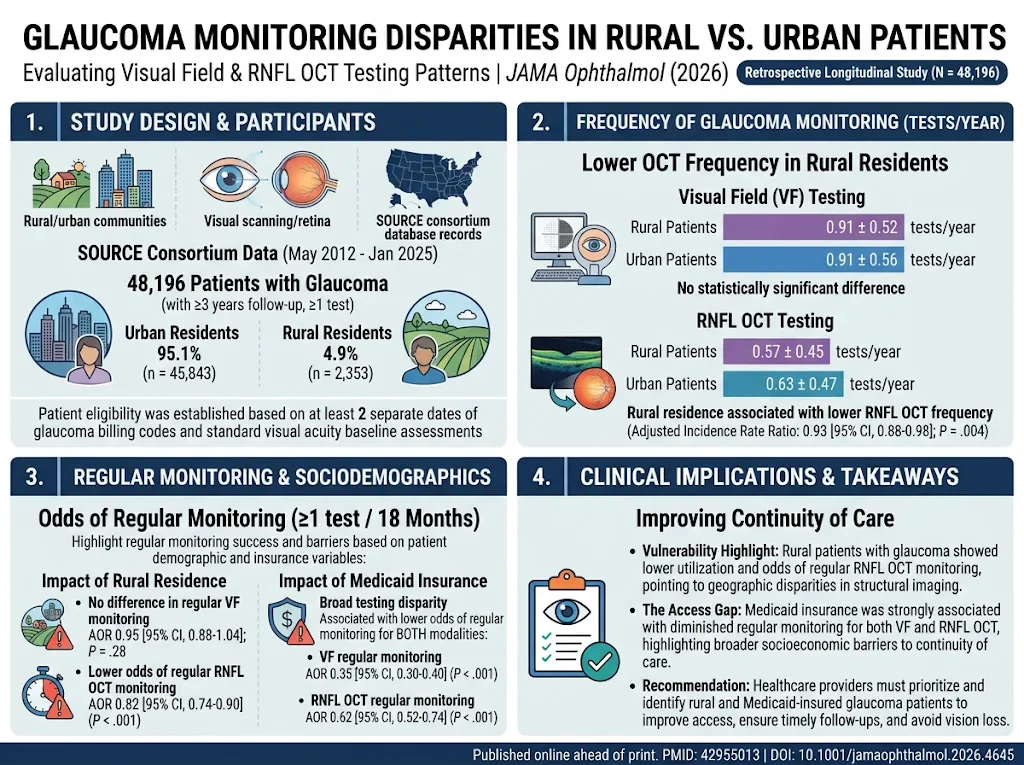
This is a retrospective longitudinal cohort analysis of data derived from the Sight Outcomes Research Collaborative (SOURCE) consortium, encompassing multi-institutional academic ophthalmology clinical records across the United States, covering May 2012 through January 2025. Inclusion criteria encompassed patients with a glaucoma diagnosis indicated by billing codes at two separate dates, a minimum follow-up period of three years, and at least one VF or RNFL OCT test recorded. Rural versus urban residence was determined using Rural-Urban Commuting Area (RUCA) codes based on patients’ geographic information.
The primary outcomes examined were (1) frequency of VF and RNFL OCT testing, expressed as tests per year, and (2) adherence to regular monitoring defined as at least one test every 18 months. Multivariable negative binomial regression modeled testing frequency, and logistic regression modeled regular monitoring status, adjusting for sociodemographic variables and baseline visual acuity.
Key Findings
The cohort comprised 48,196 patients, predominantly urban dwellers (95.1%). Demographic characteristics were largely similar between rural and urban patients, with a mean age of approximately 67 years and just over half female.
Visual Field Testing: The average VF testing frequency was identical at 0.91 tests per year in both rural and urban groups. Adjusted odds ratio (AOR) for regular VF monitoring in rural versus urban residence was 0.95 (95% CI, 0.88-1.04; P=0.28), indicating no statistically significant difference in VF test adherence across settings.
RNFL OCT Testing: In contrast, RNFL OCT testing frequency was lower among rural patients (mean 0.57 tests/year) compared to urban patients (0.63 tests/year), with the difference of -0.06 tests/year reaching statistical significance (adjusted incidence rate ratio 0.93; 95% CI, 0.88-0.98; P=0.004). Furthermore, rural residence was independently associated with reduced odds of meeting regular RNFL OCT monitoring criteria (AOR 0.82; 95% CI, 0.74-0.90; P<0.001).
Insurance Status Influence: Medicaid insurance coverage strongly correlated with decreased likelihood of regular monitoring for both VF and RNFL OCT. Specifically, patients insured by Medicaid had markedly lower odds of regular VF testing (AOR 0.35; 95% CI, 0.30-0.40; P<0.001) and RNFL OCT monitoring (AOR 0.62; 95% CI, 0.52-0.74; P<0.001), highlighting a significant socioeconomic barrier to optimal glaucoma care.
Expert Commentary
The study robustly delineates nuanced disparities in glaucoma monitoring by geographic and insurance status in a large academic clinical cohort. The finding that VF testing frequency does not differ significantly between rural and urban patients suggests that access to functional testing may be less constrained or more prioritized. However, the reduced frequency and regularity of RNFL OCT in rural populations likely reflect access limitations to advanced imaging equipment or specialist services in those areas. Since structural imaging increasingly guides clinical decision-making and early detection of glaucomatous progression, the lower utilization in rural settings is concerning and may contribute to delayed intervention and worse visual outcomes.
Insurance status, particularly Medicaid coverage, emerged as a critical factor negatively impacting regular glaucoma monitoring across modalities. This is consistent with prior literature revealing disparities in specialist care and adherence related to socioeconomic factors. The study did not evaluate the direct impact on clinical outcomes or progression rates, which would be informative in understanding the real-world consequences of these disparities.
Limitations include the retrospective design and use of billing data which may not capture all aspects of clinical care or patient preferences. Additionally, the cohort drawn from academic centers might not fully represent other practice environments, such as private or community clinics. Nonetheless, the large sample size and multi-institutional data strengthen the generalizability of findings within the US academic ophthalmology context.
Conclusion
This study identifies a notable disparity in glaucoma monitoring modalities wherein rural patients receive less frequent and less regular RNFL OCT imaging compared to urban counterparts, though visual field testing rates do not differ significantly by residence. Medicaid insurance status is independently associated with reduced adherence to recommended monitoring for both VF and RNFL OCT. Ophthalmologists and health systems should acknowledge these disparities and consider strategies to improve access to structural imaging for rural patients and address socioeconomic barriers to consistent glaucoma surveillance. Future research should evaluate interventions, such as teleophthalmology or expanded imaging access in community settings, to mitigate these gaps and improve visual outcomes in disadvantaged populations.
Funding and ClinicalTrials.gov
The study used data from the Sight Outcomes Research Collaborative (SOURCE) consortium. Specific funding sources were not detailed in the publication. No clinical trial registration was applicable.
References
- Choi S, Lin SYT, Xiao X, Singh K, Wang SY, Sight Outcomes Research Collaborative (SOURCE) Consortium. Visual Field and RNFL OCT Testing Among Rural and Urban Residents With Glaucoma. JAMA Ophthalmol. 2026 Oct 29. PMID: 42955013.
- Shah N, et al. Disparities in Glaucoma Diagnosis and Management. Clin Ophthalmol. 2021;15:3189–3199.
- Quigley HA, Broman AT. The Number of People with Glaucoma Worldwide in 2010 and 2020. Br J Ophthalmol. 2006;90(3):262–267.
- Chen PC, et al. Telemedicine and structural imaging in glaucoma care: potentials and challenges. Curr Opin Ophthalmol. 2023;34(2):71-78.
Specialty calculators
For clinical reference; use professional judgment.