Highlights
- Saroglitazar at a dose of 0.97 mg achieved significant biochemical response and ALP normalization in patients with primary biliary cholangitis (PBC) inadequately controlled by ursodeoxycholic acid (UDCA).
- The phase 2b/3 EPICS-III trial demonstrated rapid and sustained ALP reduction with an excellent tolerability profile over a 52-week treatment period.
- Saroglitazar’s dual PPAR alpha/gamma agonism provides mechanistic rationale for its efficacy in cholestatic liver disease by modulating lipid metabolism and inflammation.
- While improvements in pruritus were noted at 24 weeks in patients with moderate-to-severe itch, sustained symptomatic benefit at 52 weeks was not observed.
Background
Primary biliary cholangitis (PBC) is a chronic autoimmune cholestatic liver disease characterized by destruction of intrahepatic bile ducts, leading to progressive cholestasis, liver inflammation, fibrosis, and ultimately cirrhosis. Ursodeoxycholic acid (UDCA) remains the first-line therapy; however, up to 40% of patients exhibit inadequate biochemical response or intolerance, underpinning an unmet clinical need for effective second-line agents. Elevated serum alkaline phosphatase (ALP) is a validated surrogate marker for disease progression and treatment response, with targets such as ALP <1.67 x ULN and significant reductions correlating with improved transplant-free survival. Peroxisome proliferator-activated receptors (PPARs) are nuclear receptors involved in regulation of lipid and glucose metabolism, inflammatory pathways, and fibrogenesis. Saroglitazar, a dual PPAR α/γ agonist, has emerged as a potential therapeutic candidate given its combined lipid-modulatory and anti-inflammatory properties. Early-phase clinical data indicated saroglitazar’s promise in reducing ALP levels in PBC patients with suboptimal responses to UDCA.Key Content
Chronological Development of Clinical Evidence
The initial phase 2a proof-of-concept trial published in 2022 (PMID: 34487750) enrolled 37 PBC patients intolerant or resistant to UDCA to evaluate saroglitazar 2 mg and 4 mg over 16 weeks. Both doses showed significant ALP reductions (~49%-51%) compared to placebo, with a rapid onset detectable at Week 4. Elevated aminotransferase events were noted at the 4 mg dose, raising concerns about hepatic safety at higher exposure, leading to dose adjustments in subsequent trials.
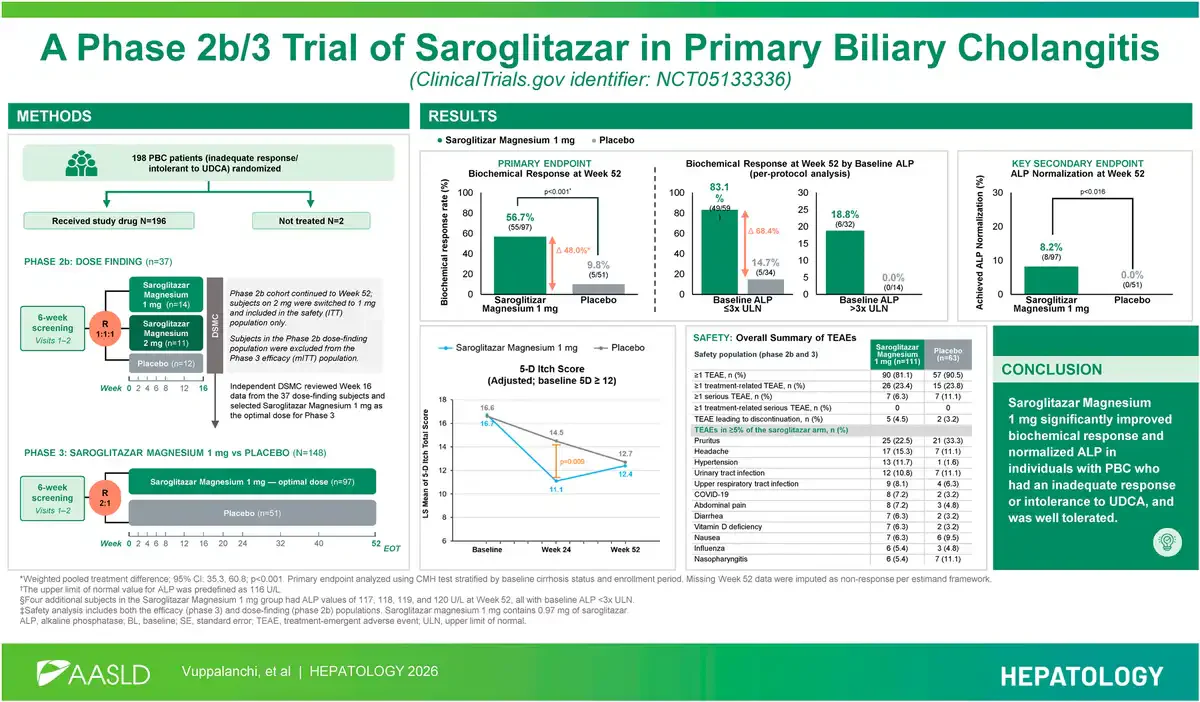
Building on these findings, the EPICS-III phase 2b/3 adaptive, double-blind randomized controlled trial (PMID: 42929426) extended investigation to 185 total patients. Phase 2b refined dosing to saroglitazar magnesium 1 mg (equivalent to 0.97 mg saroglitazar) due to safety profile. The subsequent randomized phase 3 cohort compared this dose to placebo over 52 weeks in 148 participants with inadequate UDCA response or intolerance.
Trial Design and Endpoints
The primary endpoint was a biochemical response at week 52 defined rigorously as ALP less than 1.67 times the upper limit of normal (ULN), at least 15% reduction from baseline ALP, and total bilirubin below ULN. The key secondary endpoint was normalization of ALP. Additional exploratory analyses included improvement in pruritus (5-D Itch score) and safety outcomes.
Clinical Outcomes
| Outcome | Saroglitazar (n=97) | Placebo (n=51) | Difference (95% CI) | p-value |
|---|---|---|---|---|
| Biochemical response at week 52 | 56.7% | 9.8% | 48.0% (35.3 to 60.8) | <0.001 |
| ALP normalization | 8.2% | 0% | 8.5% (2.9 to 14) | 0.016 |
| Biochemical response (baseline ALP ≤3xULN) | 79.0% | 14.3% | Not specified | Not specified |
| Serious adverse events | 6.3% | 11.1% | −4.8% | Not specified |
Noteworthy is the large magnitude of biochemical improvement, with treatment effects amplified in patients with lower baseline ALP levels (≤3x ULN). Saroglitazar was well tolerated, with fewer serious adverse events compared to placebo, and an overall favorable safety profile consistent with previous phases.
Symptom Control and Pruritus
Pruritus, a debilitating symptom experienced by many PBC patients, showed a transient improvement in saroglitazar-treated patients with moderate-to-severe baseline itch scores (≥12) at 24 weeks, with a mean difference of -3.2 points (95% CI, -5.66 to -0.82). However, this improvement was not sustained at 52 weeks, suggesting limited long-term benefit on itching with saroglitazar at this dose.
Mechanistic Insights
Saroglitazar modulates PPAR α and γ pathways, enhancing beta-oxidation of fatty acids, reducing lipotoxicity, and exerting anti-inflammatory effects through downregulation of pro-fibrogenic and inflammatory cytokines. This dual agonism is hypothesized to mitigate cholestatic injury and ameliorate liver biochemistry in PBC, where chronic inflammatory destruction of bile ducts leads to progressive fibrosis. The observed biochemical improvements validate targeting metabolic and inflammatory mechanisms in cholestatic liver disease.
Expert Commentary
The EPICS-III trial provides compelling evidence supporting saroglitazar as a promising second-line agent in PBC patients with incomplete response or intolerance to UDCA. The magnitude of ALP reduction and biochemical response surpasses many currently available alternative therapies, such as fibrates or obeticholic acid, although cross-trial comparisons require caution due to differing study designs and patient populations.
The safety profile is reassuring, with less frequent serious adverse events than placebo and no new safety signals detected over 1 year. Elevated aminotransferase elevations previously noted with higher doses were mitigated by dose selection and monitoring. Notably, saroglitazar did not demonstrate sustained antipruritic effects at 52 weeks, indicating the need for adjunctive therapies in symptom control.
Guidelines recommend therapeutic endpoints targeted at ALP and bilirubin levels to guide treatment decisions, correlating with prognosis and disease progression. Saroglitazar’s achievement of the composite biochemical endpoint aligns with these paradigms, offering a potentially mechanistically distinct option for PBC management.
Limitations include the relatively modest ALP normalization rate (8.2%) compared to biochemical response; longer-term data on clinical outcomes such as fibrosis progression, transplant-free survival, and quality of life remain awaited. Additionally, the trial predominantly included patients with early-to-moderate disease burden; efficacy in advanced cirrhosis warrants further study.
Conclusion
Saroglitazar magnesium at 0.97 mg offers a novel, oral therapeutic opportunity for PBC patients refractory or intolerant to UDCA, delivering significant improvements in biochemical markers of disease activity with a favorable safety profile over 52 weeks. Dual PPAR α/γ agonism represents a rational mechanistic approach to modifying cholestatic liver disease pathways. Future research should focus on long-term clinical outcomes, optimal patient selection, and potential combination with anti-pruritic agents to address symptomatic needs.
References
- Vuppalanchi R, Villamil A, Yilmaz Y, et al. A phase 2b/3 trial of saroglitazar in primary biliary cholangitis. Hepatology (Baltimore, Md.). 2026 Oct 26. PMID: 42929426. doi:10.1097/HEP.0000000000001895
- Parmar D, Chalasani N, et al. Proof-of-concept study to evaluate the safety and efficacy of saroglitazar in patients with primary biliary cholangitis. J Hepatol. 2022 Jan;76(1):75-85. PMID: 34487750. doi:10.1016/j.jhep.2021.08.025