Introduction
The COVID-19 pandemic brought unprecedented challenges to global health, including marked reductions in physical activity (PA) due to lockdowns and social distancing. This decline in PA has negatively impacted fitness levels and overall quality of life, especially in individuals recovering from COVID-19 infection. Rehabilitation strategies that are accessible and effective are critical to help these individuals regain physical capacity and mental well-being.
Digital health (eHealth) interventions are increasingly recognized as promising tools to motivate and guide physical activity safely and conveniently at home. One such innovation is the Activity Quotient (AQ), an eHealth tool designed to prescribe and monitor weekly physical activity doses, aiming to improve cardiorespiratory fitness measured by peak oxygen uptake (V̇O2 peak) and health-related quality of life (HRQoL).
Study Objective
This randomized controlled trial aimed to evaluate the effectiveness of an AQ-guided exercise intervention compared to standard national PA recommendations in enhancing peak oxygen uptake and HRQoL among physically inactive adults recovering from COVID-19.
Methods
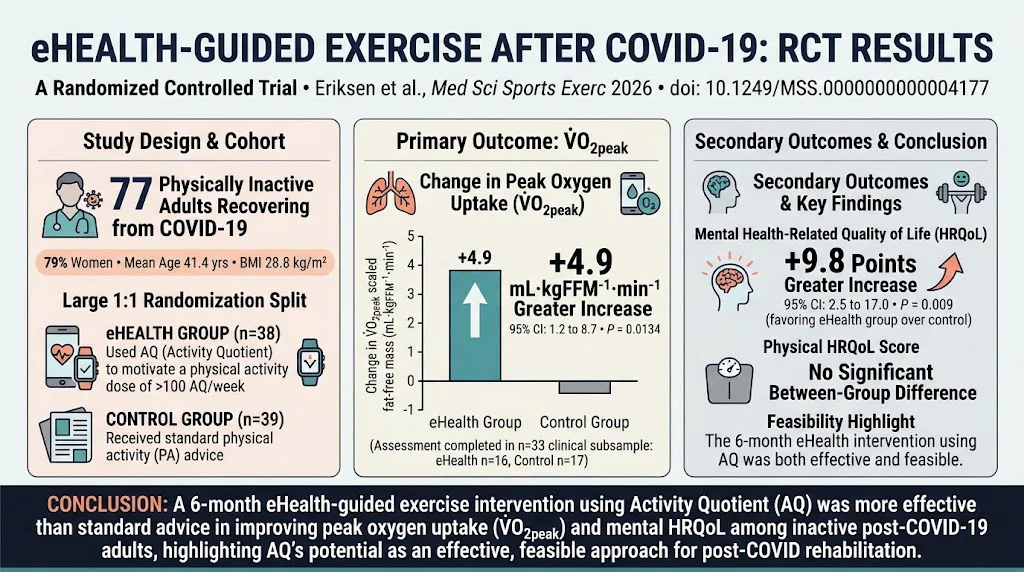
Seventy-seven adults with prior confirmed COVID-19 infection and low physical activity levels were recruited and randomized in equal numbers to either the intervention group or control group. The intervention group (n=38) received a six-month eHealth-guided exercise program using AQ to motivate participants to achieve more than 100 weekly AQ units, representing a personalized PA dose expected to improve fitness. The control group (n=39) was instructed to follow standard PA guidelines recommended nationally.
The primary outcome was V̇O2 peak adjusted for fat-free mass (FFM), reflecting cardiorespiratory fitness improvements. Due to logistics, clinical assessments including cardiopulmonary exercise testing were completed by 33 participants (eHealth group n=16, control group n=17). Secondary outcomes included physical and mental dimensions of HRQoL, assessed using validated questionnaires.
Linear mixed-effects models were employed to analyze group differences over time, accounting for baseline characteristics and repeated measures.
Results
The study cohort was predominantly female (79%), with a mean age of 41.4 years and a mean body mass index of 28.8 kg/m², indicating an overweight profile on average. Among those clinically evaluated, the eHealth group experienced a significant increase in V̇O2 peak by 4.9 mL·kgFFM-1·min-1 compared to controls, representing an important fitness gain (95% confidence interval [CI]: 1.2 to 8.7, p=0.0134).
Mental HRQoL improved markedly by 9.8 points more in the eHealth group than in controls (95% CI 2.5 to 17.0, p=0.009), highlighting enhanced psychological well-being and life satisfaction. However, no significant difference was found between groups in the physical HRQoL domain.
Discussion
This trial provides compelling evidence that a structured, eHealth-guided exercise program using AQ is more effective than standard PA advice in enhancing key health outcomes after COVID-19. The improvement in V̇O2 peak is clinically meaningful, as peak oxygen uptake is a strong predictor of cardiovascular health and mortality risk. Increased mental HRQoL suggests that engaging in guided physical activity also supports psychological recovery, which is often compromised in long-COVID and post-COVID syndromes.
The lack of significant change in the physical HRQoL score might be due to the relatively short intervention duration or the subjective nature of physical well-being assessments. Continued follow-up could reveal further benefits as fitness and health stabilize.
Implications for Practice
The findings underscore the potential of digital health tools like AQ to deliver personalized, scalable rehabilitation for adults recovering from COVID-19, especially those who are physically inactive. eHealth platforms can facilitate motivation, adherence, and safe exercise progression without requiring frequent in-person supervision, which is advantageous during ongoing pandemic restrictions or for those with limited access to conventional rehabilitation services.
Clinicians and rehabilitation specialists should consider integrating eHealth-guided exercise prescriptions into post-COVID care protocols to optimize recovery outcomes. Further research should explore long-term benefits, optimal program components, and applicability in diverse populations, including older adults and those with comorbidities.
Conclusion
A six-month eHealth-guided exercise intervention using the Activity Quotient tool significantly improved cardiorespiratory fitness and mental health-related quality of life in physically inactive adults recovering from COVID-19, outperforming standard physical activity recommendations. These results highlight eHealth-guided exercise as a feasible and effective post-COVID rehabilitation strategy with potential to enhance recovery and quality of life.