Highlight
• Compound exposure to extreme heat and substantial landscape fire-sourced air pollution (SFAP) significantly increases cardiovascular mortality beyond single-hazard effects.
• Heart failure mortality shows the strongest additive interaction effect during compound exposure.
• The study provides robust multinational evidence, with the largest interaction effects observed in Australia.
• Current health risk assessments may underestimate cardiovascular risks by ignoring combined environmental hazards.
Study Background
Climate change is intensifying environmental hazards, notably increasing the frequency of heat waves and landscape fires. These events often co-occur, exposing populations to extreme heat coupled with substantial air pollution from landscape fire emissions. Cardiovascular disease (CVD) remains a leading global cause of mortality, and both heat waves and air pollution independently contribute to cardiovascular morbidity and mortality. However, evidence on their combined effects—the so-called compound exposures—has been limited, impairing accurate risk assessment and public health planning. Understanding how these hazards interact to affect cardiovascular risk is essential for developing targeted interventions, especially given the increasing prevalence of both heat extremes and wildfire occurrences worldwide.
Study Design
This multicountry time-series study analyzed nationally representative daily cardiovascular mortality data from six countries, encompassing a total of 5.9 million CVD deaths. Daily exposure data were classified into four mutually exclusive categories: no hazard exposure, heat wave-only, substantial fire-sourced air pollution (SFAP)-only, and compound exposure to both hazards simultaneously. The primary objective was to assess excess cardiovascular mortality risk associated with compound exposure compared to single hazards and to evaluate additive interactions between heat waves and SFAP.
Statistical analysis employed quasi-Poisson regression models to estimate relative risks (RRs) for cardiovascular mortality by exposure type, controlling for potential confounders. Additive interactions were quantified using metrics such as the relative excess risk due to interaction (RERI), attributable proportion, and synergy index. Sensitivity analyses tested robustness across different buffering windows and heat wave definitions.
Key Findings
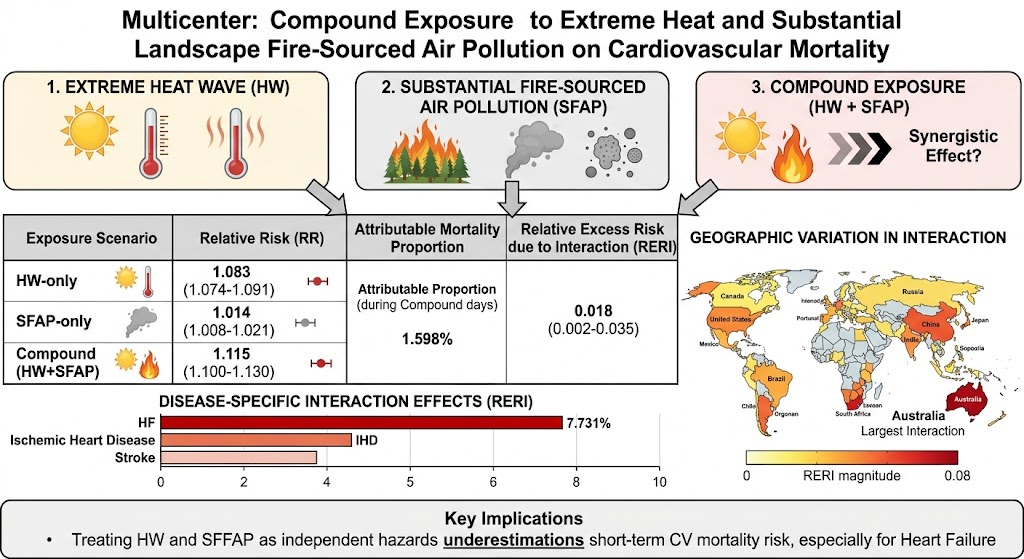
The study demonstrated that compound exposure was associated with an 11.5% increase in cardiovascular mortality risk (RR: 1.115; 95% CI: 1.100–1.130), significantly exceeding risks from heat wave-only exposure (RR: 1.083; 95% CI: 1.074–1.091) and SFAP-only exposure (RR: 1.014; 95% CI: 1.008–1.021). This suggests a supra-additive effect when these hazards co-occur.
Positive additive interactions were detected with a RERI of 0.018 (95% CI: 0.002–0.035), indicating that 1.598% (95% CI: 0.181%–3.129%) of cardiovascular deaths during compound exposure days were attributable to the interaction of heat and fire-sourced pollution.
Heart failure (HF) mortality stood out, with a compound exposure relative risk of 1.245 (95% CI: 1.191–1.301), and a notably larger additive interaction (RERI: 0.096; 95% CI: 0.040–0.161). Approximately 7.731% (95% CI: 3.293%–12.488%) of HF deaths on compound exposure days were due to the interaction effect, highlighting particular vulnerability of HF patients.
Smaller but positive additive interactions were also noted for ischemic heart disease and stroke mortality. Geographic variation was observed, with Australia exhibiting the largest interaction effects, likely reflecting region-specific environmental and population factors.
Sensitivity analyses affirmed the consistency of results across alternative exposure definitions, though effect sizes modestly attenuated with broader buffering periods between exposures.
Expert Commentary
This comprehensive analysis underscores the public health importance of recognizing compound environmental hazards affecting cardiovascular mortality. The finding that combined heat and fire-sourced air pollution produce interactive deleterious effects beyond the sum of their individual impacts has significant clinical and epidemiological implications.
Biologically, extreme heat can exacerbate cardiovascular strain by increasing heart rate and promoting dehydration and blood viscosity, whereas wildfire smoke contains fine particulate matter and toxicants that contribute to systemic inflammation, oxidative stress, and vascular dysfunction. The synergy between these mechanisms likely explains the amplified risk observed, especially for heart failure patients who have reduced cardiopulmonary reserve.
Current public health advisories and early warning systems frequently address heat waves and air pollution separately. This study suggests this approach might underestimate short-term cardiovascular mortality risk. Future guidelines and intervention strategies need to integrate compound hazard risk assessments to better protect susceptible populations.
Limitations include potential exposure misclassification inherent in ecological time-series studies and heterogeneity across countries in environmental monitoring and population vulnerability. Nonetheless, the large sample size and multinational scope enhance generalizability.
Conclusion
The study provides critical evidence that co-exposure to extreme heat and landscape fire-sourced air pollution significantly elevates cardiovascular mortality risk beyond single-hazard exposure, with the greatest impact observed in heart failure mortality. These insights highlight the urgency of revising public health policies to incorporate compound hazard assessments amid a warming climate prone to more frequent wildfires. Clinicians and policymakers should incorporate compound exposure risks when devising strategies for cardiovascular patient care and disaster preparedness.
Funding and ClinicalTrials.gov
The original study did not specify funding sources or clinical trial registration.
References
1. Wen B, Wu Y, Lavigne E, et al. Compound Exposure to Extreme Heat and Substantial Landscape Fire-Sourced Air Pollution on Cardiovascular Mortality. J Am Coll Cardiol. 2026;88(9):965–977. doi:10.1016/j.jacc.2026.07.029
2. Bouchama A, Knochel JP. Heat stroke. N Engl J Med. 2002;346(25):1978-88. doi:10.1056/NEJMra011089
3. Brook RD, Rajagopalan S, Pope CA 3rd, et al. Particulate matter air pollution and cardiovascular disease: An update to the scientific statement from the American Heart Association. Circulation. 2010;121(21):2331-78. doi:10.1161/CIR.0b013e3181dbece1
4. Reid CE, Brauer M, Johnston FH, Jerrett M, Balmes JR, Elliott CT. Critical Review of Health Impacts of Wildfire Smoke Exposure. Environ Health Perspect. 2016;124(9):1334-43. doi:10.1289/ehp.1409277
5. Ebi KL, Balbus JM, Luber G. Overall summary and conclusions: Health risks due to climate change. Environ Health Perspect. 2018;126(8):084001. doi:10.1289/EHP2822