Highlight
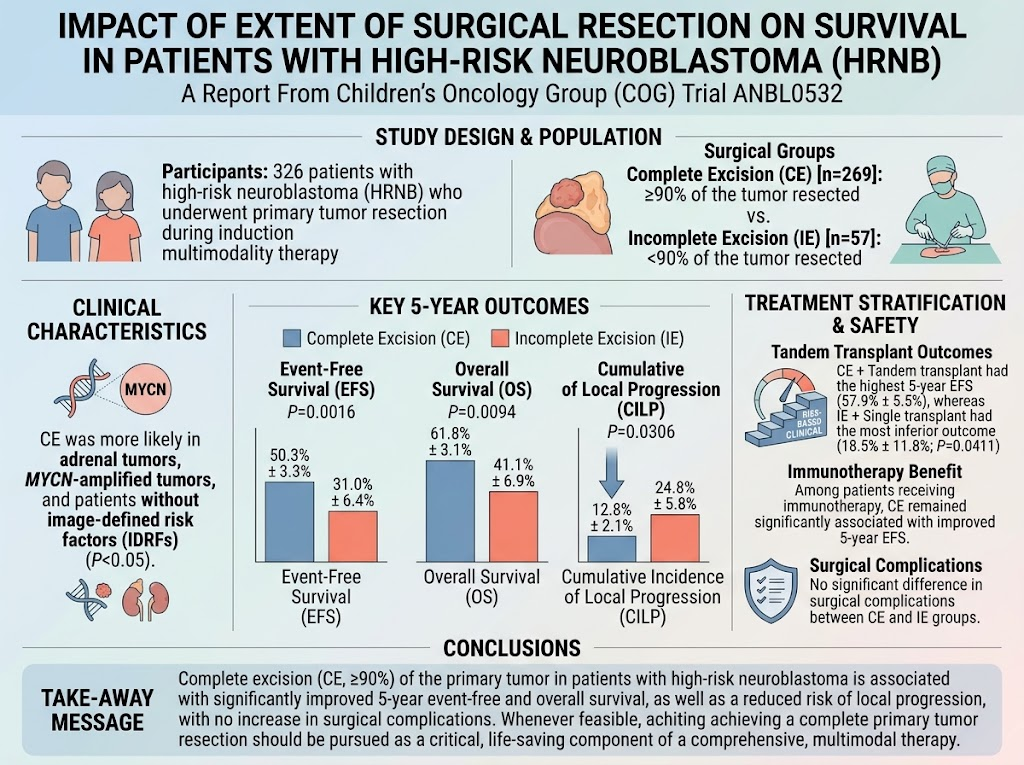
This prospective analysis from the Children’s Oncology Group ANBL0532 trial reports that complete surgical excision (≥90%) of the primary tumor in high-risk neuroblastoma significantly improves event-free survival (EFS) and overall survival (OS) compared to incomplete excision. Complete resection also decreases the cumulative incidence of local progression without increasing surgical complications. The benefit persists across transplant and immunotherapy subgroups, reinforcing the role of aggressive surgical management within multimodal therapy.
Study Background
Neuroblastoma is the most common extracranial solid tumor in children, with high-risk neuroblastoma (HRNB) representing a particularly aggressive subset associated with poor prognosis. Multimodal treatment, comprising intensive chemotherapy, surgery, autologous stem cell transplant, radiation, and immunotherapy, has advanced survival rates over recent decades. However, the optimal extent of surgical resection of the primary tumor remains debated due to concerns about surgical morbidity and the heterogeneous biology of HRNB. Prior retrospective studies suggested a possible survival advantage with more extensive resection but lacked standardized definitions and comprehensive analysis within contemporary multimodal regimens.
Study Design
The COG ANBL0532 was a prospective clinical trial enrolling patients with HRNB who underwent surgical resection during induction therapy. Extent of resection was classified intraoperatively by the surgeon as either complete excision (CE), involving ≥90% tumor removal, or incomplete excision (IE), with less than 90% tumor resected. The primary endpoints were event-free survival (EFS) and overall survival (OS) measured from time of surgery. Secondary endpoints included cumulative incidence of local progression (CILP) and assessment of surgical complications. Additional stratification accounted for autologous stem cell transplant type (single vs. tandem) and receipt of immunotherapy to evaluate interaction effects.
Key Findings
A total of 326 eligible patients were included, with 269 undergoing CE and 57 undergoing IE. Baseline demographics and disease characteristics were generally balanced, though CE was more common in patients with adrenal tumors, MYCN amplification, and absence of image-defined risk factors.
Survival Outcomes: Patients receiving CE had substantially improved 5-year EFS (50.3%±3.3%) compared to the IE group (31.0%±6.4%), with a statistically significant difference (P=0.0016). Similar trends were observed for OS, with CE patients exhibiting 61.8%±3.1% vs. 41.1%±6.9% in the IE group (P=0.0094). These data indicate a strong association between extensive tumor resection and prolonged survival.
Local Control: The 5-year cumulative incidence of local progression was significantly lower in the CE group (12.8%±2.1%) than in the IE group (24.8%±5.8%, P=0.0306), implicating complete tumor excision as critical to reducing local recurrence.
Transplant and Immunotherapy Subgroups: When patients were stratified by both extent of resection and autologous stem cell transplant type, those with CE combined with tandem transplantation had the highest survival rates (5-year EFS 57.9±5.5%), whereas patients with IE and single transplant had inferior outcomes (18.5±11.8%, P=0.0411). Among patients receiving immunotherapy, CE similarly correlated with improved 5-year EFS, underscoring the additive benefits of maximal surgical resection within comprehensive treatment protocols.
Surgical Safety: Importantly, the incidence of surgical complications did not differ significantly between CE and IE groups, suggesting that more aggressive tumor resection can be safely performed without increasing perioperative morbidity.
Expert Commentary
This analysis supports a paradigm where complete primary tumor resection is a key determinant of successful treatment outcomes in HRNB within current multimodal protocols. The prospective design and standardized surgical resection definitions strengthen the evidence beyond prior retrospective studies. Moreover, the absence of increased surgical complications alleviates concerns regarding the safety of aggressive resections in this vulnerable pediatric cohort. However, the study’s reliance on surgeon-determined extent of resection introduces inherent subjectivity, and further validation using objective radiographic or pathological quantification may refine these findings.
Translationally, improved local control from CE may reduce tumor burden that could harbor resistant clones, thereby enhancing systemic therapy effectiveness. Integration with advanced imaging, intraoperative navigation, and expert pediatric surgical teams will be central to safely achieving these outcomes. Future research may also evaluate molecular and biologic predictors of resectability and survival to individualize surgical goals.
Conclusion
This comprehensive prospective analysis from the COG ANBL0532 trial establishes that complete excision of the primary tumor, defined as resection of ≥90%, is associated with significantly improved event-free and overall survival and reduced local progression in children with high-risk neuroblastoma. Importantly, this benefit occurs without increasing surgical complication rates, highlighting that maximal safe resection should be pursued within multimodal treatment frameworks including stem cell transplantation and immunotherapy. These findings provide a compelling clinical framework for surgical decision-making and reinforce surgery’s critical role in optimizing outcomes in high-risk neuroblastoma.
Funding and ClinicalTrials.gov
Funding sources for the COG ANBL0532 trial have been detailed in the original publication. The trial was conducted in accordance with ethical standards and regulatory approvals. ClinicalTrials.gov registration information was not provided in the abstract but may be available in the primary trial documentation.
Reference
Grant CN, Naranjo A, Zhang FF, Diller LR, Brown EG, Geiger JD, Doski JJ, Haas-Kogan DA, Nuchtern JG, Davidoff AM, Park J, DuBois SG, Bagatell R, Lal DR, Newman EA. Impact of Extent of Surgical Resection on Survival in Patients With High-risk Neuroblastoma: A Report From Children’s Oncology Group ANBL0532. Ann Surg. 2026 Oct 7. doi: 10.1097/SLA.0000000000007228. Epub ahead of print. PMID: 42839317.