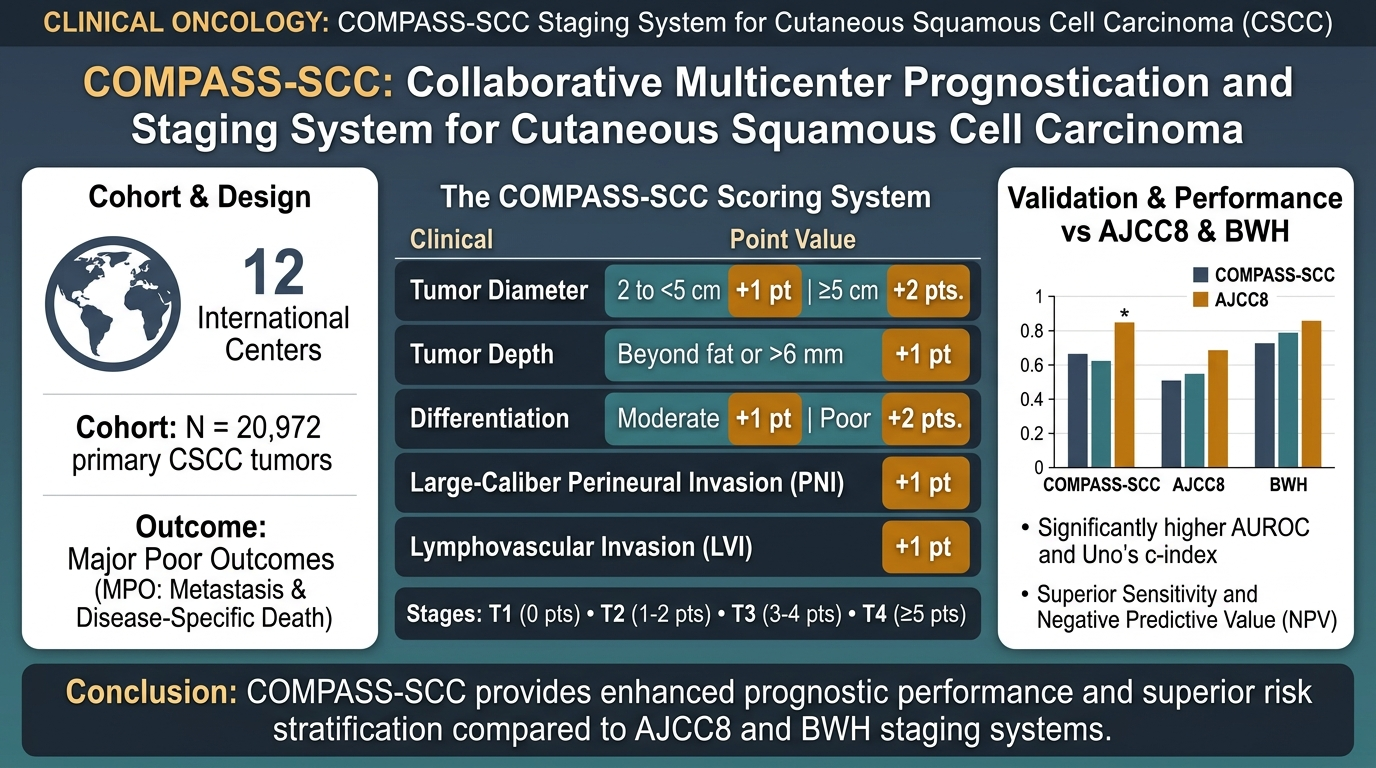
COMPASS-SCC incorporates tumor diameter, depth, differentiation, large-caliber perineural invasion, and lymphovascular invasion into a weighted scoring system.
Developed using a large retrospective database of over 20,000 primary CSCC tumors from 12 international centers.
Demonstrated superior sensitivity, negative predictive value, and prognostic accuracy over AJCC8 and Brigham and Women’s Hospital (BWH) systems.
Improved identification of patients at risk for metastasis or disease-specific death, supporting personalized management strategies.
Study Background
Cutaneous squamous cell carcinoma (CSCC) represents one of the most common types of skin cancer globally, with an increasing incidence related to aging populations and cumulative sun exposure. While most CSCCs are cured by surgery, a subset behaves aggressively with risks of metastasis and disease-specific mortality. Prognostication and appropriate risk stratification are essential for guiding treatment intensity and surveillance.
Currently, the American Joint Committee on Cancer 8th edition (AJCC8) and the Brigham and Women’s Hospital (BWH) staging systems are widely used for CSCC. Nevertheless, these systems have notable limitations. AJCC8 is comprehensive but may lack sensitivity to identify high-risk tumors accurately. The BWH system has a more limited focus but may underperform in certain cohorts. Both approaches rely on somewhat arbitrary thresholds and categorical variables that may not fully capture the spectrum of tumor aggressiveness.
Given the clinical need for an improved staging model that better discriminates risk and supports clinical decision-making, a new model named COMPASS-SCC (Collaborative Multicenter Prognostication and Staging System for CSCC) was developed. This system leverages a large international retrospective dataset to generate a weighted, evidence-based staging approach.
Study Design
The investigators conducted a retrospective multicenter cohort study, aggregating data from 12 international institutions. The database included 20,972 primary CSCC tumors with detailed clinical, histopathological, and outcome information.
Risk factors potentially predictive of major poor outcomes (MPO)—defined as metastasis or disease-specific death—were assessed using univariable and multivariable Fine and Gray competing risk models. Candidate variables included tumor diameter, depth, differentiation grade, perineural invasion (with a focus on large-caliber nerves), and lymphovascular invasion.
Following statistical modeling, variables with significant independent prognostic value were assigned weighted points based on effect size to formulate the COMPASS-SCC scoring system.
Comparative performance metrics, including sensitivity, specificity, positive and negative predictive values (PPV/NPV), area under the receiver operating characteristic curve (AUROC), and Uno’s concordance index (c-index), were calculated for COMPASS-SCC with benchmark comparison to AJCC8 and BWH systems.
Key Findings
COMPASS-SCC utilizes a point-based scoring system incorporating:
– Tumor diameter: 1 point for ≥2 cm but 6 mm or invasion beyond fat
– Differentiation: 1 point for moderate; 2 points for poor differentiation
– Perineural invasion (large-caliber nerves): 1 point
– Lymphovascular invasion: 1 point
Stages are assigned based on total points:
– T1: 0 points
– T2: 1-2 points
– T3: 3-4 points
– T4: ≥5 points
Performance metrics showed that COMPASS-SCC had significantly higher sensitivity and negative predictive value for MPO than AJCC8 and BWH. Furthermore, AUROC and Uno’s c-index metrics demonstrated superior discriminatory ability of COMPASS-SCC to predict metastasis and disease-specific death.
These improved prognostic measures suggest that COMPASS-SCC can more accurately identify patients at heightened risk who may benefit from intensified therapy or closer monitoring, as well as reliably recognize low-risk patients suitable for standard treatment.
Expert Commentary
The development of COMPASS-SCC represents a significant step forward in the personalized management of cutaneous squamous cell carcinoma. By quantitatively weighting multiple histologic and clinical risk factors, COMPASS-SCC moves beyond categorical staging to a more nuanced risk stratification that reflects real-world tumor behavior.
While retrospective, the study’s large cohort and international representativeness add validity. However, prospective validation in independent cohorts and assessment of clinical utility in treatment decision algorithms remain essential next steps.
COMPASS-SCC also highlights the importance of integrating histopathologic variables such as lymphovascular and perineural invasion in staging, which are recognized predictors of aggressive CSCC but sometimes underutilized in traditional models.
Current guideline bodies may consider incorporating findings from COMPASS-SCC into future editions to optimize patient outcomes.
Conclusion
COMPASS-SCC is a novel, evidence-based staging system for cutaneous squamous cell carcinoma that outperforms AJCC8 and BWH in prognostic accuracy. With improved sensitivity and predictive performance, it offers a robust tool for clinicians to stratify CSCC risk, inform management strategies, and potentially improve patient outcomes. Further prospective validation and integration into clinical workflows will be critical.
Funding and ClinicalTrials.gov
The study was supported through institutional resources and collaborative database efforts; no specific funding or clinical trial registration was declared.
References
1. Shahwan KT, Voller LM, Jairath NK, et al. Collaborative Multicenter Prognostication and Staging System for Cutaneous Squamous Cell Carcinoma (COMPASS-SCC). J Am Acad Dermatol. 2026 Oct 1; PMID: 42822770.
2. National Comprehensive Cancer Network. NCCN Clinical Practice Guidelines in Oncology: Squamous Cell Skin Cancer. Version 2.2024.
3. Alam M, Armstrong A, Baum C, et al. Guidelines of care for the management of cutaneous squamous cell carcinoma. J Am Acad Dermatol. 2018;78(3):560-578.
4. Karia PS, Han J, Schmults CD. Cutaneous squamous cell carcinoma: estimated incidence of disease, nodal metastasis, and deaths from disease in the United States, 2012. J Am Acad Dermatol. 2013;68(6):957-966.