Highlight
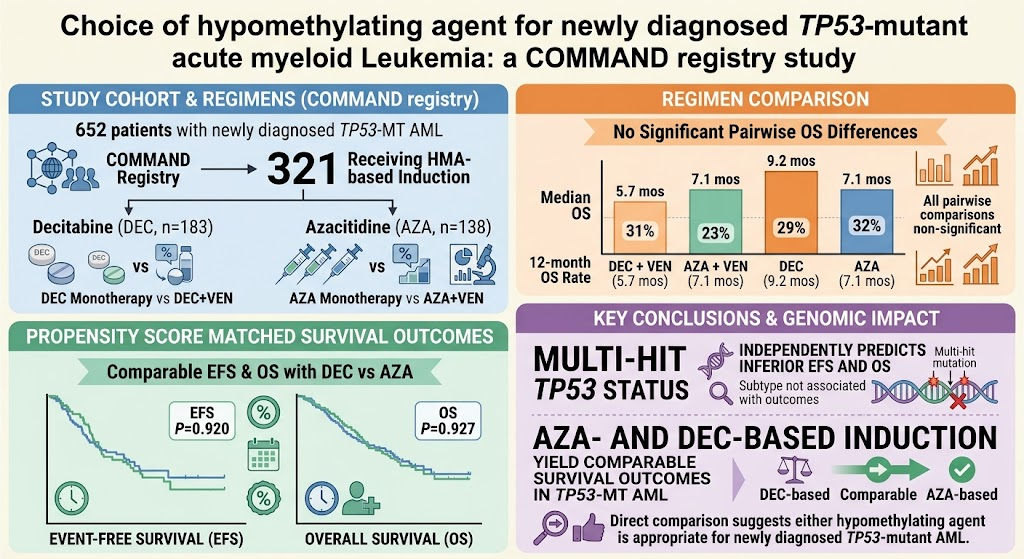
- No significant survival differences found between azacitidine and decitabine-based induction therapies in TP53-mutant AML.
- Multi-hit TP53 mutation status independently predicts poorer event-free and overall survival.
- Combination therapy with venetoclax did not significantly improve survival over hypomethylating agents alone in this cohort.
- This large, multicenter retrospective study offers real-world evidence guiding treatment choices in a genomically high-risk AML subset.
Study Background
Acute myeloid leukemia (AML) characterized by TP53 mutations (TP53-MT AML) represents a highly aggressive and treatment-refractory subgroup with poor prognosis. TP53 mutations confer resistance to conventional chemotherapy and associate with complex cytogenetics and genomic instability. The advent of hypomethylating agents (HMAs)—azacitidine (AZA) and decitabine (DEC)—has provided therapeutic options, but their comparative efficacy in TP53-MT AML remains unclear. Some prior studies suggest DEC may achieve deeper molecular clearance and higher response rates, but robust comparative data are lacking, particularly when combined with the BCL-2 inhibitor venetoclax (VEN), which has transformed frontline therapy in AML. Against this backdrop, elucidating optimal HMA choice is critical for improving management and outcomes in this genetically defined subset.
Study Design
The COMMAND registry study is a large multicenter retrospective analysis involving 652 newly diagnosed patients with TP53-mutant AML. Among these, 321 patients received HMA-based induction therapy: 183 treated with decitabine and 138 with azacitidine. Treatment regimens included monotherapy as well as combinations with venetoclax. Baseline clinical and genomic characteristics—including mutation subtype and multi-hit TP53 status—were well balanced between groups. The primary endpoints were event-free survival (EFS) and overall survival (OS). Additional analyses assessed molecular subtypes and multi-hit mutation impact. Propensity score matching was employed to minimize confounding and allow more accurate comparisons between DEC- and AZA-based treatments.
Key Findings
1. Survival Outcomes: In the propensity-matched cohort, no significant differences were observed in median EFS or OS between DEC- and AZA-based induction. Median EFS ranged from 3.4 to 5.9 months and median OS ranged from 5.7 to 9.2 months across treatment groups. Specifically, median EFS was 5.1 months with DEC plus VEN, 3.4 with AZA plus VEN, 5.9 with DEC alone, and 5.6 with AZA alone. Median OS was 5.7, 7.1, 9.2, and 7.1 months, respectively. The 12-month survival estimates were similarly comparable, with no statistically significant pairwise differences identified.
2. TP53 Mutation Subtype and Multi-hit Status: The type of TP53 mutation (subtype) did not correlate with outcomes. However, multi-hit TP53 status, characterized by multiple allelic hits or loss of heterozygosity, was independently associated with significantly inferior EFS and OS, highlighting its strong negative prognostic impact. This confirms accumulating evidence that multi-hit mutations represent a distinct biologic subset with worse clinical trajectory.
3. Impact of Venetoclax Addition: Contrary to expectations from broader AML populations, adding venetoclax to HMA therapy did not translate into significant survival advantages in this TP53-MT cohort. While venetoclax combinations have revolutionized AML treatment, their benefit in TP53-mutated disease remains limited, underscoring the need for novel therapeutic approaches for this subgroup.
4. Safety and Tolerability: Although detailed toxicity data were not reported, the retrospective design captured real-world clinical use, suggesting comparable tolerability profiles enabling outpatient administration of HMAs in this frail population.
Expert Commentary
The COMMAND registry study provides valuable real-world evidence addressing a critical knowledge gap in TP53-mutant AML management. The equivalence of AZA and DEC-based regimens contrasts with some earlier reports favoring DEC, highlighting the importance of evaluating larger, well-matched cohorts with contemporary co-treatments like venetoclax.
Mechanistically, while DEC has been posited to induce more effective hypomethylation and TP53 molecular clearance, this large dataset did not translate those effects into meaningful survival differences. This may reflect the dominant adverse biology conferred by TP53 mutations and the overwhelming impact of multi-hit status, which remains resistant to current HMA strategies.
Limitations include the retrospective design, potential residual confounding despite propensity matching, and lack of detailed molecular response or minimal residual disease data. Prospective randomized trials focusing on TP53-mutant AML remain essential to definitively guide therapy choices. Additionally, novel agents and combinations exploiting synthetic lethality or immunotherapy approaches should be explored given the poor outcomes observed.
Conclusion
In summary, this rigorous multicenter analysis indicates that azacitidine and decitabine provide comparable survival outcomes in newly diagnosed TP53-mutant AML, regardless of venetoclax co-administration. Multi-hit TP53 mutation status emerges as a crucial prognostic biomarker identifying patients with particularly poor prognosis. These findings inform clinical decision-making by supporting flexibility in HMA choice and highlighting the urgent need for more effective therapeutic modalities targeting TP53-mutated AML.
Future research should focus on prospective validation, integration of molecular response monitoring, and development of targeted treatments to improve outcomes in this challenging AML subset.
Funding and Clinical Trials
The study was conducted using data from the COMMAND registry, supported by participating academic institutions and cancer centers specializing in hematologic malignancies. There was no indication of specific trial registration. The authors acknowledge the need for ongoing clinical trials investigating novel agents tailored for TP53-mutant AML.
References
- Badar T, Foran J, Jamy O, Lin C, et al. Choice of hypomethylating agent for newly diagnosed TP53-mutant acute myeloid Leukemia: a COMMAND registry study. Leukemia. 2026 Aug 31. PMID: 42675141.
- Döhner H, et al. Diagnosis and management of AML in adults: 2017 ELN recommendations. Blood. 2017 Jan 26;129(4):424-447.
- Bernard E, et al. TP53 mutations in AML: detection and prognostic implications. Blood Adv. 2020;4(2):236-244.
- DiNardo CD, et al. Venetoclax combined with hypomethylating agents in AML. N Engl J Med. 2020 Jan;383(7):617-627.
- Boultwood J. Epigenetic therapies in AML: a focus on TP53 mutated AML. Leukemia. 2021;35(7):1876-1884.