Highlight
- The University of California, Irvine Corneal Cystine Crystal Score (UCI CCCS) demonstrates excellent inter-rater reliability for slit-lamp grading of corneal cystine crystals.
- UCI CCCS grades significantly correlate with objective corneal densitometry measurements and patient-reported symptoms such as photophobia, foreign body sensation, and dryness.
- Best-corrected visual acuity (BCVA) does not show a significant association with UCI CCCS grades, highlighting the dissociation between crystal burden and visual function.
- Topical cysteamine treatment status showed no significant difference in UCI CCCS or corneal densitometry, underscoring the need for longitudinal studies.
Study Background
Cystinosis is a rare, autosomal recessive lysosomal storage disorder characterized by pathologic accumulation of cystine crystals in many organs, including the cornea. Corneal cystine crystal deposition leads to ocular discomfort and photophobia and, in severe cases, may compromise corneal clarity and visual function. Therapeutic approaches, primarily involving topical cysteamine, aim to reduce crystal burden and symptomatology. However, standardized, reproducible clinical tools to grade corneal crystal deposits objectively and relate these assessments to patient outcomes have been lacking. The University of California, Irvine Corneal Cystine Crystal Score (UCI CCCS) was developed as a simplified slit-lamp-based clinical grading scale to quantify crystal density, yet its validation against objective imaging and symptom measures remained to be established in real-world clinical settings. This study addresses this gap by prospectively validating the UCI CCCS in a large cystinosis cohort, examining its associations with Scheimpflug-based corneal densitometry, patient-reported ocular symptoms, and visual acuity measures, providing critical evidence for its practical utility in clinical care and research trials.Study Design
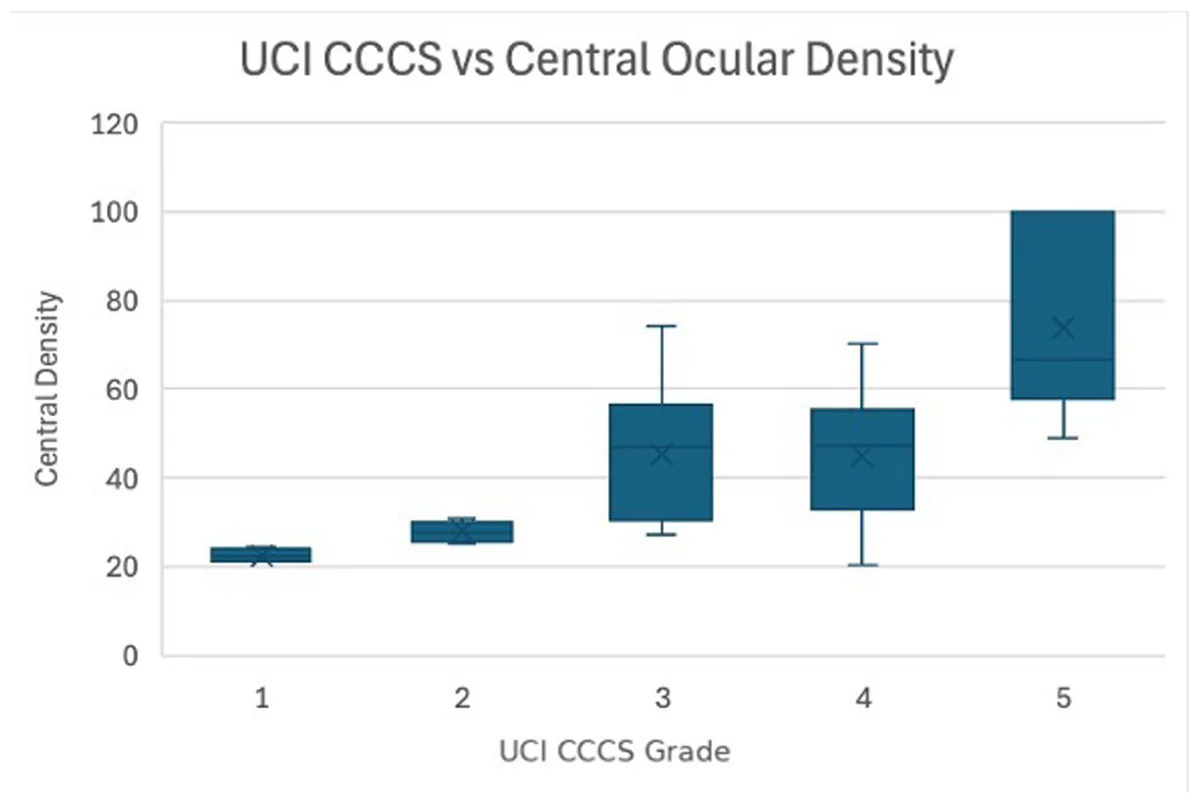
This was a prospective, observational cross-sectional study conducted at the 2024-2025 Cystinosis Research Foundation Day of Hope Clinics. Seventy patients with genetically or biochemically confirmed cystinosis were enrolled, contributing 140 eyes. Examinations included live slit-lamp grading using the UCI CCCS on a 0–5 scale. Corneal densitometry was measured by Pentacam Scheimpflug imaging in 68 eyes, providing objective quantification of corneal light backscatter in central and anterior corneal layers. Two ophthalmologists independently graded patients during the 2025 clinic to assess inter-rater reliability. Patient-reported symptom data—encompassing photophobia, foreign body sensation, and ocular dryness—were collected using standardized questionnaires. Best-corrected visual acuity (BCVA) was measured using standardized protocols. Data regarding topical cysteamine treatment were also gathered. Statistical analyses involved linear mixed-effects models adjusting for inter-eye correlation and Kendall’s tau-b tests for symptom associations.Key Findings
Inter-rater Reliability of UCI CCCS
The UCI CCCS demonstrated an exceptionally high inter-rater reliability, with an intraclass correlation coefficient (ICC) of 0.995 (95% CI 0.992–0.996). This robustness indicates the tool’s reproducibility and supports its suitability for clinical and research use requiring consistent grading between observers.Correlation with Corneal Densitometry
Linear mixed-effects modeling revealed significant positive associations between UCI CCCS scores and corneal densitometry readings focusing on the central cornea (p=0.0016) and anterior corneal layers (p=0.0011), confirming that higher clinical grades correspond to increased corneal crystal-related light scattering. This validates the UCI CCCS against an advanced objective imaging biomarker.Symptom Correlates
Patient-reported ocular symptom burdens correlated moderately to strongly with UCI CCCS grades. Photophobia showed the strongest association (Kendall’s τ=0.397, p<0.0001), while foreign body sensation (τ=0.295, p=0.0047) and ocular dryness (τ=0.405, p=0.0001) were also significantly linked to higher crystal scores. These findings emphasize the clinical relevance of UCI CCCS grades in reflecting symptomatology.Visual Acuity and Treatment Status
No statistically significant relationship was detected between UCI CCCS grades and BCVA once accounting for within-patient eye correlations (p=0.4389). Additionally, topical cysteamine treatment status did not produce significant differences in either UCI CCCS grades or densitometry values, suggesting the need for longitudinal data to evaluate treatment response.Expert Commentary
The current study robustly confirms the UCI CCCS as a reliable and valid clinical grading measure for corneal cystine crystal deposits in cystinosis. Its excellent inter-rater reliability and correlation with objective imaging and symptom outcomes enhance its potential for widespread clinical adoption and use as a standardized endpoint in clinical trials. The disconnect between CCCS grade and BCVA aligns with other literature highlighting that corneal crystal burden primarily affects comfort and light scatter rather than central visual acuity—important for patient counseling and research design. The lack of discernable impact of topical cysteamine treatment on cross-sectional crystal measures underscores the complexity of treatment monitoring and the need for prospective longitudinal studies incorporating serial imaging and symptom tracking. Limitations include the cross-sectional design limiting evaluation of temporal changes and treatment effects, potential selection bias from specialty clinic sampling, and the reliance on subjective symptom reports. Nonetheless, the UCI CCCS offers a practical, low-cost approach that can be implemented without sophisticated imaging, expanding accessibility in diverse clinical settings.Conclusion
The University of California, Irvine Corneal Cystine Crystal Score (UCI CCCS) is validated as a highly reproducible and clinically meaningful grading tool in cystinosis-related corneal crystal disease. It significantly correlates with objective corneal densitometry measures and patient-reported symptoms but does not correlate with visual acuity. Its practical application in routine clinical settings and trials can facilitate standardized monitoring and better symptom correlation. Future longitudinal and interventional studies are warranted to establish its responsiveness to therapeutic agents such as topical cysteamine and its prognostic implications for patient outcomes.Funding and Registration
This study was supported by the Cystinosis Research Foundation. No clinicaltrials.gov registration number was reported.References
1. Rezaei K, Crook T, Shah J, et al. Validation of the University of California, Irvine Corneal Cystine Crystal Score (UCI CCCS): Correlations with Clinical, Imaging, and Symptom Outcomes in Cystinosis. Am J Ophthalmol. 2026 Oct 26; PMID: 42933522. 2. Gahl WA, Thoene JG, Schneider JA. Cystinosis. N Engl J Med. 2002 Apr 25;346(10):677-86. 3. Langford MP, Carr JJ, Donahue S, et al. Corneal cystine crystal evaluation in nephropathic cystinosis: comparison of slit-lamp and confocal microscopy findings. Ophthalmology. 2018 Nov;125(11):1674-1681. 4. Kleta R, Bernardini I, Ueda M, et al. Serendipity and Cystinosis: A Review of Advances in Cystinosis Management. Pediatr Nephrol. 2017;32(2):239-248.Specialty calculators
For clinical reference; use professional judgment.