Highlight
– Psychosocial stress diminishes vocal fold epithelial adherens junctions and mucin protein expression, impairing barrier function.
– This epithelial barrier dysfunction occurs regardless of presence or absence of microbiota.
– Presence of microbiota is associated with increased epithelial proliferation in response to stress, indicating a microbial role in adaptive epithelial repair.
– These findings provide a basis for exploring probiotic therapies targeting vocal fold epithelial health under stress.
Study Background
Voice disorders affect a substantial portion of the population, with up to 25% of affected patients reporting concomitant psychosocial stress. Recent insights link stress exposure to laryngeal microbiome dysbiosis, paralleling findings in other organ systems where microbial imbalance contributes to epithelial barrier disruption and disease pathophysiology. The vocal fold (VF) epithelium, critical for phonation and airway protection, may be particularly vulnerable to stress-modulated changes. However, the distinct roles of microbial presence versus direct nonmicrobial stress pathways on VF epithelial integrity remain poorly understood. This gap limits targeted therapeutic development, especially in tailoring microbiome-based interventions for voice disorders influenced by stress.
Study Design
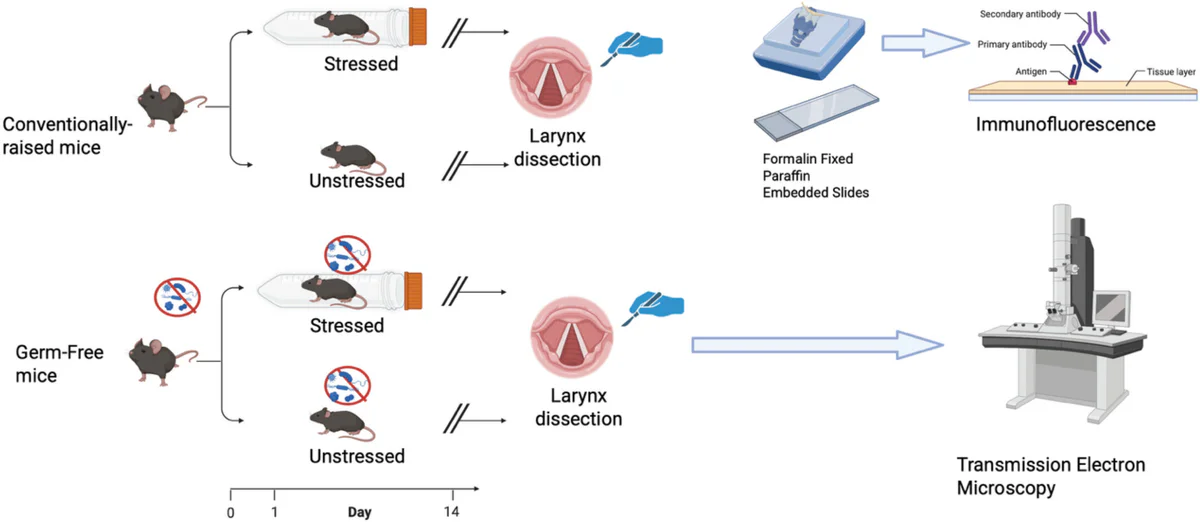
This preclinical study utilized adult C57BL/6 mice either conventionally raised (CR) with normal microbiota or maintained germ-free (GF) to examine microbiota-dependent effects. Each group (n=32 per mouse type) was evenly divided into stressed and unstressed cohorts. The stress paradigm comprised a validated restraint stress protocol to mimic psychosocial stress. Following stress induction, larynges were harvested for histological, immunofluorescence, and ultrastructural analyses. Outcomes assessed included expression of epithelial adherens junction proteins (critical for cell-cell adhesion), mucin (MUC1, MUC4) levels essential for mucosal barrier function, cell proliferation markers in mid-membranous vocal fold tissue, and ultrastructural epithelial permeability by transmission electron microscopy.
Key Findings
Epithelial Barrier Dysfunction Independent of Microbiota: Both CR and GF stressed mice demonstrated significantly decreased expression of adherens junction proteins and mucins MUC1 and MUC4 compared to their unstressed counterparts. Electron microscopy revealed increased VF epithelial permeability with disrupted cellular junctions under stress in both groups, indicating that epithelial barrier breakdown is driven primarily by stress, independent of microbial colonization.
Microbiota-Dependent Epithelial Proliferation: Notably, a significant increase in epithelial proliferation was observed only in stressed CR mice, whereas GF stressed mice did not demonstrate this proliferative response. This suggests that the presence of microbiota modulates the VF epithelial reparative or adaptive proliferative capacity following stress-induced epithelial injury.
The data imply that stress disrupts barrier function universally, but microbiota presence may facilitate compensatory epithelial regeneration, potentially preserving mucosal integrity over time. This proliferative response could be an adaptive mechanism triggered by microbial signaling or cross-talk not present in GF conditions.
Expert Commentary
These findings emphasize a dual-pathway model for stress-induced vocal fold epithelial injury: a direct stress-mediated epithelial barrier compromise and a microbiota-modulated proliferative response. While the animal model provides mechanistic clarity, extrapolation to human VF physiology warrants cautious interpretation given species differences and controlled laboratory conditions.
Limitations include the absence of detailed microbiome characterization and functional analyses of immune mediators that may bridge stress, microbiota, and epithelial responses. Future research should incorporate longitudinal studies, microbiome sequencing, and modulation experiments to delineate causal microbial species and their metabolites. Clinically, these insights advocate for incorporating microbiome-targeted strategies such as probiotics or microbiota-preserving therapeutics in patients with stress-related voice disorders.
Conclusion
This study elucidates that psychosocial stress compromises vocal fold epithelial barrier integrity regardless of microbial status, with microbiota uniquely enhancing epithelial proliferative repair responses. These findings underscore the integral role of laryngeal microbiota in modulating epithelial resilience to stress-induced damage, positioning the microbiome as a promising therapeutic target. Advancing probiotic-based interventions holds potential to improve mucosal health and clinical outcomes in voice disorders associated with psychosocial stress.
Funding and Trials Information
No specific funding or clinical trial registration was reported for this study.
References
1. Venkatraman A, Jacobs K, Thibeault SL. Comparison of Stress-Mediated Vocal Fold Epithelial Effects in Conventionally-Raised and Germ-Free Mice. The Laryngoscope. 2026 Oct 21. PMID: 42907181.
2. Gill SR, Pop M, Deboy RT, Eckburg PB, Turnbaugh PJ, et al. Metagenomic analysis of the human distal gut microbiome. Science. 2006;312(5778):1355-1359.
3. Kelly JR, Borre Y, O’Brien C, Patterson E, El Aidy S, et al. Transferring the blues: Depression-associated gut microbiota induces neurobehavioural changes in the rat. J Psychiatr Res. 2016;82:109-118.
Specialty calculators
For clinical reference; use professional judgment.