Highlight
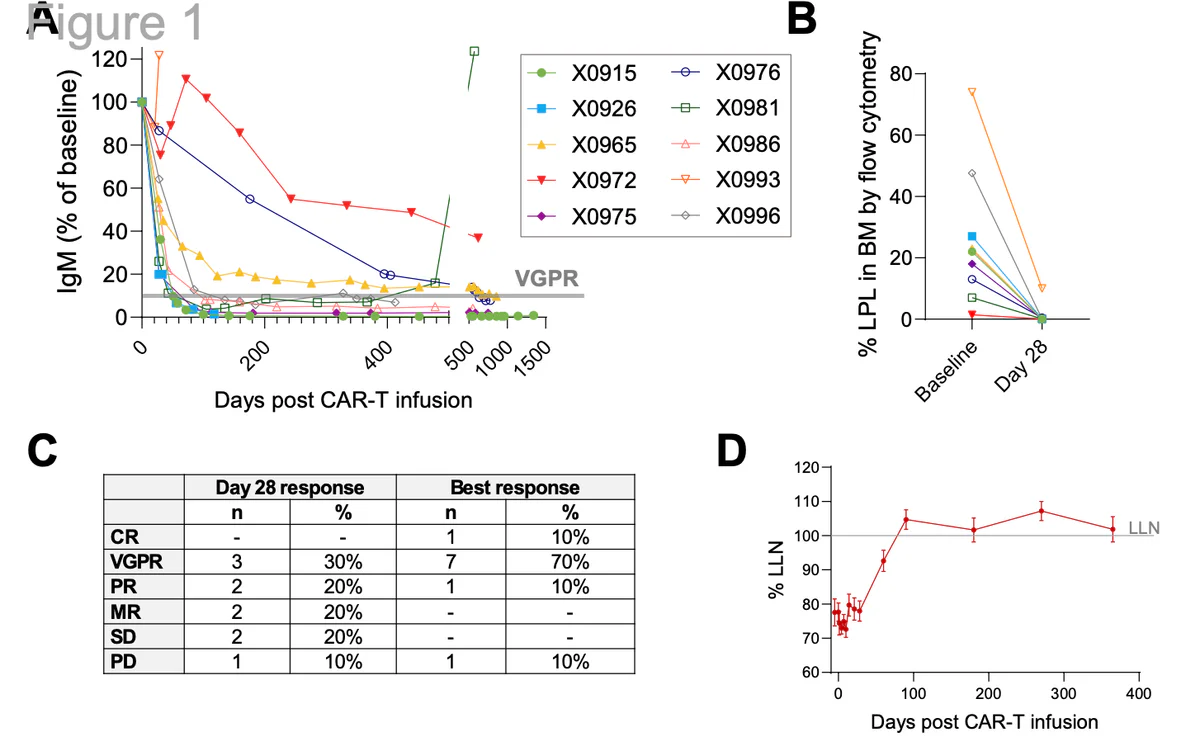
- CD20-directed autologous CAR T-cell therapy demonstrates a high overall deep response rate (CR/VGPR of 80%) in heavily pretreated, BTKi-refractory Waldenström macroglobulinemia (WM) patients.
- No CAR T-cell therapy currently holds regulatory approval for WM; this study represents a key step in advancing targeted cellular therapies for this rare lymphoma subtype.
- The favorable safety profile supports further evaluation of this novel immunotherapeutic approach in larger clinical trials.
Study Background
Waldenström macroglobulinemia (WM) is a rare, indolent B-cell lymphoma characterized by bone marrow infiltration with lymphoplasmacytic cells and secretion of monoclonal IgM. Patients often face a relapsing-remitting course and limited curative options. Key therapeutic advances include Bruton’s tyrosine kinase inhibitors (BTKi), which target a key intracellular signaling pathway. However, resistance to BTKi develops in many patients, and those with BTKi-refractory disease have poor prognoses and limited treatment alternatives.
Chimeric antigen receptor T-cell (CAR T) therapy, an approach redirecting autologous patient T cells to target cancer-specific antigens, has transformed management in certain B-cell malignancies. CD19-directed CAR T-cell therapies have been approved in diffuse large B-cell lymphoma and mantle cell lymphoma, but no CAR T therapies are yet approved for WM, and data remain sparse. CD20 is a well-established B-cell surface marker and therapeutic target in WM, making it a compelling candidate antigen for CAR T-cell targeting.
Study Design
This study evaluated the safety and efficacy of autologous CD20-directed CAR T-cell therapy in heavily pretreated, BTKi-refractory WM patients enrolled in a clinical trial registered as NCT03277729. Patients had received multiple prior therapies and demonstrated progression despite BTKi treatment. Following leukapheresis, T cells were genetically modified ex vivo to express anti-CD20 CAR constructs and expanded before reinfusion.
Key endpoints included overall response rate (ORR), specifically rates of complete remission (CR) or very good partial response (VGPR), safety profiles, and durability of responses. Adverse events related to cytokine release syndrome (CRS) and neurotoxicity were monitored carefully, given their prominence in CAR T therapy experiences in other hematologic malignancies.
Key Findings
The study reported an impressive combined CR/VGPR rate of 80% in this difficult-to-treat population, indicating deep and meaningful disease control. This response rate compares favorably to existing salvage options for BTKi-refractory WM, suggesting a potent anti-lymphoma effect of the CD20-directed CAR T cells.
Safety assessments revealed a manageable toxicity profile with no unexpected serious adverse events. The incidence and severity of CRS and neurotoxicity were consistent with other CAR T-cell therapies in B-cell malignancies and were successfully managed with established interventions.
These results suggest that targeting CD20 with engineered autologous T cells is feasible, effective, and tolerable, even in patients with prior extensive therapies and disease refractory to BTKi, a class crucial in WM management.
Comparisons and Context
Though CD19-directed CAR T therapies have shown efficacy in various B-cell lymphomas, CD20 targeting in WM might offer distinct advantages due to antigen expression patterns. These findings complement prior early-phase studies exploring CAR T in WM and provide a rationale for comparative trials.
Expert Commentary
Experts recognize the unmet clinical need in BTKi-refractory WM, a setting with limited novel therapeutic options. Dr. Shadman et al’s work underscores the potential of precision immunotherapy using CAR T cells outside of more common lymphomas. The 80% deep response rate is notably encouraging and suggests durable remissions may be achievable. Ongoing investigations should assess long-term outcomes, including progression-free and overall survival, and define biomarkers predictive of response.
Potential limitations include the small sample size and absence of comparator arms. Additionally, the manufacturing complexity and costs of CAR T therapy need consideration for broader implementation. Future studies should address these challenges and explore combination approaches with BTKi or other agents.
Conclusion
CD20-directed autologous CAR T-cell therapy represents a promising new frontier for patients with BTKi-refractory Waldenström macroglobulinemia, demonstrating a high rate of deep responses and manageable safety in this heavily pretreated cohort. These findings warrant larger multicenter trials to confirm efficacy, optimize dosing, and evaluate durability of benefit. This advancing immunotherapeutic avenue may ultimately improve long-term outcomes and quality of life in a historically difficult-to-treat population.
Funding and Clinical Trial Registration
This study was registered under ClinicalTrials.gov identifier NCT03277729. Funding sources were not specified in the abstract but can be retrieved from the full publication for detailed acknowledgment.
References
- Shadman M, Redman MW, Lee SY, et al. CD20-directed Autologous CAR T-cell Therapy for Waldenström Macroglobulinemia. Blood. 2026 Nov 5. PMID: 42986912; URL: https://pubmed.ncbi.nlm.nih.gov/42986912/
- Treon SP, Xu L, Yang G, et al. MYD88 L265P somatic mutation in Waldenström’s macroglobulinemia. N Engl J Med. 2012;367(9):826-33.
- Lin YC, Lee JW, Ziemba M, et al. Clinical outcomes of BTK inhibitor therapy in Waldenström macroglobulinemia. Leuk Lymphoma. 2021;62(12):2940-2949.
- Neelapu SS, Locke FL, Bartlett NL, et al. Axicabtagene Ciloleucel CAR T-cell Therapy in Refractory Large B-Cell Lymphoma. N Engl J Med. 2017;377(26):2531-2544.
Specialty calculators
For clinical reference; use professional judgment.