Highlight
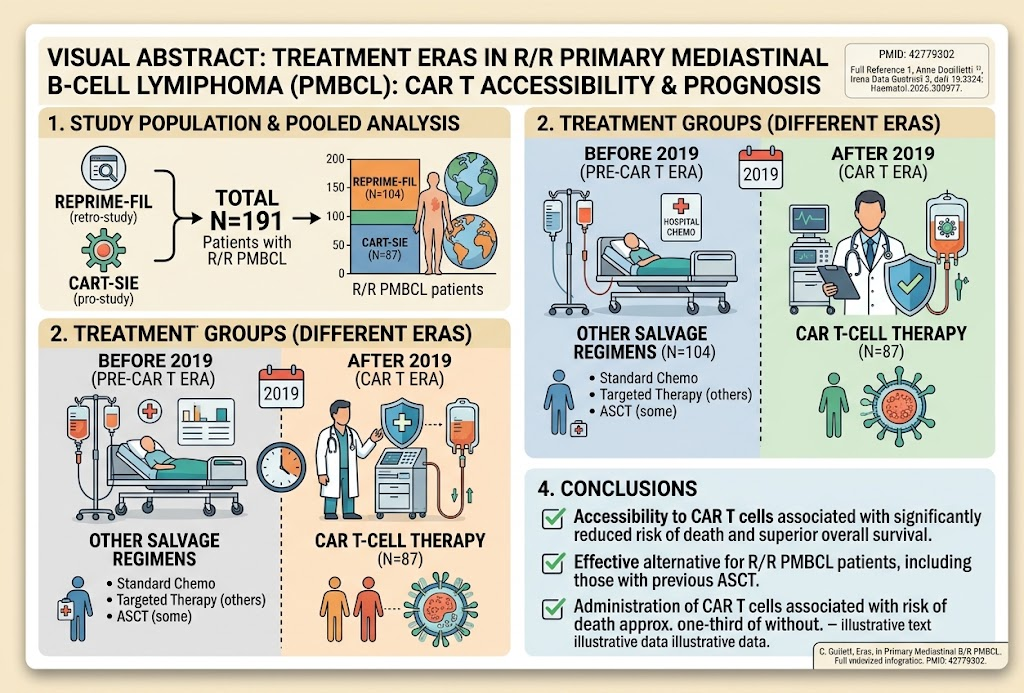
– CAR T-cell therapy targeting CD19 significantly improves overall survival (OS) in relapsed/refractory primary mediastinal B-cell lymphoma (R/R PMBCL) patients compared to historical salvage treatments.
– A robust pooled analysis of 191 patients integrating prospective CART-SIE and retrospective REPRIME-FIL cohorts revealed a 3-year OS of 62% across all R/R PMBCL patients.
– Landmark analyses demonstrated CAR T-treated patients had nearly a 70% reduction in risk of death versus those receiving other salvage therapies, including autologous stem cell transplant (ASCT).
– This real-world evidence suggests that access to CAR T therapies reflects a new treatment era with substantially better prognosis for R/R PMBCL patients.
Study Background
Primary mediastinal B-cell lymphoma (PMBCL) is an aggressive subtype of diffuse large B-cell lymphoma that primarily affects young adults and carries distinct biological and clinical features. While frontline chemoimmunotherapy achieves remission in many patients, approximately 10-20% develop relapsed or refractory (R/R) disease, which historically portends poor outcomes. Conventional salvage therapies often comprise high-dose chemotherapy followed by autologous stem cell transplantation (ASCT); however, durable responses remain limited for R/R PMBCL.
Chimeric antigen receptor (CAR) T-cell therapy, a groundbreaking immunotherapeutic approach harnessing genetically engineered T cells directed against CD19, has shown promising activity in various B-cell lymphomas. Its role in R/R PMBCL, a distinct clinical entity, is under growing investigation. Despite encouraging efficacy reported in trials, comparative effectiveness against standard salvage regimens in real-world settings remains incompletely defined. This study aims to address that knowledge gap by directly comparing survival outcomes among R/R PMBCL patients treated with CAR T cells versus other salvage approaches, stratified by treatment era reflective of treatment accessibility.
Study Design
This analysis pooled patient-level data from two multi-institutional studies: the ongoing prospective CART-SIE observational study and the retrospective REPRIME-FIL study. Both cohorts included patients with confirmed relapsed or refractory PMBCL following first-line therapy failure. The combined dataset comprised 191 patients, with 87 receiving CD19-targeted CAR T-cell therapy after 2019—marking the era of CAR T availability—and 104 treated with various salvage regimens prior, including chemotherapy and ASCT.
The primary endpoint was overall survival (OS) from the time of first-line treatment failure. Secondary analyses employed landmark approaches at six months post-failure to mitigate immortal time bias, comparing the risk of death between CAR T-cell recipients and those receiving other salvage therapies. Adjusted hazard ratios accounted for baseline clinical characteristics, with subgroup analyses evaluating outcomes relative to ASCT recipients within the historical cohort.
Key Findings
The pooled cohort exhibited a 3-year OS of 62% (95% confidence interval [CI], 55%-69%) following first-line treatment failure, underscoring the clinical challenges in managing R/R PMBCL.
The pivotal finding was a significantly improved OS among patients receiving CAR T-cell therapy compared to other salvage programs. In the 6-month landmark analysis, CAR T-cell treated patients had an adjusted hazard ratio (HR) for death of 0.34 (95% CI, 0.17-0.66; p=0.001), indicating a roughly 66% reduction in mortality risk versus non-CAR T therapies.
Furthermore, when comparing CAR T recipients specifically to the subset of REPRIME patients undergoing ASCT, CAR T therapy was associated with a superior OS (adjusted HR 0.27; 95% CI, 0.13-0.66; p=0.001). This suggests that CAR T cells may offer greater survival benefit over the current standard salvage approach of ASCT in R/R PMBCL.
While safety profiles were not detailed in the pooled analysis, existing literature on CAR T-cell therapy indicates a manageable toxicity spectrum with appropriate monitoring.
These results affirm that access to CAR T cells, reflecting advancement in therapeutic options post-2019, correlates with a paradigm shift in prognosis and survival for patients with R/R PMBCL, potentially transforming the salvage treatment landscape.
Expert Commentary
This pooled analysis provides one of the first direct comparative assessments of CAR T-cell therapy versus conventional salvage regimens in R/R PMBCL, strengthening the evidence base supporting CAR T as a preferable salvage option. The substantial survival benefit observed aligns with evolving clinical guidelines endorsing CAR T therapy for eligible relapsed B-cell lymphoma patients refractory to conventional salvage.
However, it is important to acknowledge inherent limitations of a pooled cohort combining prospective and retrospective data, including potential selection bias, heterogeneity in follow-up, and unmeasured confounders. Additionally, toxicity and quality-of-life outcomes require further elucidation in larger prospective trials.
Mechanistically, CAR T cells directly target malignant B cells via CD19, overcoming resistance mechanisms to chemotherapy and ASCT, thus offering durable immunologic control. The improvement in OS reported here provides clinical validation of this therapeutic principle in the challenging R/R PMBCL setting.
Conclusion
In summary, the integration of CAR T-cell therapy into salvage treatment of R/R PMBCL represents a significant advance that markedly improves overall survival compared to traditional salvage regimens, including ASCT. The findings from this pooled analysis of the REPRIME-FIL and CART-SIE studies underscore the critical importance of treatment accessibility to CAR T cells, translating into substantial prognostic gains.
Future research should focus on optimizing patient selection, managing CAR T-related toxicities, and exploring combinational strategies to further enhance outcomes. Meanwhile, health systems should prioritize equitable access to CAR T therapies to ensure that patients with this aggressive lymphoma subtype benefit from these life-extending innovations.
Funding and ClinicalTrials.gov
Details on funding sources and clinical trial registrations were not explicitly provided in the source article. However, the contributing studies are associated with multicenter consortia in Europe and likely supported by institutional and national research grants.
References
1. Guidetti A, Dogliotti I, Chiappella A, et al. Different treatment eras for relapsed and refractory primary mediastinal B-cell lymphoma patients: accessibility to CAR T cells is associated with a better prognosis in a pooled analysis of the REPRIME-FIL and the CART-SIE studies. Haematologica. 2026 Sep 24. doi:10.3324/haematol.2026.42779302.
2. Neelapu SS, Locke FL, Bartlett NL, et al. Axicabtagene Ciloleucel CAR T-Cell Therapy in Refractory Large B-Cell Lymphoma. N Engl J Med. 2017;377(26):2531-2544.
3. Abramson JS, Palomba ML, Gordon LI, et al. Lisocabtagene Maraleucel for Patients with Relapsed or Refractory Large B-Cell Lymphomas (TRANSCEND NHL 001): a multicentre seamless design study. Lancet. 2020;396(10254):839-852.
4. Crump M, Neelapu SS, Farooq U, et al. Outcomes in refractory diffuse large B-cell lymphoma: results from the international SCHOLAR-1 study. Blood. 2017;130(16):1800-1808.
5. Chen R, Zinzani PL, Fanale MA, et al. Phase II Study of the Efficacy and Safety of Pembrolizumab for Relapsed/Refractory Primary Mediastinal Large B-Cell Lymphoma. J Clin Oncol. 2019;37(27):2357-2364.