Background
Trauma is a prevalent and impactful factor influencing patient health, clinical care, and the educational environment within medicine. Exposure to trauma, including adverse childhood experiences (ACEs), can profoundly affect physical and mental health outcomes for patients, and similarly affect healthcare learners and professionals. Trauma-informed care (TIC) has emerged as a crucial framework focused on recognizing and addressing trauma while fostering safety, trust, choice, and collaboration in clinical settings. Despite the growing emphasis on TIC in healthcare systems, understanding how knowledge, attitudes, and practices (KAP) concerning TIC develop across different stages of medical training and between learners and instructors remains underexplored.
Study Design and Methods
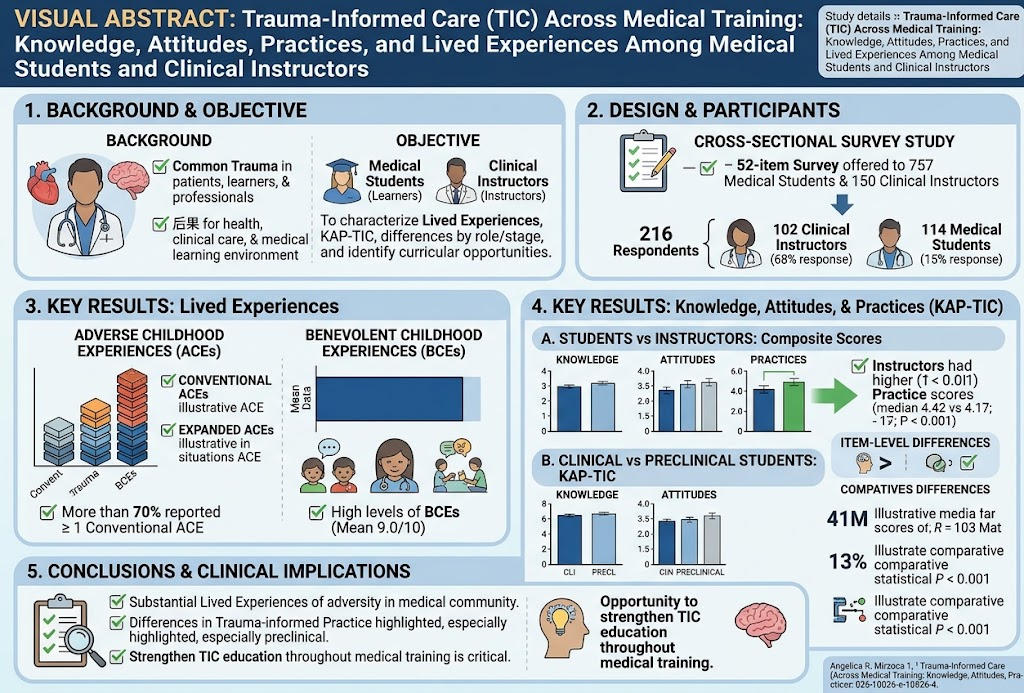
This cross-sectional survey study aimed to characterize the lived experiences related to trauma—both adverse and benevolent—and TIC-related knowledge, attitudes, and practices among medical students and clinical instructors. A 52-item validated questionnaire was disseminated to 757 medical students and 150 clinical instructors, collecting data on conventional and expanded ACEs, benevolent childhood experiences (BCEs), and KAP related to TIC. The survey assessed composite and item-level responses to explore significant differences by educational role (student vs instructor) and training stage (preclinical vs clinical), with appropriate statistical corrections including false discovery rate adjustments for multiple comparisons.
Key Findings
A total of 216 participants responded, including 114 medical students (15% response rate) and 102 clinical instructors (68% response rate). Notably, over 70% of respondents reported experiencing at least one conventional ACE, while benevolent childhood experiences were high (mean BCE score: 9.0 out of 10), indicating complex trauma exposures coexisting with protective factors.
Composite scores revealed no significant differences in TIC-related knowledge and attitudes between students and instructors. However, clinical instructors demonstrated significantly higher trauma-informed practice scores compared to students (median 4.42 vs 4.17; P<0.001, effect size rrb=0.27), especially demonstrating greater transparency, respect for patient choice, and tailored clinical responses.
Item-level analysis showed the most pronounced differences between preclinical students and instructors, with clinical students’ TIC understanding and application more closely aligned with instructors after false discovery correction. This suggests that clinical exposure and training stages influence the adoption of trauma-informed practices. Students expressed a stronger desire for TIC training, signaling recognition of educational gaps.
Importantly, a history of elevated early-life adversity (≥4 ACEs) was not significantly associated with overall KAP-TIC agreement (OR 1.29, 95% CI 0.62-2.65), indicating that personal trauma history alone may not predict TIC competency or agreement.
Expert Commentary
These findings underscore both challenges and opportunities in medical education regarding trauma-informed care. The high prevalence of ACEs among medical learners and instructors aligns with broader population data and suggests shared backgrounds contributing to empathy but also potential vulnerability within training environments. The elevated desire among students for TIC training reflects increasing awareness of trauma’s clinical relevance and the need for structured curricular integration.
The discrepancy between knowledge/attitudes and practice highlights that while foundational TIC concepts may be understood early, practical application improves with clinical experience and mentorship. This gap emphasizes the necessity of embedding TIC principles longitudinally in curricula, from preclinical didactics through clinical rotations and faculty development.
Limitations include the single-institution study design and response bias due to lower student response rates, warranting cautious generalization. Future work could expand to multisite settings and longitudinal designs assessing TIC competency evolution.
Conclusions
This study illuminates significant trauma exposure among both medical trainees and instructors and reveals nuanced differences in trauma-informed care practices across training stages. The findings advocate for comprehensive developments in TIC education, targeting earlier incorporation in medical school curricula and continuous reinforcement during clinical training and faculty development. Such efforts may foster safer, more collaborative clinical environments and improve outcomes for patients affected by trauma.
Funding and Trial Registration
No funding information or clinicaltrials.gov registration was reported for this study.
References
1. Substance Abuse and Mental Health Services Administration (SAMHSA). Trauma-Informed Care in Behavioral Health Services. Treatment Improvement Protocol (TIP) Series 57. 2014.
2. Felitti VJ, Anda RF, Nordenberg D, et al. Relationship of childhood abuse and household dysfunction to many of the leading causes of death in adults. Am J Prev Med. 1998;14(4):245-258.
3. Isobel S, Delgado C, Thom K, et al. Trauma-Informed Care Education Impact on Social Work Students: A Systematic Review. J Soc Work Educ. 2020;56(4):738-754.
4. Harris PA, Wolf MS, Shenvi NK. Trauma-Informed Care: Transforming Healthcare to Address Adversity. J Gen Intern Med. 2024;39(3):494-498.
5. Bennett MA, Greene R, Dobson K, et al. Benevolent Childhood Experiences Questionnaire: development and psychometric evaluation. Child Abuse Negl. 2019;100:104214.
6.Mirzoca AR, Stanford AE, Li RE, Hundertmark L, Weil A. Trauma-Informed Care Across Medical Training: Knowledge, Attitudes, Practices, and Lived Experiences Among Medical Students and Clinical Instructors. J Gen Intern Med. 2026 Sep 23. doi: 10.1007/s11606-026-10826-4. Epub ahead of print. PMID: 42778819.