Highlights
- Significant knowledge deficits exist in Australia concerning recovery after traumatic brain injury (TBI), particularly regarding long-term outcomes and rehabilitation processes.
- Prior education, higher educational attainment, paid caregiving roles, and English-speaking backgrounds correlate with better TBI knowledge, though misconceptions persist even among individuals with lived experience.
- International evidence aligns with Australian findings, highlighting global challenges in TBI knowledge dissemination and the need for improved interdisciplinary collaboration and guideline adherence.
- Targeted educational initiatives, inclusive of primary care providers, families, and patients, are essential to address these gaps, enhance care navigation, and optimize recovery trajectories.
Background
Traumatic brain injury (TBI) remains a leading cause of mortality and long-term disability worldwide, placing a substantial burden on individuals and healthcare systems. In Australia, TBI incidence is noteworthy, with community members frequently encountering individuals affected by concussion and more severe brain injuries. Adequate public and professional knowledge regarding injury mechanisms, symptomatology, recovery expectations, and management is critical to optimizing outcomes through timely help-seeking, appropriate rehabilitation engagement, and effective self-management strategies. Despite this, persistent misconceptions and knowledge gaps have been documented internationally and within Australia, potentially undermining recovery and rehabilitation processes. Understanding these knowledge gaps, particularly related to recovery after TBI, is essential for guiding educational and policy interventions.Key Content
Assessment of TBI Knowledge in Australia: The Doust et al. Study
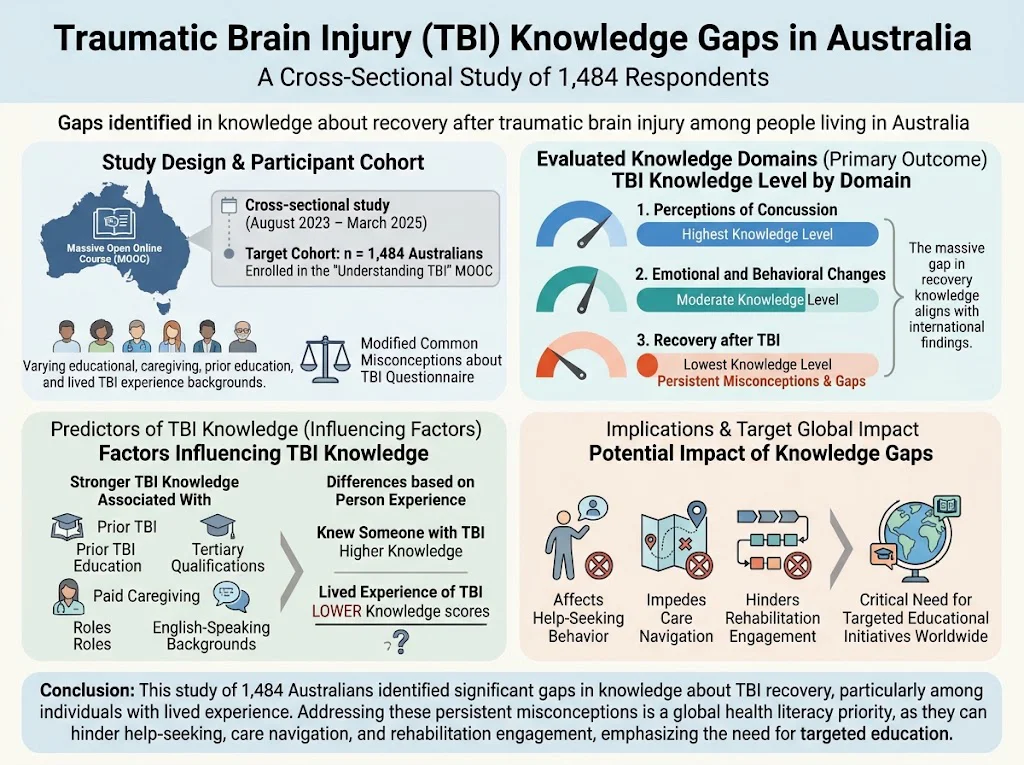
A recent cross-sectional study by Doust et al. (2026) evaluated knowledge levels about TBI recovery among 1,484 Australians participating in an online TBI education course. Using a modified Common Misconceptions about Traumatic Brain Injury questionnaire, knowledge was assessed across three domains: perceptions of concussion, emotional and behavioral changes, and recovery after TBI. Key Findings:- Knowledge was highest in perceptions of concussion but lowest in understanding recovery after TBI, indicating significant misconceptions about the recovery process and long-term outcomes.
- Individuals with prior TBI education, tertiary qualifications, paid caregiving experience, and English-speaking backgrounds demonstrated higher knowledge levels.
- Surprisingly, participants with lived TBI experience had lower knowledge scores compared to those who knew someone with a TBI, pointing to possible gaps in patient-centered education.
International Perspectives on TBI Knowledge and Rehabilitation Practices
Comparable studies worldwide underscore similar challenges. – In Israel, a study assessing emergency physicians’ knowledge of mild TBI guidelines found that despite high recognition of common symptoms, adherence to evidence-based protocols (e.g., return-to-activity advice) was suboptimal, with low referral rates to specialized services (Laor et al., 2026). – In Saudi Arabia, healthcare professionals valued interdisciplinary collaboration in TBI rehabilitation but reported inconsistencies in collaboration frequency, indicating systemic barriers that may affect rehabilitation quality (Alghamdi et al., 2026). – A French-speaking sports community survey highlighted varying levels of concussion knowledge, with healthcare professionals scoring highest but athletes and coaches demonstrating knowledge gaps, suggesting the need for tailored educational strategies (Labbé et al., 2026). These international insights parallel Australian findings, emphasizing global deficits in knowledge transfer and guideline implementation.Community and Healthcare Provider Knowledge Regarding Concussion in Australia
An Australian nationwide survey (Hammond et al., 2026) found that while most participants could identify concussion mechanisms, only a minority correctly understood symptoms warranting immediate medical attention and the usual recovery timeframe. This gap in fundamental concussion knowledge may delay appropriate care and affect rehabilitation engagement. Further, variability in discharge instructions for pediatric mild TBI in emergency departments has been addressed through quality improvement interventions incorporating age-appropriate educational materials, demonstrating feasibility and positive parental feedback (Patel et al., 2026).Impact of Misperceptions on Recovery and Rehabilitation Engagement
Misunderstanding recovery trajectories and symptoms can impede optimal care. – Illness perceptions significantly predict cognitive symptom reporting after mild TBI independently of psychological distress, suggesting psychoeducation is crucial for managing subjective recovery experiences (Smith et al., 2026). – Parent-child agreement on brain injury perceptions post-concussion is low, highlighting the need for individualized education to align expectations and support (Jones et al., 2026). Moreover, physician perceptions of TBI outcomes may influence clinical decision-making and rehabilitation referrals, underpinning the role of provider education (Kumar et al., 2026).Translational Implications and Emerging Research Directions
Recent molecular research in pediatric TBI uncovers biological pathways influencing recovery, offering potential therapeutic targets (Chen et al., 2025). While these advances inform medical management, public and provider education remains a cornerstone to ensure engagement with evidence-based rehabilitation services. Technological advances, such as AI-based language models demonstrating growing accuracy in physical medicine and rehabilitation knowledge, present opportunities for enhancing training and patient education but require cautious application (Li et al., 2025).Expert Commentary
The consistent observation of knowledge gaps regarding TBI recovery, including in Australia, reflects broader challenges in disseminating complex medical information to diverse populations. Educational attainment and professional exposure facilitate better understanding, yet lived experience alone may not guarantee accurate knowledge, underscoring the necessity for structured patient and caregiver education. Interdisciplinary collaboration in rehabilitation services is essential but hindered by systemic barriers and variable training, as seen in global research. Tailored guidelines and coordination pathways that consider local healthcare contexts could improve knowledge uptake and clinical outcomes. Addressing misconceptions through contact-based interventions, psychoeducation, and improved communication strategies can reduce stigma and enhance willingness to engage in rehabilitation. Engaging primary care providers as education and management gatekeepers is crucial, given their frontline role in TBI care and follow-up. In policy terms, embedding standardized, evidence-based educational materials within healthcare systems, leveraging technology, and fostering community awareness are pivotal. Additionally, further research should examine effective methods to align perceptions among patients, families, and healthcare providers to optimize shared decision-making.Conclusion
Persistent gaps in knowledge about recovery after traumatic brain injury present a significant barrier to effective rehabilitation and optimal outcomes in Australia and globally. Despite recognition of concussion mechanisms, understanding of recovery trajectories and long-term sequelae remains limited. Educational initiatives targeted at patients, caregivers, healthcare professionals, and the broader public are urgently needed to correct misconceptions and facilitate engagement with rehabilitation resources. Interdisciplinary collaboration and clear referral pathways should be strengthened to support comprehensive TBI management. Future research should focus on tailored knowledge translation strategies, integration of psychoeducation to address illness perceptions, and leveraging technological innovations to enhance TBI education. Bridging these knowledge gaps will be critical to improving care navigation, enhancing recovery, and reducing the societal burden of TBI.References
- Doust YV et al. Gaps identified in knowledge about recovery after traumatic brain injury among people living in Australia. Clin Rehabil. 2026 Nov 1;2692155261502389. PMID: 42967985.
- Alghamdi S et al. Interdisciplinary collaboration in traumatic brain injury rehabilitation: a cross-sectional survey of rehabilitation services in Saudi Arabia. Front Neurol. 2026 Sep 17;17:1891136. PMID: 42824024.
- Laor D et al. Knowledge and practice of evidence-based mild traumatic brain injury guidelines among physicians in Israel. Isr J Health Policy Res. 2026 Sep 15;15(1):41. PMID: 42736565.
- Hammond G et al. Understanding Australian community members’ knowledge of concussion: a cross-sectional nationwide survey. Aust Health Rev. 2026 Sep;50(3):AH26055. PMID: 42656089.
- Patel S et al. Standardization of discharge instructions by age for children presenting to the ED with mild traumatic brain injury: a quality improvement project. Pediatr Emerg Care. 2026 Jan;42(1):69-75. PMID: 41088525.
- Smith R et al. Illness perceptions predict subjective cognitive complaints independently of sex and psychological distress in post-acute mTBI. Neuropsychol Rehabil. 2026 May;36(4):803-824. PMID: 40990419.
- Jones T et al. Parent and child agreement of brain injury perceptions following pediatric concussion. Arch Clin Neuropsychol. 2026 Jan 30;41(1):acaf123. PMID: 41615394.
- Kumar P et al. A survey of physicians perceptions of disability outcomes after hypothetical traumatic brain injury. Sci Rep. 2026 Jan 10;16(1):4978. PMID: 41520007.
- Chen L et al. The molecular architecture of severe pediatric traumatic brain injury: integrated omics reveal therapeutic pathways. Crit Care. 2025 Dec 9;30(1):23. PMID: 41361486.
- Li X et al. Advancements in large language model accuracy for answering physical medicine and rehabilitation board review questions. PM R. 2025 Sep;17(9):1091-1096. PMID: 40318209.
Specialty calculators
For clinical reference; use professional judgment.