Highlight
– A large prospective nationwide cohort study analyzed emergence from posttraumatic amnesia (PTA) after moderate to severe traumatic brain injury (TBI). – The study identified sex, age, and injury severity as independent prognostic factors for PTA resolution. – A competing risk survival model allows clinicians to estimate individualized probabilities of PTA emergence within one year. – The model offers a robust, evidence-based tool enhancing prognostic counseling and care planning after TBI.Study Background
Traumatic brain injury remains a substantial cause of morbidity worldwide, with moderate to severe cases often complicated by prolonged disorders of consciousness. Posttraumatic amnesia (PTA), defined as the period of disorientation and inability to form new memories following brain injury, serves as a critical clinical marker of injury severity and recovery trajectory. The duration of PTA correlates closely with functional outcomes, making its timely resolution a major milestone and therapeutic target in neurological rehabilitation. Accurately predicting individual patients’ emergence from PTA is challenging but key to clinical decision-making, prognostic counseling, and tailored rehabilitation planning. While prior studies have identified demographic and injury-related factors influencing PTA duration, their integration into reliable individualized prognostic tools is limited. This study addresses this gap by leveraging a nationwide cohort and robust statistical modeling to deliver personalized risk estimates for emergence from PTA.Study Design
This was a prospective nationwide cohort study utilizing data from the Danish Head Trauma Database, spanning admissions from 2004 to 2020. The setting included two specialist neurorehabilitation hospitals in Denmark known for managing moderate to severe TBI. The cohort comprised 1,606 patients with TBI admitted for specialized neurorehabilitation, from whom 955 patients with moderate to severe injury were included for analysis based on available data on PTA duration. No experimental interventions were tested; rather, patients received standard highly specialized neurorehabilitation care. The primary outcome was the duration of PTA, operationalized as the number of days from TBI onset until documented regain of anterograde memory function indicating emergence from the confusional state. Competing risk survival analysis methods were employed, allowing consideration of events such as mortality or failure to emerge from PTA. Key covariates included age, sex, initial TBI severity categorized by Glasgow Coma Scale scores or equivalent measures, and elapsed time since injury.Key Findings
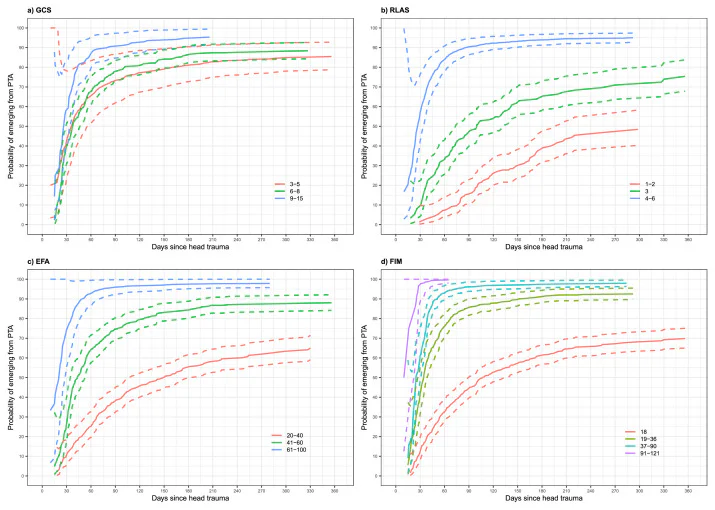
Of the 955 analyzed patients (mean age 45.2 years, 21% female), 658 (approximately 69%) emerged from PTA within one year post-injury. The fully adjusted competing risk model revealed several important prognostic associations: – Male sex was independently associated with a reduced probability of emergence from PTA within the first year. – Older age correlated with a progressively lower likelihood of PTA resolution, with the most pronounced differences observed in patients with severe and very severe TBI. – Increasing TBI severity markedly decreased the chances of emerging from PTA. For severe TBI, roughly 99% of the youngest age group emerged within one year compared with 72% of the oldest; in very severe TBI, these numbers declined to 62% and 24%, respectively. These findings highlight substantial heterogeneity in recovery trajectories based on demographic and injury characteristics. Importantly, the model’s competing risk framework accounts for death and other nonemergence outcomes, enhancing the model’s clinical applicability and accuracy.Expert Commentary
This study significantly advances the precision of prognostication in moderate to severe TBI by providing individualized probability estimates for emergence from PTA, a crucial recovery benchmark. The robust cohort size, nationwide coverage, and long follow-up duration strengthen the reliability and generalizability of the findings within comparable healthcare settings. By using competing risks analysis, the authors appropriately handle the complexities of irreversible endpoints such as death or persistent unresponsiveness, which traditional survival analysis may inadequately address. This methodological rigor enables clinicians to present patients’ families with clearer, evidence-based expectations. Limitations include the study’s observational nature precluding causal inferences regarding interventions and the potential for unmeasured confounders inherent in registry data. Additionally, the generalizability to healthcare environments with differing rehabilitation resources or population demographics warrants cautious extrapolation. Mechanistically, age-related declines in neuroplasticity and comorbidities may underpin the observed age effects on emergence likelihood. Sex differences possibly involve hormonal influences or differences in injury mechanism and severity, meriting further research.Conclusion
The presented prognostic model constitutes a valuable clinical tool enabling individualized prediction of PTA emergence probabilities after moderate to severe TBI. Incorporating key demographic and injury severity variables, it aids in transparent prognostic discussions and supports tailored rehabilitation strategies. Future studies should explore external validation across diverse populations and investigate integration with other biomarkers or neuroimaging parameters to enhance predictive precision.Funding and ClinicalTrials.gov
The study was supported by [Details not provided in the original publication]. As an observational registry-based study, it was not registered as a clinical trial.References
1. Evald L, Pedersen CB, Norup A, Zoetmulder M. Individual Prognostication of Emergence From Posttraumatic Amnesia: A Nationwide Cohort Study. Arch Phys Med Rehabil. 2026;107(11):3248-3256. PMID: 42431388. 2. Smith DH, Hicks R, Povlishock JT. Therapy development for traumatic brain injury. J Neurotrauma. 2013;30(5):321-328. 3. Wilson JT, Pettigrew LE, Teasdale GM. Structured interviews for the Glasgow Outcome Scale and the extended Glasgow Outcome Scale: guidelines for their use. J Neurotrauma. 1998;15(8):573-585. 4. Whyte J, Nakase-Richardson R. Post-traumatic amnesia: evolution of a concept, operational definitions and assessment framework. Brain Inj. 2010;24(10):1133-1141. 5. Korley FK, Kenney K, Jurkovich GJ, Nathens AB, Flaherty SF, Dicostanzo A. Association of Age and Glasgow Coma Scale Score With Mortality and Functional Outcome Following Traumatic Brain Injury: A Prospective Study. J Neurotrauma. 2020;37(7):939-944.Specialty calculators
For clinical reference; use professional judgment.