Highlight
- Intismeran, a personalized neoantigen therapy, combined with pembrolizumab significantly increases 24-month recurrence-free survival in resected stage IIB to IV melanoma.
- Combination therapy reduces distant metastasis incidence compared to pembrolizumab alone, indicating improved systemic control.
- The safety profile is acceptable, with grade 3 or higher adverse events slightly higher but manageable.
Study Background
Cutaneous melanoma remains a challenging malignancy with high rates of recurrence after surgical resection, especially in patients with stage IIB to IV disease. Despite the advent of immune checkpoint inhibitors like pembrolizumab improving outcomes, a substantial proportion of high-risk patients still experience relapse and metastatic progression. Neoantigens—patient-specific tumor mutations recognized by the immune system—offer a promising target for personalized immunotherapy strategies. Intismeran autogene (abbreviated intismeran), an individualized neoantigen vaccine, is designed to amplify both novel and preexisting T-cell responses against a patient’s unique tumor neoantigens, thereby potentially improving the efficacy of adjuvant immunotherapy in melanoma.
Study Design
This phase 3, randomized, double-blind trial enrolled 1137 patients with completely resected stage IIB to IV cutaneous melanoma. Patients were randomized in a 2:1 ratio to receive either intismeran plus pembrolizumab or placebo plus pembrolizumab. Intismeran or placebo was administered intramuscularly at a fixed dose of 1 mg every three weeks for nine doses. Concurrently, all patients received intravenous pembrolizumab at 400 mg every six weeks for nine cycles. The primary endpoint was investigator-determined recurrence-free survival (RFS), assessed using time-to-event analysis. Key secondary endpoints included distant-metastasis-free survival (DMFS) and safety evaluation.
Key Findings
With a median follow-up of 24.6 months, the addition of intismeran to pembrolizumab yielded a statistically significant improvement in RFS. At 24 months, the RFS rate was 82.2% in the combination group versus 70.0% in the pembrolizumab-only group (P<0.001). Hazard ratio (HR) analyses demonstrated a time-dependent effect: HR was 0.99 before 6 months, indicating no early separation, but significantly favored the combination therapy thereafter (HR 0.42, 95% CI 0.30 to 0.58).
Similarly, DMFS at 24 months was higher with intismeran plus pembrolizumab (88.5%) compared to placebo plus pembrolizumab (80.2%) (P=0.002). The piecewise HR again showed no early benefit (HR 1.01 before 6 months) but a significant reduction in risk of distant metastasis after 6 months (HR 0.50, 95% CI 0.34 to 0.73). These findings suggest that the neoantigen vaccine’s immunologic effects accrue over time, consistent with the expected delayed kinetics of vaccine-induced T-cell responses.
Regarding safety, grade 3 or higher adverse events occurred in 23.6% of patients receiving the combination versus 20.3% in the pembrolizumab-alone group, indicating a slight increase in severe toxicity. Importantly, there were eight deaths attributed to adverse events in the intismeran group (1.1%), with five deaths occurring prior to intismeran administration. This data suggests that combination therapy has an acceptable safety profile consistent with known pembrolizumab toxicities and manageable vaccine-related side effects.
Expert Commentary
This trial robustly establishes that adding personalized neoantigen vaccination to standard adjuvant pembrolizumab immunotherapy significantly delays melanoma recurrence and distant metastases in high-risk, resected patients. The strength of the benefit emerging after 6 months underscores the biological plausibility that neoantigen-induced T-cell priming and expansion require time to translate to clinical effect.
The safety profile remains favorable, with severe toxicities comparable to prior pembrolizumab monotherapy trials, highlighting the feasibility of integrating intismeran in routine practice. However, longer follow-up is warranted to assess overall survival benefit and durability of response. Results also raise interest in exploring neoantigen vaccines in combination with other immune modulators or in earlier disease stages.
While promising, limitations include the relatively short median follow-up for a disease with a variable natural history and potential variability in neoantigen identification and vaccine manufacturing. Nevertheless, this trial represents a milestone in personalized cancer immunotherapy, suggesting that tailoring vaccines to tumor mutational profiles can meaningfully enhance checkpoint blockade efficacy.
Conclusion
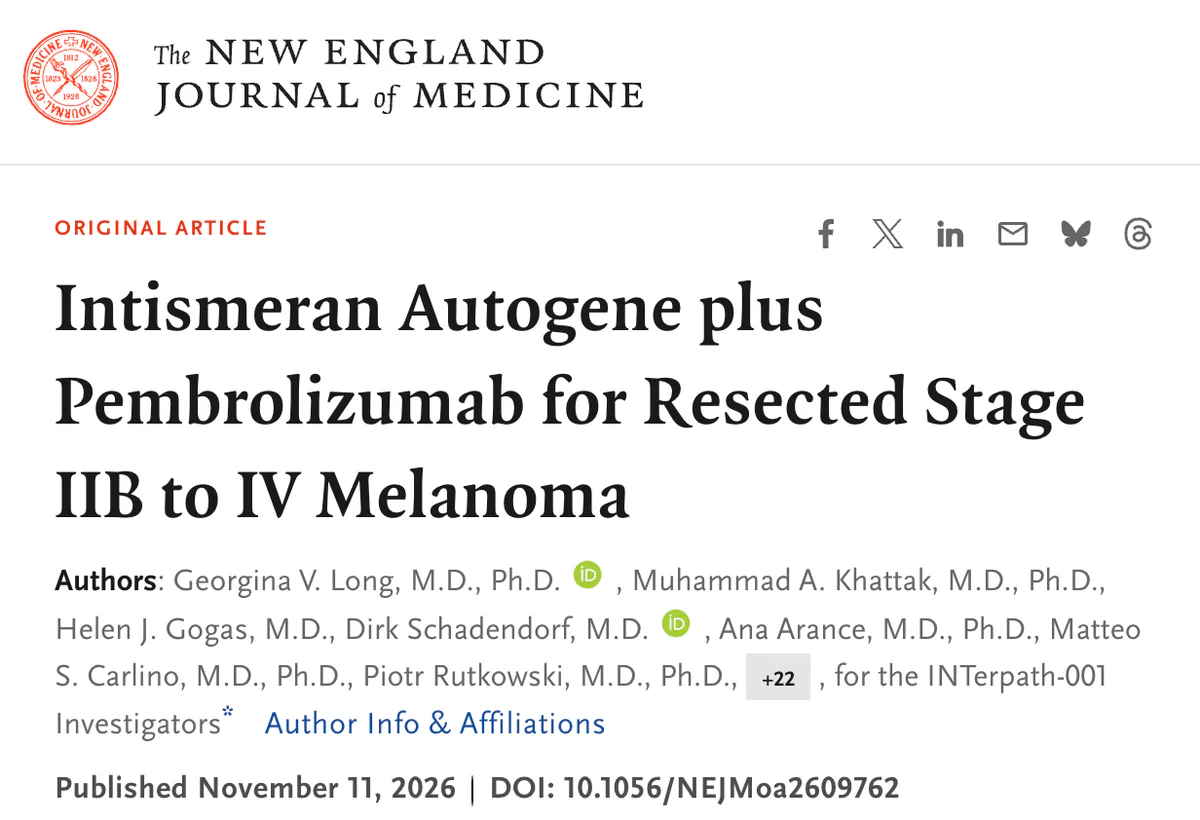
The INTerpath-001 phase 3 trial demonstrates that adjuvant intismeran autogene combined with pembrolizumab significantly improves recurrence-free and distant-metastasis-free survival in patients with completely resected stage IIB to IV cutaneous melanoma compared to pembrolizumab alone. Personalized neoantigen vaccination emerges as a promising strategy to enhance immunotherapy outcomes and may represent a new standard of care for high-risk melanoma patients post-surgery.
Funding and Registration
This study was funded by Merck Sharp and Dohme and Moderna. The clinical trial is registered under ClinicalTrials.gov number NCT05933577.
References
- Long GV, Khattak MA, Gogas HJ, et al. Intismeran Autogene plus Pembrolizumab for Resected Stage IIB to IV Melanoma. N Engl J Med. 2026; DOI:10.1056/NEJMoa2606412. PMID: 43013837.
- Hodi FS, O’Day SJ, McDermott DF, et al. Improved survival with ipilimumab in patients with metastatic melanoma. N Engl J Med. 2010;363(8):711-723.
- Ott PA, Hu Z, Keskin DB, et al. An immunogenic personal neoantigen vaccine for patients with melanoma. Nature. 2017;547(7662):217-221.
Specialty calculators
For clinical reference; use professional judgment.