Highlight
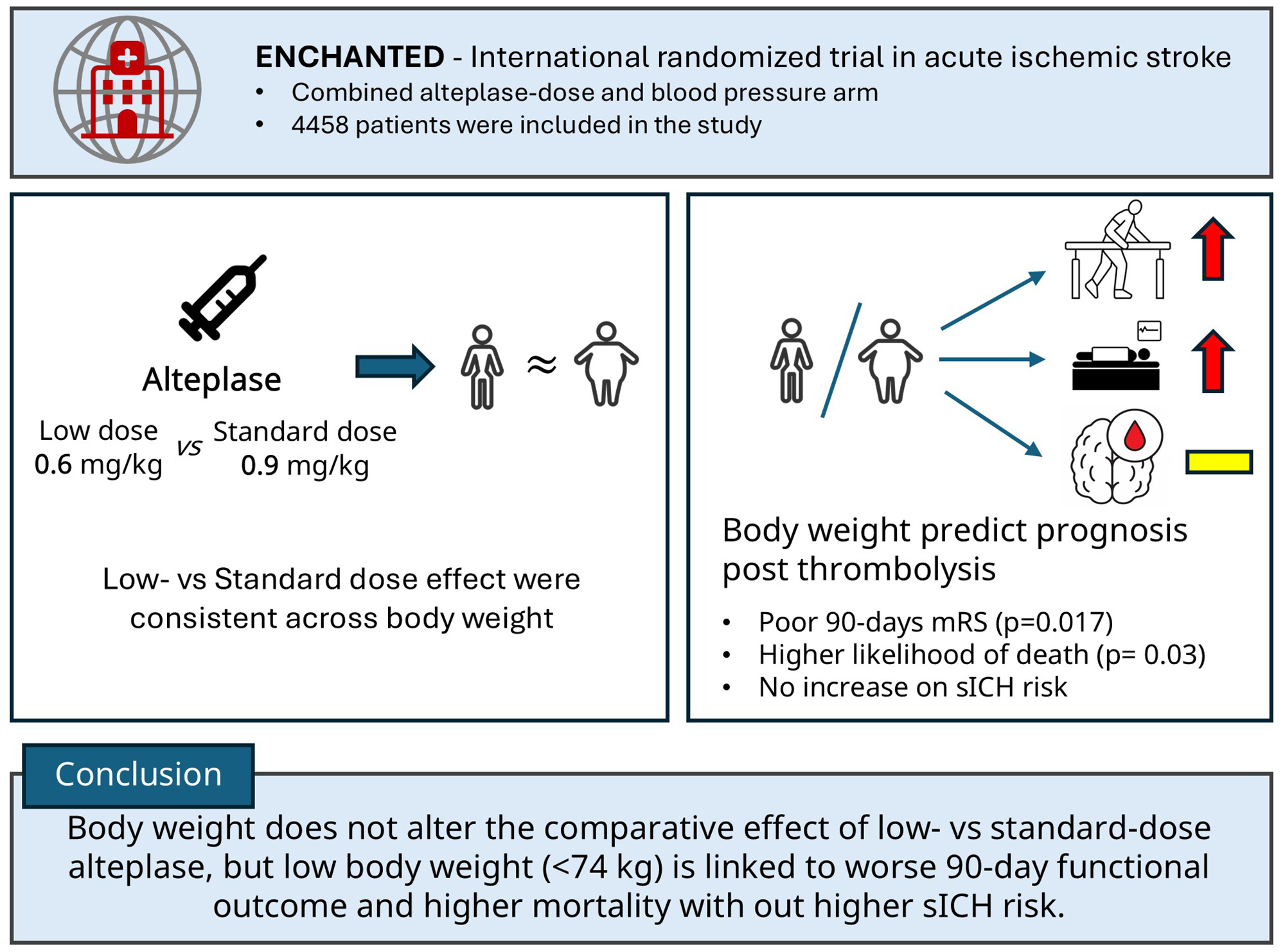
- Body weight does not significantly modify the comparative therapeutic effects of low- (0.6 mg/kg) versus standard-dose (0.9 mg/kg) intravenous alteplase in acute ischemic stroke.
- Low body weight (<74 kg) independently predicts higher odds of poor functional outcomes and mortality at 90 days post-thrombolysis.
- No increased risk of symptomatic intracerebral hemorrhage (sICH) was associated with low body weight despite worse functional prognosis.
- The ENCHANTED trial results support current alteplase dosing strategies without weight-based dose adjustments beyond standard mg/kg calculations.
Study Background
Acute ischemic stroke (AIS) is a leading cause of mortality and long-term disability worldwide. Intravenous thrombolysis with alteplase remains the gold standard treatment when administered within a therapeutic window, significantly improving patient outcomes by promoting clot dissolution. However, patient heterogeneity including body weight may influence pharmacodynamics and clinical response. Although alteplase dosing is weight-based, the prognostic role of body weight and its interaction with the alteplase dose remains unclear. Some observational studies have suggested that extremes of body weight may alter risk profiles for bleeding or treatment efficacy, but robust evidence is lacking. Given the global burden of stroke and widespread use of alteplase, understanding how body weight affects thrombolytic outcomes is crucial to optimise therapy and improve stroke recovery.
Study Design and Methods
This study is a post hoc analysis of the ENCHANTED (Enhanced Control of Hypertension and Thrombolysis Stroke Study) trial, a large, international, partial-factorial randomized controlled trial. ENCHANTED enrolled 4484 patients with AIS treated within 4.5 hours of symptom onset. The trial compared two doses of intravenous alteplase: low-dose (0.6 mg/kg) versus standard-dose (0.9 mg/kg), alongside stratified blood pressure control strategies.
The primary outcome was poor functional outcome defined as a modified Rankin Scale (mRS) score of 2 to 6 at 90 days post-treatment, which encompasses disability and death. Secondary outcomes included mortality and symptomatic intracerebral hemorrhage (sICH). The post hoc analysis focused on examining whether body weight modified the comparative effect of alteplase dosing on outcomes and assessed the association between body weight alone and clinical endpoints.
Logistic regression models were applied to evaluate associations, incorporating restricted cubic splines to capture potential nonlinear relationships between continuous body weight and outcomes. The alteplase-dose arm included 3206 patients, and the full cohort totaled 4458 patients.
Key Findings
Analysis demonstrated that body weight did not significantly interact with alteplase dose regarding functional recovery (Pinteraction=0.60), mortality (Pinteraction=0.56), or risk of sICH (Pinteraction=0.46). This implies that the therapeutic benefit and safety profile of low- versus standard-dose alteplase are consistent across different body weights.
Interestingly, when analyzing body weight across the full cohort regardless of dose group, a nonlinear association with clinical outcomes emerged. An inflection point was identified around 74 kg. Patients weighing less than 74 kg experienced significantly higher odds of poor functional outcome (adjusted odds ratio [OR], 1.41; 95% confidence interval [CI], 1.06–1.87; P=0.017) and death (OR, 1.65; 95% CI, 1.04–2.61; P=0.03) at 90 days compared to heavier counterparts. Crucially, low body weight was not associated with increased sICH risk, mitigating concerns about bleeding complications in this subgroup.
These findings underscore low body weight as an independent predictor of less favorable stroke recovery despite thrombolytic therapy. Possible explanations may include reduced physiological reserve, comorbid conditions, or different stroke etiologies in lighter patients.
Expert Commentary
The ENCHANTED post hoc analysis addresses an important and understudied clinical question regarding the influence of patient weight on thrombolysis outcomes. By leveraging data from a rigorously conducted, international randomized trial, the study provides compelling evidence that the standard weight-based alteplase dosing regimen remains appropriate across diverse body weights.
The observation that low body weight predicts worse outcomes but not increased hemorrhagic risk may reflect multifactorial contributors to stroke recovery not directly modifiable by adjusting alteplase dosage. It highlights the need for comprehensive management tailored to patients of lower weight, possibly integrating rehabilitation, nutrition, and comorbidity optimization.
Limitations include the post hoc nature of the analysis and potential residual confounding. The ENCHANTED cohort was predominantly Asian, limiting global generalizability, particularly to populations with different body weight distributions or vascular risk profiles. Future research could explore mechanistic pathways linking body weight to stroke prognosis and test whether adjunct therapies might benefit lower-weight patients.
Conclusion
The ENCHANTED trial analysis confirms that body weight does not modify the relative safety and efficacy of low- versus standard-dose intravenous alteplase in acute ischemic stroke patients. Low body weight independently portends poorer functional outcomes and higher mortality but does not increase symptomatic intracerebral hemorrhage risk after thrombolysis. Standard weight-based alteplase dosing remains appropriate without further dose adjustment based solely on body weight extremes. Clinicians should consider low body weight as a marker of higher stroke risk profile and guide holistic patient management accordingly.
Funding and Trial Registration
The ENCHANTED trial was funded by multiple national and international stroke research organizations. Trial registration numbers are NCT01422616 (clinicaltrials.gov) and ACTRN12611000236998 (anzctr.org.au). Detailed funding sources are documented within the original trial publication.
References
1. Ge Y, Gao Y, Chen X, et al. Body Weight in Relation to the Effectiveness of Intravenous Alteplase in Acute Ischemic Stroke: The ENCHANTED Trial. Stroke. 2026 Aug 26; PMID: 42644244.
2. Emberson J, Lees KR, Lyden P, et al. Effect of treatment delay, age, and stroke severity on the effects of intravenous thrombolysis with alteplase for acute ischemic stroke: a meta-analysis of individual patient data from randomized trials. Lancet. 2014;384(9958):1929-1935.
3. Powers WJ, Rabinstein AA, Ackerson T, et al. 2018 Guidelines for the Early Management of Patients With Acute Ischemic Stroke. Stroke. 2018;49(3):e46-e110.