Highlight
– Azetukalner, a novel KV7 potassium channel opener, significantly reduces seizure frequency in adults with drug-resistant focal epilepsy.
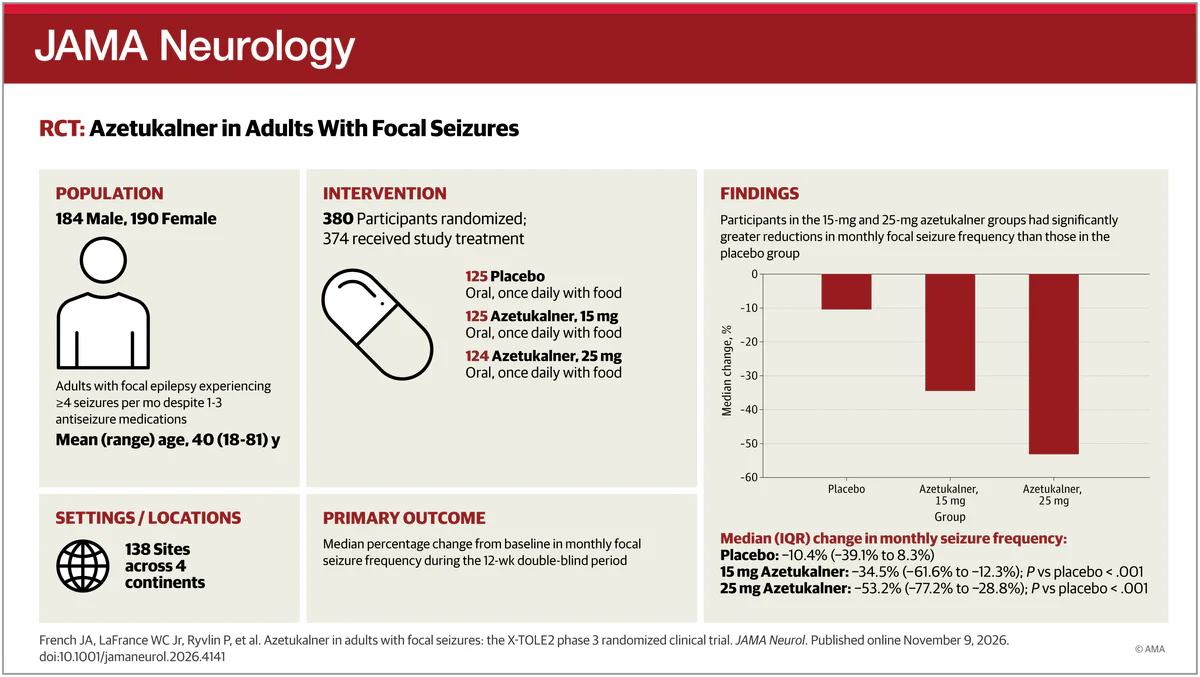
– The phase 3 X-TOLE2 trial demonstrated median seizure frequency reductions of 34.5% and 53.2% for 15 mg and 25 mg doses, respectively, versus placebo.
– The treatment was well tolerated, with adverse events comparable to previous phase 2 data.
– These findings suggest azetukalner as a potent and promising antiseizure medication addressing a substantial unmet clinical need.
Study Background
Epilepsy is a chronic neurological disorder characterized by recurrent seizures, affecting approximately 50 million people worldwide. Focal seizures constitute a substantial proportion of epilepsy cases and often persist despite treatment. Although over 30 antiseizure medications (ASMs) are approved, around one-third of patients exhibit drug-resistant epilepsy, defined as failure to achieve sustained seizure freedom despite adequate trials of two or more ASMs. Drug resistance leads to increased morbidity, mortality, and reduced quality of life. Hence, there remains a critical need for effective novel therapies targeting new mechanisms.
Azetukalner is a first-in-class, potent KV7 potassium channel opener. KV7 channels regulate neuronal excitability by controlling membrane potential and action potential firing. Enhancing their function stabilizes neuronal activity and suppresses hyperexcitability underlying seizures. Previous phase 2b trials indicated promising efficacy and safety, motivating this definitive phase 3 evaluation.
Study Design
The X-TOLE2 study is a multinational, randomized, double-blind, placebo-controlled phase 3 trial conducted from November 18, 2022, through February 3, 2026. It enrolled 374 adults across 138 sites in North America, South America, Europe, and the Asia Pacific region. Eligible participants had focal epilepsy experiencing at least four focal seizures monthly despite stable treatment with 1 to 3 ASMs.
Participants were randomized 1:1:1 to receive placebo, 15 mg, or 25 mg of azetukalner once daily with the evening meal for 12 weeks, without a titration phase. Following the double-blind period, subjects could enter an open-label extension. The primary efficacy outcome was the median percentage change in monthly focal seizure frequency compared to baseline. Secondary endpoints included safety assessments encompassing treatment-emergent adverse events (TEAEs), laboratory parameters, vital signs, and electrocardiogram (ECG) changes.
Key Findings
Among the 374 randomized and treated participants (mean age 40 years; 50.8% female), baseline median monthly seizure frequency was 12.75. Notably, participants had a median of five previously tried ASMs discontinued, and nearly 90% were on 2–3 concomitant ASMs, underscoring the resistant nature of the study population.
The median reduction in seizure frequency during the 12-week treatment was -10.4% for placebo, -34.5% for the 15 mg azetukalner group, and -53.2% for the 25 mg group. Both azetukalner doses achieved statistical significance versus placebo (P < .001). These reductions are among the largest median seizure frequency decreases reported in phase 3 trials for drug-resistant epilepsy, reflecting robust efficacy.
Safety data indicated that azetukalner was generally well tolerated. The frequency and type of TEAEs were consistent with previous phase 2b data, without new safety signals. No significant abnormalities emerged from clinical labs, vital signs, or ECG monitoring. These findings suggest a favorable benefit-risk profile common to potassium channel openers, which typically exhibit central nervous system-related adverse events but generally low systemic toxicity.
Expert Commentary
Azetukalner’s mechanism targeting KV7 channels offers distinct advantages by modulating intrinsic neuronal excitability rather than broad-spectrum inhibition. This specificity may underlie its potent antiseizure effect combined with favorable tolerability. The large median seizure reductions meet clinically meaningful thresholds, which could translate into improved patient quality of life and reduced healthcare utilization.
However, limitations include the relatively short double-blind duration and the need for longer-term outcome data on seizure freedom, cognitive effects, and impact on comorbidities. Since most patients were on multiple concurrent ASMs, the interaction profile and optimal positioning in treatment algorithms merit further exploration. The open-label extension may provide insights into durability and safety over time.
Moreover, while the trial was geographically diverse, assessing efficacy in special populations such as elderly patients, those with comorbidities, or pediatric groups remains necessary to inform broad clinical application.
Conclusion
The X-TOLE2 phase 3 trial establishes azetukalner as a highly effective and safe novel antiseizure medication for adults with drug-resistant focal seizures. Its ability to significantly reduce seizure frequency with a manageable safety profile addresses an urgent unmet need in epilepsy care. These results support incorporation of azetukalner into clinical practice as a promising treatment to improve outcomes for patients refractory to conventional therapies.
Funding and Trial Registration
The trial was registered at ClinicalTrials.gov under identifier NCT05614063. Funding sources and disclosures are detailed in the original publication.
References
French JA, LaFrance WC, Ryvlin P, Trinka E, Villanueva V, Wechsler R, et al. Azetukalner in Adults With Focal Seizures: The X-TOLE2 Phase 3 Randomized Clinical Trial. JAMA Neurol. 2026 Nov 9. PMID: 43002431.
Kwan P, Brodie MJ. Early identification of refractory epilepsy. N Engl J Med. 2000;342(5):314-319.
Miceli F, Soldovieri MV, Ambrosino P, Taglialatela M. KV7 channels and epilepsy. Front Physiol. 2008;9:543.
Perucca E, Scheffer IE, Kiley M. Assessing the efficacy and safety of antiepileptic drugs in clinical trials. Epilepsia. 2020;61 Suppl 1:S13-S28.
Specialty calculators
For clinical reference; use professional judgment.