Highlights
- Astegolimab, targeting the IL-33 receptor ST2, significantly reduces moderate and severe exacerbations in COPD patients with frequent exacerbations.
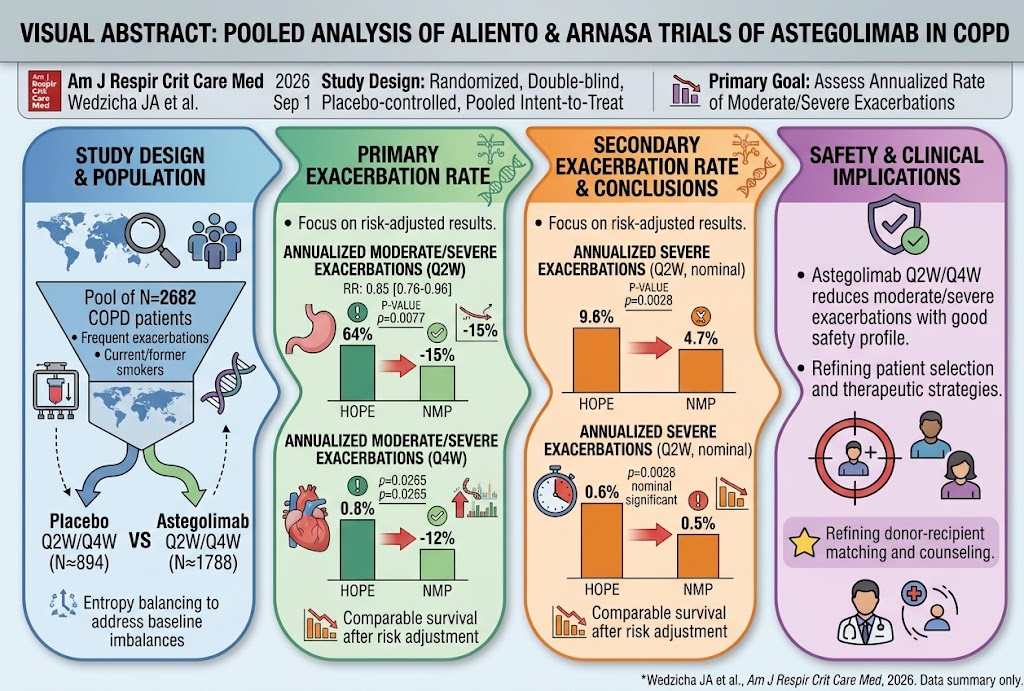
- The pooled analysis of ALIENTO (phase 2b) and ARNASA (phase 3) trials demonstrated a 12-15% reduction in annualized moderate/severe exacerbation rates with astegolimab dosing every 2 or 4 weeks.
- Astegolimab was well tolerated without significant safety concerns, supporting its potential as a novel biologic therapy for COPD exacerbation prevention homogeneous across eosinophil subgroups.
- Mechanistic insights implicate IL-33/ST2 signaling in neutrophilic and eosinophilic airway inflammation, highlighting a novel therapeutic target beyond type 2 inflammation pathways.
Background
Chronic obstructive pulmonary disease (COPD) remains a leading cause of morbidity and mortality worldwide, characterized by persistent airflow limitation and chronic airway inflammation. A major clinical challenge is the prevention of acute exacerbations, which accelerate lung function decline, worsen quality of life, and increase healthcare burden. Current inhaled therapies reduce exacerbations but leave a significant unmet need, especially in patients with frequent exacerbations despite optimized maintenance therapy.
Type 2 inflammation and eosinophilic phenotypes have garnered attention with biological therapies like dupilumab and benralizumab showing efficacy in eosinophilic COPD, yet a large proportion of COPD exacerbations are associated with neutrophilic and mixed inflammatory pathways. The interleukin-33 (IL-33)/ST2 axis has been increasingly recognized as a key driver of airway inflammation and exacerbations, acting upstream of both eosinophil and neutrophil recruitment and activation. Astegolimab, a fully human IgG2 monoclonal antibody targeting ST2, the IL-33 receptor, was developed to explore this mechanism for exacerbation reduction in COPD.
Key Content
Development of Astegolimab in COPD: Early Phase Evidence
Initial evidence from the COPD-ST2OP phase 2a trial (Wedzicha et al., Lancet Respir Med 2022) reported that astegolimab administered every 4 weeks for 44 weeks did not significantly reduce exacerbations overall, but demonstrated improvements in health status measured by the St George’s Respiratory Questionnaire and reductions in blood and sputum eosinophil counts. This trial enrolled patients with moderate-to-very severe COPD and included stratified analyses by eosinophil levels, which showed better outcomes in lower eosinophil subgroups. These findings suggested biological activity and tolerability but warranted larger confirmatory trials.
Pivotal Phase 2b and 3 Trials: ALIENTO and ARNASA
The ALIENTO (phase 2b) and ARNASA (phase 3) trials were contemporaneous, randomized, double-blind, placebo-controlled studies designed with near-identical protocols enrolling a broad COPD population with a history of frequent exacerbations, irrespective of blood eosinophil count or chronic bronchitis status. Participants (n=2682 pooled) were randomized to receive subcutaneous astegolimab 476 mg every 2 weeks (Q2W), every 4 weeks (Q4W), or placebo, atop optimized inhaled maintenance therapy for 52 weeks.
The primary endpoint was the annualized rate of moderate or severe exacerbations, adjudicated per standard definitions. Secondary endpoints included the annualized rate of severe exacerbations and safety measures. A hierarchical statistical approach gated testing of secondary endpoints on primary endpoint success.
Efficacy Outcomes
The pooled intent-to-treat analysis demonstrated that astegolimab Q2W significantly reduced the annualized moderate/severe exacerbation rate by 15% (rate ratio 0.85, 95% CI 0.76-0.96, P=0.0077), while the Q4W dosing achieved a 12% reduction (rate ratio 0.88, 95% CI 0.78-0.99, P=0.0265) compared with placebo. A nominally significant 32% reduction in severe exacerbations was observed in the Q2W arm (rate ratio 0.68, 95% CI 0.52-0.87, P=0.0028).
Notably, these benefits were evident across a clinically heterogeneous population, including patients with varied eosinophil counts and smoking status, underscoring astegolimab’s broad applicability. Subgroup analyses revealed consistent trends regardless of baseline blood eosinophil stratification, contrasting biologics targeting type 2 inflammation that are often restricted to eosinophilic COPD subsets.
Safety and Tolerability
Astegolimab demonstrated a favorable safety profile with adverse event rates comparable to placebo across both trials. The most frequent non-COPD adverse events were mild upper respiratory tract infections (nasopharyngitis, upper respiratory chest infection). Mortality rates were balanced, and only a small fraction of deaths were considered treatment-related. Importantly, no new safety signals or immunogenicity concerns emerged during the 52-week treatment period.
Contextualizing Astegolimab Among Biologics for COPD
Biological therapies for COPD are an expanding therapeutic frontier, particularly agents modulating type 2 inflammation such as dupilumab and benralizumab, which have demonstrated efficacy in eosinophilic COPD subpopulations. A 2025 network meta-analysis (Zhao et al.) indicated dupilumab and benralizumab had significant reductions in exacerbations and improved lung function, primarily in patients with elevated eosinophil counts.
Astegolimab, by targeting the IL-33/ST2 axis involved in both eosinophilic and neutrophilic inflammation, potentially addresses a broader inflammatory spectrum. Meta-analyses encompassing monoclonal antibodies in eosinophilic COPD confirm overall exacerbation rate reductions (rate ratio 0.79), with good safety profiles (Alshabani et al., 2025), supporting the role of monoclonals as adjunctive therapies when inhaled therapies are insufficient.
Mechanistic Insights and Translational Implications
IL-33, an epithelial alarmin released upon tissue damage, engages ST2 on various immune cells to promote cytokine production driving neutrophil and eosinophil recruitment. By blocking ST2, astegolimab interrupts this upstream pathway to mitigate airway inflammation and hyperresponsiveness, as evidenced by reductions in eosinophil counts and exacerbation frequency.
This upstream blockade may bypass limitations of targeting individual downstream inflammatory mediators and offers a mechanistically novel avenue to tackle the heterogeneous inflammatory milieu in COPD exacerbations. The success of astegolimab in large phase 2b/3 studies marks a translational milestone linking pathobiology with clinical benefit.
Expert Commentary
The pooled ALIENTO and ARNASA results establish astegolimab as a proof-of-concept biologic that effectively reduces moderate to severe COPD exacerbations in patients with frequent exacerbations, transcending eosinophil-based phenotyping. This addresses a significant unmet clinical need, as many COPD patients do not neatly fit into type 2 eosinophilic endotypes.
While modest in absolute effect size, the 12-15% reduction is clinically relevant given the refractory nature of frequent exacerbators. The favorable safety profile and convenience of subcutaneous administration every 2-4 weeks enhance its translational potential.
Limitations include heterogeneous trial results, with ARNASA not meeting statistical significance alone, emphasizing the importance of pooled analyses. Future research should focus on biomarker identification to optimize patient selection, exploring combination strategies with existing inhaled therapies, and long-term outcomes.
Current COPD guidelines do not yet incorporate anti-ST2 therapies, but these data could redefine clinical paradigms when integrated with existing phenotype-driven approaches. Moreover, mechanistic insights encourage further exploration of IL-33/ST2 pathway blockade in other airway diseases.
Conclusion
Astegolimab, a novel anti-ST2 monoclonal antibody targeting the IL-33 receptor, demonstrates statistically and clinically significant reductions in COPD exacerbations in a broad population of frequent exacerbators. The pooled ALIENTO and ARNASA trials represent a pivotal advancement validating the IL-33/ST2 axis as a therapeutic target beyond traditional eosinophilic pathways.
This biologic offers a promising addition to COPD management, particularly for patients with limited treatment options and non-eosinophilic inflammation. Ongoing investigation into patient stratification, long-term effects, and combination regimens will clarify its role in personalized COPD care.
References
- Wedzicha JA et al. Astegolimab for chronic obstructive pulmonary disease with frequent exacerbations: pooled analysis of the ALIENTO and ARNASA trials. Am J Respir Crit Care Med. 2026 Sep 1;212(9):2050-2060. PMID: 42148875.
- Wedzicha JA et al. Safety and efficacy of astegolimab for COPD with frequent exacerbations regardless of baseline blood eosinophil counts (ALIENTO and ARNASA): randomized, double-blind, placebo-controlled phase 2b and 3 trials. Lancet. 2026 May 23;407(10543):2027-2039. PMID: 42150581.
- Zhao K et al. Efficacy and safety of biologics targeting type 2 inflammation in COPD: a systematic review and network meta-analysis. Int J Chron Obstruct Pulmon Dis. 2025 Jul 3;20:2143-2159. PMID: 40626315.
- Alshabani K et al. Role of monoclonal antibodies in the management of eosinophilic chronic obstructive pulmonary disease: a meta-analysis of randomized controlled trials. Ann Am Thorac Soc. 2025 May;22(5):768-775. PMID: 39589286.
- Wedzicha JA et al. Astegolimab, an anti-ST2, in chronic obstructive pulmonary disease (COPD-ST2OP): a phase 2a, placebo-controlled trial. Lancet Respir Med. 2022 May;10(5):469-477. PMID: 35339234.