Introduction
Hepatitis C virus (HCV) infection remains the most common blood-borne viral infection in the United States with significant public health implications due to its potential to cause chronic liver disease, cirrhosis, and liver cancer. Early diagnosis via screening, particularly in high-contact healthcare settings like emergency departments (EDs), is crucial to linking patients to appropriate treatment and improving outcomes.
Emergency departments serve as critical points for HCV screening, especially for populations who may not regularly access primary healthcare services. Despite the effectiveness of ED-based screenings, disparities exist in test offer and acceptance rates, notably influenced by the patient’s preferred language of communication.
Objective
This study aimed to assess the association between patient language preference—specifically preference for a language other than English (PLOE)—and the likelihood of being offered and accepting HCV screening tests during routine screening in ED settings. Understanding these associations helps identify barriers and optimize screening protocols for linguistically diverse populations.
Methods
The data for this analysis were drawn from the DETECT Hep C Screening Trial, a pragmatic, randomized clinical trial conducted at three centers. The trial compared targeted screening (offering tests based on identified risk factors) versus nontargeted screening (universal offer regardless of risk) among ED patients.
Patients’ preferred language was recorded, categorizing them into English speakers or PLOE. The primary outcomes measured were the offer of the HCV test and the acceptance of testing by patients. Secondary outcomes included completion of HCV antibody and RNA testing to confirm infection status.
To adjust for variables that could influence outcomes—such as age, sex, and ethnicity—multivariable modified Poisson regression was utilized, calculating risk ratios (RRs) with 95% confidence intervals (CIs) to determine the strength of associations between language preference and screening outcomes.
Results
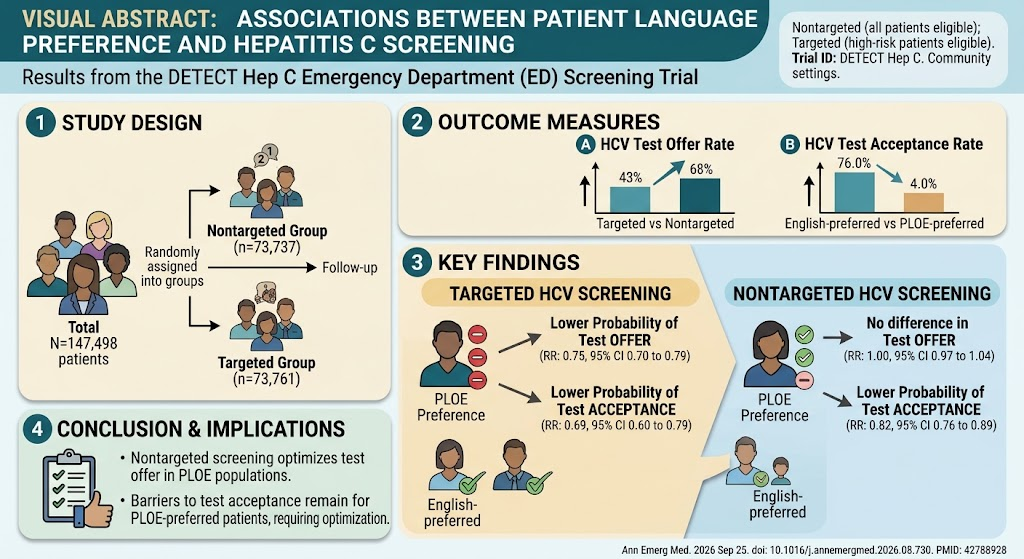
The study randomized 147,498 patients with a median age of 41 years. The cohort was diverse: 51.5% male, 42.3% Black non-Hispanic, 20.9% Hispanic, 32.2% White non-Hispanic, and 10.3% preferred a language other than English.
Significant heterogeneity was observed across the three centers in patient demographics and outcomes, underscoring the importance of site-specific contextual factors.
Within the targeted screening group, patients with PLOE had a significantly lower likelihood of being offered an HCV test (RR 0.75; 95% CI 0.70-0.79) and of accepting testing when offered (RR 0.69; 95% CI 0.60-0.79) compared to English speakers.
In the nontargeted screening group, PLOE was not significantly associated with the offer of testing (RR 1.00; 95% CI 0.97-1.04), indicating equitable test offer across language groups. However, these patients were still less likely to accept testing (RR 0.82; 95% CI 0.76-0.89) compared with those preferring English.
Discussion
The findings highlight critical disparities in HCV screening within emergency departments linked to language preference. The reduced probability of both offering and accepting HCV screening among patients who prefer a language other than English in targeted screening suggests potential language barriers affecting provider-patient communication or provider unconscious biases in risk assessment.
The absence of disparity in test offer in the nontargeted screening approach suggests that universal offers of HCV testing might help reduce language-based inequities in access to screening, though acceptance remains lower among PLOE patients, possibly due to communication difficulties, cultural perceptions, or lack of awareness about HCV and its treatment.
Addressing these barriers requires culturally and linguistically tailored interventions, including the provision of professional medical interpreters, culturally appropriate educational materials, and training for healthcare providers on effective communication with linguistically diverse patients to enhance both the offer and acceptance rates of HCV screening.
Clinical Implications
To optimize HCV screening in the ED setting, especially for patients with PLOE, emergency departments might consider implementing universal (nontargeted) screening protocols combined with language-access services to minimize disparities in test offering. Additionally, patient education in the preferred language and community outreach are vital to improving acceptance rates.
Effective linkage to care post-screening is equally critical to ensure patients receive timely antiviral treatments such as direct-acting antivirals (DAAs), which have revolutionized HCV therapy with cure rates exceeding 95%.
Conclusions
This study underscores that language preference significantly influences both the offer and acceptance of HCV screening in emergency departments. Targeted screening approaches may inadvertently perpetuate disparities among PLOE populations. Nontargeted, universal screening strategies alongside culturally sensitive communication approaches are recommended to improve hepatitis C detection and subsequent treatment referrals in linguistically diverse patient populations.
Future research should focus on identifying specific barriers to screening acceptance in PLOE populations and developing tailored interventions to overcome these, ensuring equitable healthcare delivery and improved public health outcomes.
References
Thiessen M, Haukoos J, Hopkins E, et al. Associations Between Patient Language Preference and Hepatitis C Screening: Results From the DETECT Hep C Emergency Department Screening Trial. Ann Emerg Med. 2026 Sep 25. PMID: 42788928.