Highlights
- Extended follow-up up to 5 years confirms that a single-dose infant PCV13 primary series plus booster (1+1) induces non-inferior serotype-specific antibody responses compared to traditional two-dose plus booster (2+1) regimens.
- PCV10 1+1 schedules initially meet immunogenicity non-inferiority at age 3 but fail to sustain comparable antibody levels at ages 4 and 5 years versus 2+1 schedules.
- Comparative analysis reveals PCV13 generally outperforms PCV10 in 1+1 schedules across shared serotypes, suggesting enhanced durability of immunity.
- Findings support the potential for reduced dosing with PCV13 in countries with mature immunization programs, balancing immunogenicity and programmatic efficiency.
Background
Streptococcus pneumoniae remains a leading cause of invasive pneumococcal disease (IPD) in young children globally, with substantial morbidity and mortality. Pneumococcal conjugate vaccines (PCVs), including the 10-valent (PCV10) and 13-valent (PCV13) formulations, have significantly reduced IPD burden through infant immunization. Traditional infant schedules involve two or three primary doses plus a booster (2+1 or 3+0), demanding substantial health system resources and coverage efforts.
Reduced-dose schedules, such as a single primary dose plus a booster (1+1), are attractive options to optimize vaccine resources, especially in settings with established herd immunity. The United Kingdom has adopted a 1+1 PCV13 schedule with encouraging early results. However, data assessing long-term immunological persistence, particularly beyond age two years and comparing PCV10 and PCV13 in low- and middle-income settings, remain limited.
This article reviews the extended follow-up findings from a rigorously designed single-centre, open-label, non-inferiority randomized controlled trial conducted in South Africa, focusing on the persistence of serotype-specific serum IgG geometric mean concentrations (GMCs) up to age 5 years after infant PCV10 or PCV13 vaccination under 1+1 versus 2+1 schedules.
Key Content
Study Design and Population
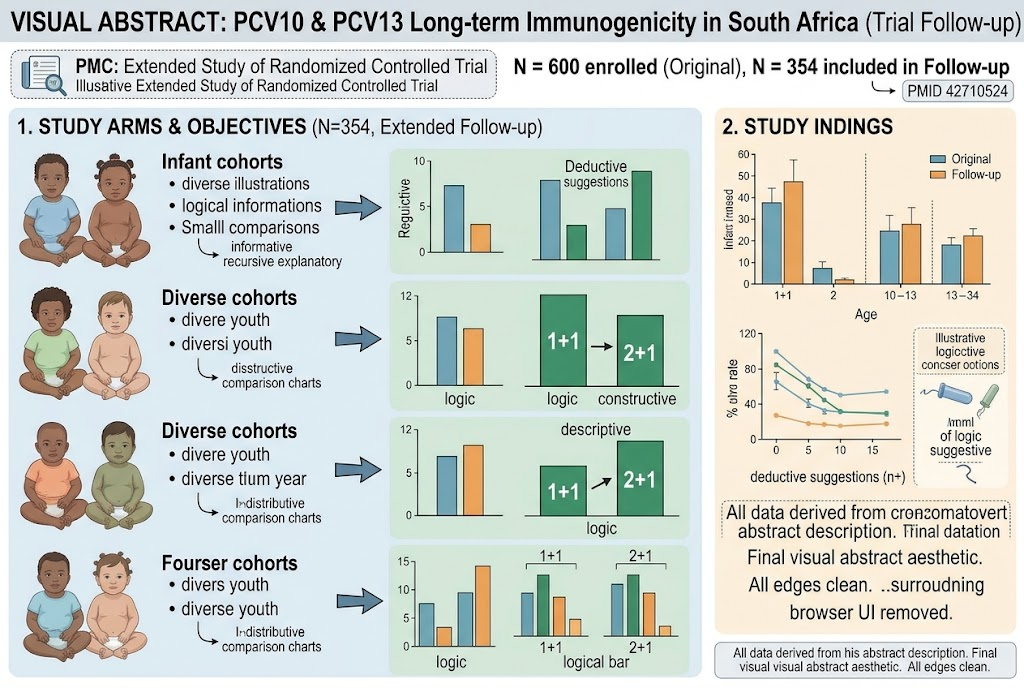
The original trial screened 1,695 infants and enrolled 600 HIV-unexposed infants, randomized evenly (1:1:1:1:1:1) into six groups: 6w+1 and 14w+1 single-dose PCV10 or PCV13, and 2+1 PCV10 or PCV13 (two doses at 6 and 14 weeks followed by a 9-month booster). The extended follow-up study included 354 children across these groups, with serial blood sampling at ages 3, 4, and 5 years to measure serotype-specific IgG using a validated in-house Luminex assay.
Immunogenicity Outcomes
Non-inferiority was predefined as the lower bound of the 95% confidence interval (CI) of the GMC ratio exceeding 0.5 for at least ten of the 13 PCV13 serotypes or at least eight of the 10 PCV10 serotypes.
– PCV13 1+1 schedules (whether primed at 6 weeks or 14 weeks) demonstrated consistent non-inferiority compared with the PCV13 2+1 group through 5 years, with maintained serotype-specific GMCs.
– PCV10 1+1 schedules met non-inferiority criteria at age 3 years but fell short at ages 4 and 5.
– When comparing PCV10 2+1 and PCV13 2+1 schedules for shared serotypes, similar IgG GMCs were observed up to 5 years.
– Across 1+1 groups, PCV13 generally yielded higher GMCs than PCV10, suggesting superior long-term immunogenicity in the reduced-dose context.
Contextual Integration with Additional Evidence
These findings align with previous observations that booster doses are critical for sustained immunity post-primary series and that PCV13’s broader serotype coverage and immunogenic composition may impart enhanced durability. The differential performance of PCV10 1+1 schedules highlights the need to carefully consider vaccine formulation characteristics when optimizing infant immunization schedules.
Parallel research in vaccine effectiveness and herd immunity dynamics, such as the UK experience with 1+1 PCV13 schedules, supports the clinical relevance of sustained antibody levels as correlates of protection.
Expert Commentary
This extended RCT follow-up provides robust immunogenicity data informing PCV schedule optimization. The preservation of non-inferiority in PCV13 1+1 schedules through 5 years offers a compelling argument for schedule simplification in settings with established vaccine coverage and epidemiological surveillance.
However, the diminished long-term immunogenicity observed in PCV10 1+1 groups cautions against broad application of reduced-dose schedules without vaccine-specific evaluation. Differences in carrier proteins and serotype-specific immunogenicity profiles likely underpin these distinctions.
The trial’s single-centre, open-label design and 59% retention rate in follow-up constitute limitations, potentially affecting generalizability. Nevertheless, stringent randomization, standardized immunological assessments, and predefined non-inferiority margins enhance data reliability.
Mechanistically, the stronger persistence of PCV13-elicited IgG may be attributed to inclusion of serotypes 3, 6A, and 19A and the CRM197 carrier protein, which enhances T-cell-dependent memory responses, critical for sustained immunity.
Policy-wise, this evidence supports the World Health Organization and country-level consideration of 1+1 PCV13 schedules, particularly in middle- and high-income settings with mature immunization infrastructure. Broader application must consider local epidemiology, healthcare delivery capacity, and serotype prevalence.
Conclusion
This extended follow-up of a randomized trial in South Africa demonstrates that a single-dose infant PCV13 primary series followed by a booster maintains serotype-specific IgG non-inferiority compared with two-dose priming up to age 5 years. Conversely, PCV10 1+1 schedules exhibit waning immunity beyond 3 years.
These data endorse consideration for transition to reduced PCV13 dosing schedules in countries with well-established vaccination programs, potentially improving cost-effectiveness and vaccine supply management.
Continued surveillance of vaccine effectiveness, serotype replacement, and population immunity remains critical to adapt policies appropriately.
Future research should explore vaccine-specific immunological mechanisms, field-effectiveness, and long-term clinical outcomes, guiding tailored immunization strategies globally.
References
- Kapelus DJ, Olwagen CP, Izu A, Ranchod H, Mukendi CK, Mutsaerts EAML, Koen A, Jose L, Kwatra G, Faustini SE, Richter AG, Madhi SA. Immunogenicity up to age 5 years following a single-dose or two-dose infant primary series of 10-valent or 13-valent pneumococcal conjugate vaccine each followed by a booster dose in South Africa: extended follow-up of a single-centre, open-label, non-inferiority, randomised controlled trial. Lancet Child Adolesc Health. 2026 Sep 8. PMID: 42710524. https://pubmed.ncbi.nlm.nih.gov/42710524/