Highlight
This study demonstrates that adjusting whole genome sequencing-estimated telomere length (WGS-TL) for patient age significantly improves the detection of pathologically short telomeres in idiopathic pulmonary fibrosis (IPF) patients. Age-adjusted WGS-TL better identifies telomere-related qualifying variants (TRQVs) than raw measurements and correlates with transplant-free survival, though it does not enhance survival prediction beyond existing clinical assessments.
Background
Idiopathic pulmonary fibrosis (IPF) is a chronic, progressive interstitial lung disease characterized by fibrosis of the lung parenchyma, leading to respiratory failure and high mortality. Genetic factors, particularly mutations affecting telomere biology, have been increasingly recognized as contributors to IPF pathogenesis. Telomeres—repetitive nucleotide sequences at chromosomal ends—shorten naturally with age, but pathological shortening due to telomere-related gene variants accelerates cellular senescence, promoting fibrosis.
While telomere length can be directly measured via peripheral blood assays, whole genome sequencing (WGS) offers an emerging, scalable method to estimate telomere length (WGS-TL) bioinformatically. However, raw WGS-TL measurements fail to account for expected age-related telomere attrition, potentially confounding identification of patients with clinically significant telomere shortening. This gap limits WGS-TL’s utility in clinical stratification and prognostication in IPF.
Study Design
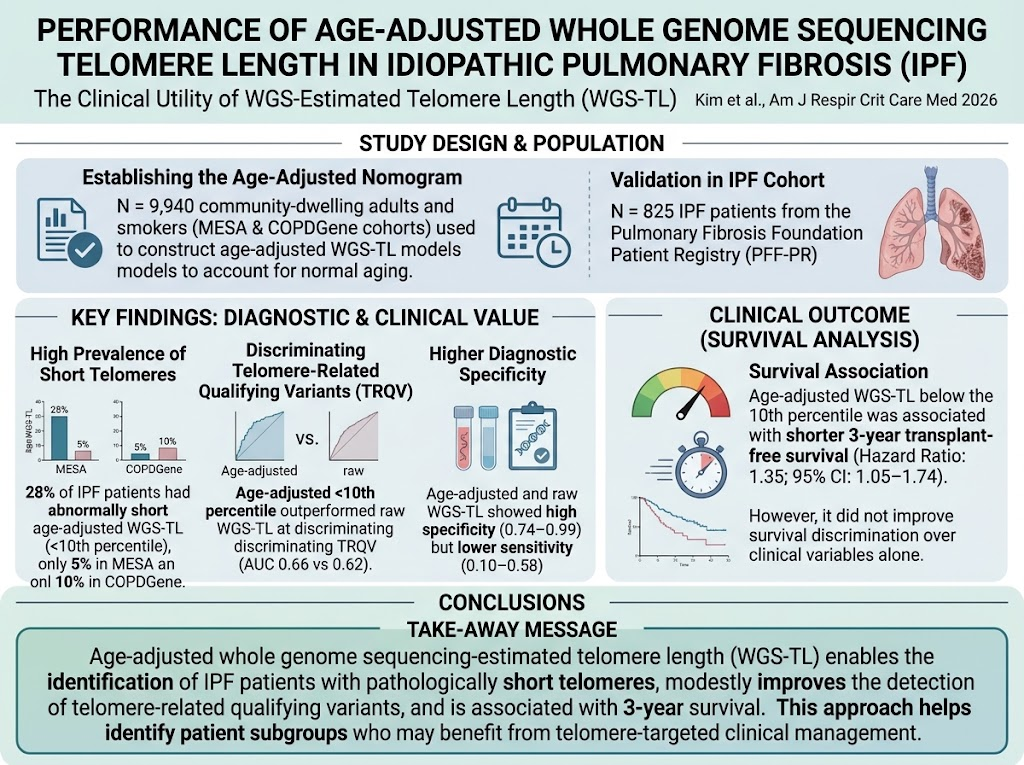
This investigation used data from three cohorts: the Multi-Ethnic Study of Atherosclerosis (MESA), COPDGene, and the Pulmonary Fibrosis Foundation Patient Registry (PFF-PR). The first two cohorts included community-dwelling adults (MESA) and people who smoke cigarettes (COPDGene), serving as reference populations to develop an age-adjusted WGS-TL nomogram.
Linear regression models were built on raw WGS-TL values and patient chronological age from a large combined sample (n=9,940) to generate age-adjusted percentiles of WGS-TL. The derived nomogram then was applied to 825 IPF patients from PFF-PR, with the goal to assess the nomogram’s performance in detecting telomere-related qualifying variants (TRQVs) and its association with clinical outcomes, notably transplant-free survival.
Key Findings
Age-adjusted WGS-TL identified a substantially higher proportion of IPF patients with abnormally short telomeres below the 10th percentile (28%) compared with community-dwelling adults in MESA (5%) and smokers in COPDGene (10%). This supports an enrichment of pathological telomere shortening in IPF.
Diagnostic discrimination for TRQVs improved when using age-adjusted WGS-TL thresholds as opposed to raw WGS-TL, with areas under the receiver operating curve (AUROC) of 0.66 versus 0.62, respectively. This modest improvement suggests the clinical relevance of adjusting for age-related telomere attrition. Both approaches exhibited higher specificity (0.74 to 0.99) than sensitivity (0.10 to 0.58), implying that low WGS-TL is a fairly reliable indicator of TRQV presence but misses a proportion of variant carriers.
Regarding prognosis, IPF patients with age-adjusted WGS-TL below the 10th percentile had significantly worse three-year transplant-free survival (hazard ratio 1.35; 95% CI, 1.05–1.74). However, when combined with established clinical variables, age-adjusted WGS-TL did not improve overall survival prediction models appreciably, indicating limited incremental prognostic value.
Expert Commentary
This study advances the field by addressing a key limitation of WGS-TL estimation—its failure to consider physiological telomere shortening with age—and demonstrates a practical approach to enhance genetic risk stratification in IPF. The integration of age-adjustment enables better differentiation of pathological telomere attrition from normal aging, strengthening the biomarker’s diagnostic utility.
Nonetheless, the modest sensitivities highlight that WGS-TL, even when age-adjusted, should not be used as a standalone screening tool for telomere-related genetic variants. Rather, it should complement comprehensive genetic testing, especially given the heterogeneous genetic underpinnings of IPF.
From a mechanistic perspective, telomere dysfunction contributes to alveolar epithelial cell senescence and defective repair responses, driving fibrosis. Tools accurately capturing telomere status can thus enrich our understanding and identify patients who might benefit from emerging targeted therapies correcting telomere defects.
Limitations include the reliance on peripheral blood WGS-TL as a proxy for lung tissue telomere status and currently modest performance characteristics. Future research should explore pan-tissue correlation, longitudinal change, and incorporation with multi-omic classifiers.
Conclusion
Age-adjusted WGS-TL offers a refined biomarker for identifying pathologically short telomeres in IPF, modestly improving detection of telomere-related genetic variants and correlating with survival. Although it does not enhance survival prediction beyond clinical parameters, it provides valuable biological insight and may guide genetic counseling and precision medicine approaches in IPF. Further validation and integration in clinical workflows remain necessary.
Funding and ClinicalTrials.gov
Details on funding sources and ClinicalTrials.gov registration were not specified in the original publication but typically accompany large registry and sequencing-based studies such as those utilized here. Readers should consult the original article (PMID: 42261270) for complete disclosures.
References
1. Kim JS, et al. Performance of age-adjusted whole genome sequencing telomere length in idiopathic pulmonary fibrosis. Am J Respir Crit Care Med. 2026;212(10):2445-2454. PMID: 42261270.
2. Stuart BD, et al. Telomere shortening and pulmonary fibrosis: the missing link between aging and IPF. J Clin Invest. 2021;131(16):e144497.
3. Armanios MY. Telomeres and idiopathic pulmonary fibrosis: the science and the medicine. Eur Respir J. 2020;55(2):1901418.