Highlight
This study identifies a marked increase in the proportion of female oral board examiners in ophthalmology coinciding with a shift to virtual exam administration. Despite this, female representation among examinees showed no significant change during the same period. Flexibility afforded by virtual platforms may facilitate greater workforce inclusion, emphasizing the importance of adaptive certification policies.
Study Background
Equity and diversity within medical specialties have garnered increased attention due to their relevance in optimizing workforce effectiveness and patient care. Ophthalmology, like other medical specialties, has historically faced gender disparities, particularly in senior roles such as board examiners who influence professional standards. The American Board of Ophthalmology (ABO) oral board examination is a critical credentialing process for ophthalmologists in the United States. Understanding demographic shifts among examiners and examinees is essential as diversity may impact educational dynamics, professional mentorship, and broader workforce inclusivity.
Study Design
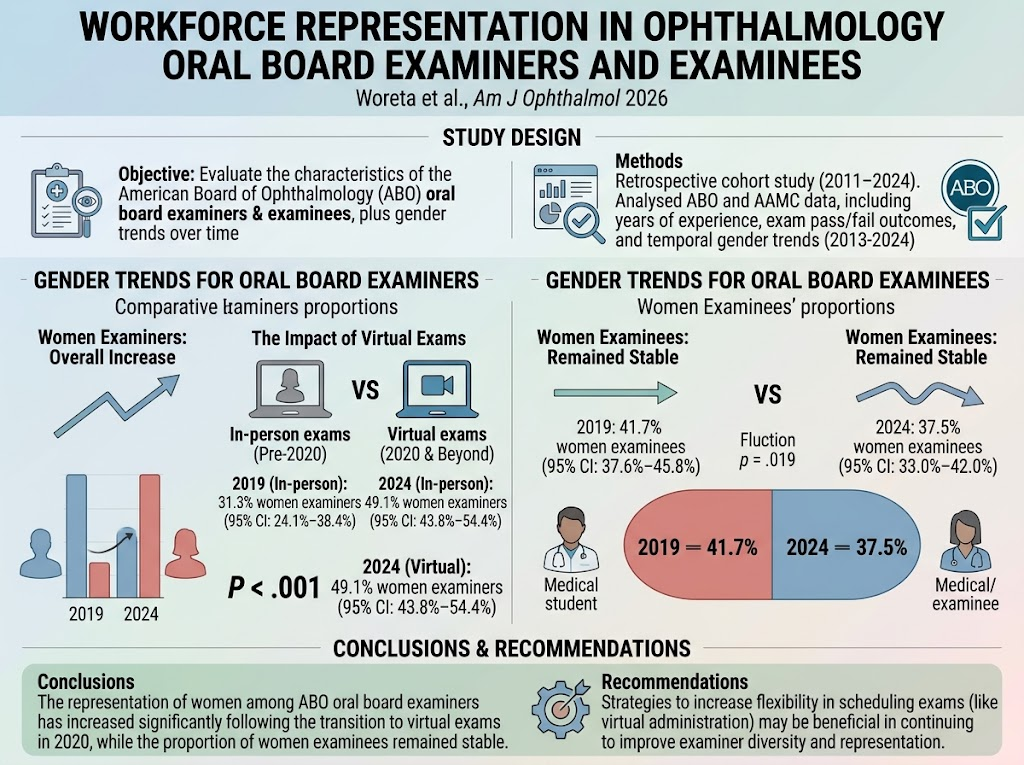
This retrospective cohort study analyzed demographic data from the ABO and the Association of American Medical Colleges (AAMC) spanning 2011 to 2024. The primary focus was on gender distribution among oral board examiners and examinees. Key examiner variables included gender, years of clinical experience, year of initial certification, and average examiner score. Examinee variables comprised gender, years since residency graduation, and examination outcomes (pass versus fail). Logistic regression models assessed temporal trends in examiner and examinee gender proportions, with particular attention to differences before and after the 2020 transition from in-person to virtual oral exams.
Key Findings
The proportion of female examiners increased significantly over the study period, with the most notable rise following the 2020 pivot to a virtual exam format. Female examiner representation expanded from 31.3% in 2019 (95% CI: 24.1%-38.4%) to 49.1% in 2024 (95% CI: 43.8%-54.4%), yielding a statistically significant p-value of less than 0.001. This suggests that virtual exam administration may reduce logistical barriers such as travel and schedule inflexibility, thereby enabling greater participation by women in examiner roles.
In contrast, the percentage of female examinees remained relatively stable, measuring 41.7% in 2019 (95% CI: 37.6%-45.8%) and 37.5% in 2024 (95% CI: 33.0%-42.0%), with a p-value of 0.019 indicating minor but statistically significant variation without an upward trend. This stability in examinee gender distribution indicates persistent gender dynamics in ophthalmology training and certification candidacy.
Expert Commentary
These findings highlight the transformative potential of virtual technology in advancing equity in medical certification processes. Increased female representation among examiners may contribute to more inclusive assessment perspectives and mentorship opportunities for examinees. Nonetheless, the study is limited by its observational design and lack of granular data on other diversity dimensions such as race/ethnicity or socioeconomic background. Additionally, causality between virtual exam administration and increased female participation cannot be definitively established. Further qualitative studies assessing examiner and examinee experiences may elucidate underlying facilitators and barriers to participation.
Conclusion
The transition to virtual oral board examinations is associated with a significant increase in the representation of women among American Board of Ophthalmology oral board examiners, suggesting improved inclusivity linked to scheduling flexibility. Female examinee representation remained stable, underscoring ongoing challenges in recruiting and certifying women ophthalmologists. Continued efforts to integrate flexible certification processes and targeted initiatives aimed at enhancing gender diversity at trainee and examiner levels are warranted to foster equity in ophthalmology.
Funding and ClinicalTrials.gov
No external funding was reported for this retrospective cohort study. The study was not registered on ClinicalTrials.gov as it involved analysis of pre-existing data without patient interventions.
References
1. Woreta FA, Aamir FB, Ali M, Culican S, Wang J, Dun C, Martin B, Schnabel S, Bartley GB. Workforce Representation in Ophthalmology Oral Board Examiners and Examinees. American Journal of Ophthalmology. 2026 Jun 25;290:252-257. PMID: 42349536.
2. Association of American Medical Colleges. Diversity in Medicine: Facts and Figures 2019.
3. Esfandiari H, Lee AG. Gender Disparities in Academic Ophthalmology and Vision Science Leadership. Ophthalmology. 2020;127(3):299-301.
4. Carr PL, et al. Effect of institutional culture and policies on women’s academic careers in academic medicine. JAMA. 2018;320(23):2459-2460.