Highlight
– A novel quantitative modeling framework improves prediction of critical oral pH parameters linked to dental caries risk.
– Sparse clinical pH datasets often underestimate key cariogenic measures such as minimum pH and recovery time.
– The developed web-based interface, GatorpH, enables accurate and rapid characterization of pH dynamics for clinical and research applications.
– Enhanced pH profiling aids in evaluating dietary cariogenicity, cariostatic agents, and microbiome shifts relevant to oral health.
Study Background
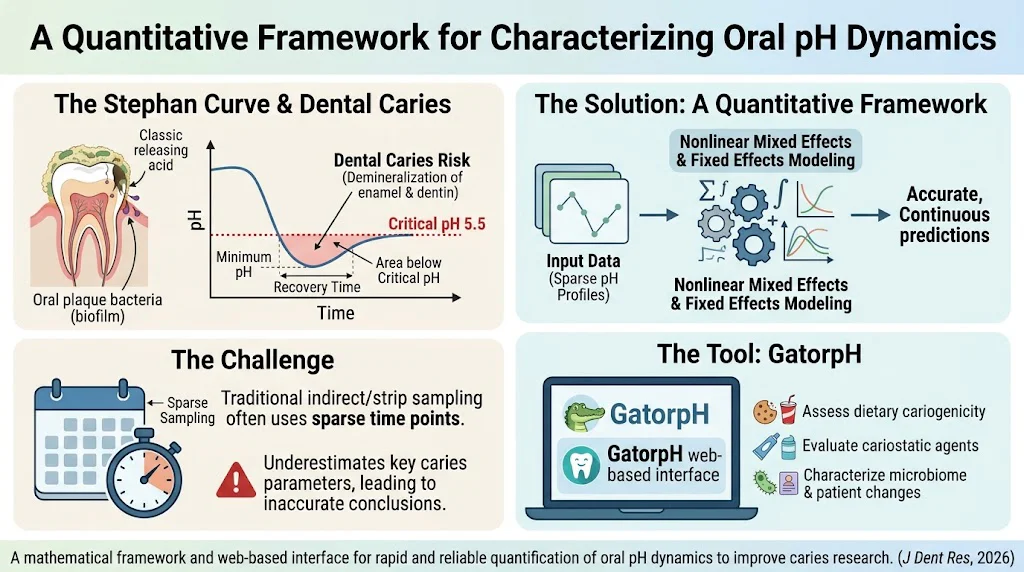
Dental caries remains a significant global health burden, caused by polymicrobial biofilms producing acid that erodes enamel and dentin. Measurement of oral plaque and saliva pH changes after exposure to fermentable carbohydrates, historically depicted as the “Stephan curve,” is a pivotal method to assess cariogenic potential. Parameters including the nadir pH, time to minimum pH, duration below the critical threshold (~5.5), and area under the curve have clinical relevance for assessing caries risk. However, traditional measurement techniques frequently rely on sparse time-point sampling due to patient compliance, cost, and technical constraints, limiting data resolution and potentially biasing risk interpretation.
Study Design
This study introduces a quantitative modeling approach employing nonlinear mixed effects and fixed effects models to analyze oral pH dynamics more accurately from sparse datasets. Rather than relying solely on direct measurements at discrete time points, the model robustly predicts key cariogenic parameters across heterogeneous patient data. The authors also developed a publicly accessible, web-based tool, GatorpH, implementing these models for end-user application in both plaque and saliva pH profiling. This framework was validated against existing clinical datasets, comparing performance to traditional analytical approaches used in prior studies.
Key Findings
The modeling approach demonstrated superior accuracy in predicting critical cariogenic parameters from sparse data, notably minimum pH, time to minimum pH, recovery time, and the integral of pH below critical values. Traditional methods tended to underestimate these values, which may misguide caries risk evaluation and clinical decision-making. By incorporating population variability and nonlinear pH kinetics, the mixed effects model corrected for sampling limitations, offering reproducible and reliable parameter estimates even from limited data points. This enhances the interpretative power of pH measurements in dietary assessments, efficacy trials of cariostatic agents, and studies examining microbiome-associated acidogenicity.
The GatorpH interface facilitated convenient application of complex modeling methodologies without requiring advanced statistical expertise, democratizing access to state-of-the-art analytic techniques for clinicians and researchers alike. The tool’s deployment promises to standardize oral pH analyses, enabling harmonized data interpretation across clinical studies and regulatory evaluations.
Expert Commentary
The introduced quantitative framework addresses a prominent methodological gap in cariology research and clinical risk assessment. Accurate estimation of oral acidogenic profiles is critical due to the dynamic and individualized nature of microbial biofilms and host factors influencing demineralization and remineralization. By overcoming sparse sampling limitations, this approach elevates the quality of data interpretation, which may refine patient risk stratification and tailored preventive strategies.
Limitations include the need for further validation in diverse populations and real-world clinical settings, as model generalizability depends on underlying data heterogeneity. While promising, the approach should be integrated with comprehensive clinical and microbiological assessments for holistic caries management. Future work may incorporate additional biomarkers and integrate salivary flow and buffering capacity to augment predictive accuracy.
Conclusion
This study offers a transformative advancement in the quantitative analysis of oral pH dynamics relevant to dental caries. The nonlinear mixed effects modeling framework and GatorpH interface provide robust, accessible tools enabling precise characterization of cariogenic acid profiles from commonly collected clinical data. This methodology not only standardizes oral pH assessment but also enhances the evaluation of dietary items, therapeutic agents, and microbiome influences on caries risk. Consequently, it holds considerable translational potential to improve clinical decision-making, research reproducibility, and regulatory assessment within oral health sciences.
Funding and Clinical Trials
The original study did not specify funding sources or registered clinical trials. Future dissemination should include such information to support transparency and reproducibility.
References
1. Elashkar OI, Kasparian KV, McCurdy CR, Abranches J, Sharma A. A Quantitative Framework for Characterizing Oral pH Dynamics. Journal of dental research. 2026 Nov 3:220345261474858. PMID: 42978267.
2. Stephan RM. Changes in hydrogen-ion concentration on the surface of human teeth after eating various foods. J Dent Res. 1944;23(4):257-66.
3. Featherstone JD. The science and practice of caries prevention. J Am Dent Assoc. 2000 Jul;131(7):887-99.
4. Zero DT. Dental caries process. Dent Clin North Am. 1999 Apr;43(2):635-54.
5. Tenuta LM, Cury JA. The role of cariogenic biofilms in dental caries pathogenesis. J Appl Oral Sci. 2010 Nov-Dec;18(6):1-7.
Specialty calculators
For clinical reference; use professional judgment.