Highlight
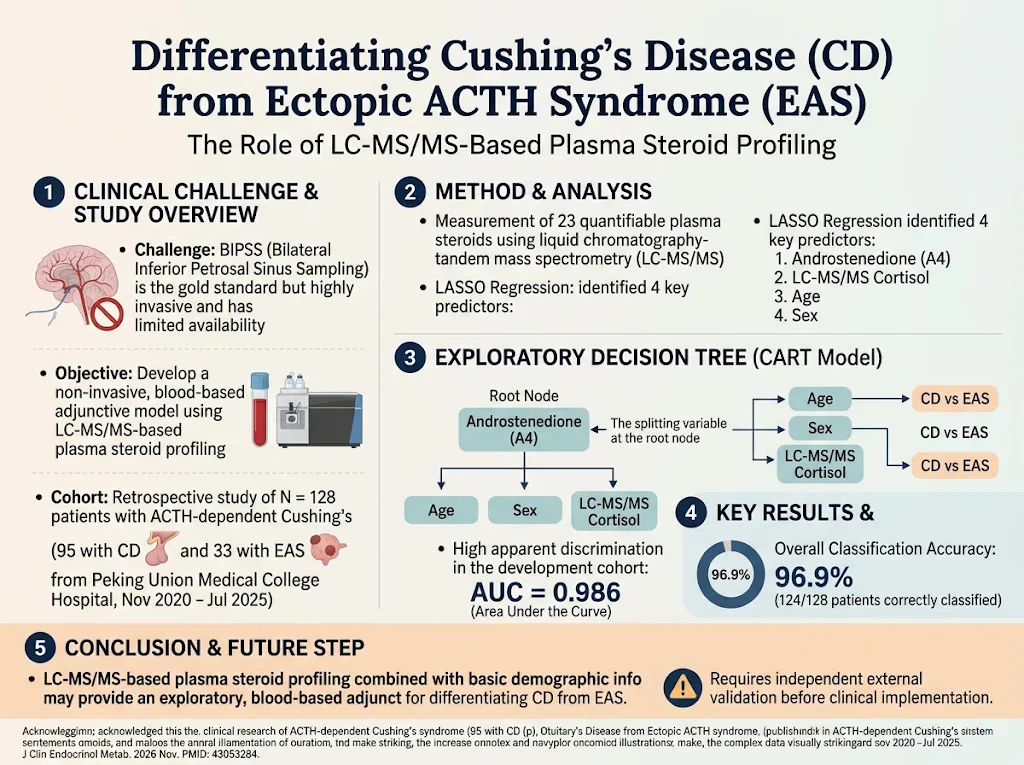
- A blood-based plasma steroid profiling model combining androstenedione, LC-MS/MS cortisol, age, and sex can distinguish Cushing’s disease (CD) from ectopic ACTH syndrome (EAS) with high accuracy.
- The model offers a noninvasive adjunct to the gold standard bilateral inferior petrosal sinus sampling (BIPSS), overcoming invasiveness and limited availability challenges.
- This approach achieved an area under the curve (AUC) of 0.986 and classification accuracy of 96.9% in a large retrospective cohort.
- Independent external validation is essential before clinical adoption, given the model’s derivation from a single-center retrospective cohort.
Study Background and Disease Burden
Cushing’s syndrome caused by excess adrenocorticotropic hormone (ACTH) secretion poses a significant diagnostic challenge in endocrinology. Differentiating the pituitary origin—Cushing’s disease (CD)—from ectopic ACTH syndrome (EAS) is critical, as their treatment approaches and prognoses differ markedly. The current gold standard for distinguishing these is bilateral inferior petrosal sinus sampling (BIPSS), which measures ACTH gradients between central and peripheral sites. However, BIPSS is invasive, carries procedural risks, and demands expertise and resources that are often unavailable in many clinical settings. Consequently, there is an unmet need for accurate, minimally invasive, and widely accessible diagnostic tools to aid clinical decision-making in ACTH-dependent Cushing’s syndrome. Advances in analytical chemistry using liquid chromatography-tandem mass spectrometry (LC-MS/MS) enable precise quantification of diverse plasma steroids, providing detailed steroidogenic profiles potentially reflective of underlying disease mechanisms. These profiles might help discriminate CD from EAS by capturing subtle differences in steroid biosynthesis linked to the source of ACTH excess.Study Design
This retrospective cohort study analyzed 128 patients with confirmed ACTH-dependent Cushing’s syndrome evaluated between November 2020 and July 2025 at Peking Union Medical College Hospital. The cohort included 95 patients with Cushing’s disease and 33 with ectopic ACTH syndrome. Plasma samples were subjected to LC-MS/MS to quantify concentrations of 23 steroids involved in adrenal steroidogenesis. To identify the most discriminatory variables, the authors applied Least Absolute Shrinkage and Selection Operator (LASSO) regression—a statistical technique suited to feature selection in high-dimensional data—to the plasma steroid measurements along with patient demographic variables. This was followed by construction of a classification and regression tree (CART) model based on the selected features to develop a clinically interpretable decision-making algorithm. The model’s discriminative ability was evaluated through calculation of the area under the receiver operating characteristic curve (AUC) and classification accuracy in the development cohort. Calibration and clinical utility were additionally appraised via logistic regression models using the same predictors, with bootstrap resampling to adjust for overfitting.Key Findings
LASSO regression identified four key predictors that best differentiated CD from EAS: plasma androstenedione (A4), LC-MS/MS measured cortisol, patient age, and sex. These variables form the basis of the exploratory CART decision tree. The CART model achieved remarkable performance metrics with an AUC of 0.986, indicating excellent discrimination between the two conditions. Overall classification accuracy was 96.9%, correctly classifying 124 of 128 patients. Androstenedione emerged as the root splitting variable, suggesting its pivotal role in delineating the steroidogenic profiles associated with ectopic versus pituitary ACTH secretion. Subsequent splits incorporated age, sex, and cortisol levels, reflecting the model’s multi-dimensional approach to differentiation. The high diagnostic accuracy suggests plasma steroid profiling captures relevant biochemical differences in adrenal steroidogenesis patterns stimulated by different sources of ACTH excess. Importantly, the model relies on routine demographic data in addition to steroid measurements, enhancing its practical utility.Expert Commentary
This study presents a promising blood-based adjunct for differentiating CD from EAS that could reduce reliance on invasive BIPSS. The integration of LC-MS/MS steroid quantification with clinical variables into a simple tree-based decision algorithm offers an interpretable and potentially scalable diagnostic tool. The prominence of androstenedione as the primary discriminant marker highlights differential steroidogenic pathway activation that could be reflective of underlying tumor biology. Despite the compelling findings, external validation is fundamental before clinical implementation, as single-center retrospective cohorts can introduce biases and limit generalizability. Moreover, potential confounders such as concurrent medications, variable disease severities, and assay standardization across laboratories warrant consideration. Future prospective studies should compare this approach head-to-head with BIPSS and standard biochemical tests to establish clinical pathways for integration. From a mechanistic perspective, the observed steroid profile differences between CD and EAS likely relate to distinct patterns of ACTH release and corresponding adrenal responsiveness, as well as possible paracrine factors or co-secretion of other peptides by ectopic tumors.Conclusion
LC-MS/MS-based plasma steroid profiling combined with basic demographic data represents an innovative, minimally invasive method with excellent preliminary accuracy for differentiating Cushing’s disease from ectopic ACTH syndrome. This approach has the potential to augment or partially replace invasive BIPSS in selected patients, improving safety and accessibility of diagnosis. However, rigorous external validation and prospective evaluation are essential to confirm reliability and define clinical utility before adoption into practice guidelines.Funding and ClinicalTrials.gov
The original research funding and any registered clinical trial identifiers were not specified in the abstract. Readers should consult the full article for detailed disclosures.References
1. Zhang D, Zhou X, Li M, et al. Plasma Steroid Profiling for Differentiating Cushing’s Disease from Ectopic ACTH Syndrome. J Clin Endocrinol Metab. 2026 Nov 19; [PMID: 43053284]. 2. Nieman LK, Biller BMK, Findling JW, et al. The diagnosis of Cushing’s syndrome: an Endocrine Society Clinical Practice Guideline. J Clin Endocrinol Metab. 2008;93(5):1526-1540. 3. Newell-Price J, Trainer P, Besser M, Grossman A. The diagnosis and differential diagnosis of Cushing’s syndrome and pseudo-Cushing’s states. Endocr Rev. 1998;19(5):647-672. 4. Raff H, Findling JW. A clinician’s guide to Cushing’s syndrome. Proc Assoc Am Physicians. 2003;115(4):300-306.Visual Illustration Prompt
“Liquid chromatography-tandem mass spectrometry analysis depicting plasma steroid molecules with an adjacent schematic illustrating pituitary versus ectopic sources of ACTH secretion affecting adrenal steroidogenesis.”Specialty calculators
For clinical reference; use professional judgment.