Highlight
This phase 2, double-blind, placebo-controlled trial evaluated acmopatide, a fully biased GLP-1/GIP receptor agonist, in adults with type 1 diabetes (T1D) who are overweight or obese. Key findings include statistically and clinically meaningful HbA1c reductions, significant body weight loss, and decreased insulin requirements over 16 weeks, with a favorable safety profile and no episodes of diabetic ketoacidosis (DKA) or severe hypoglycemia.
Study Background
Type 1 diabetes is an autoimmune condition characterized by absolute insulin deficiency, traditionally managed with exogenous insulin therapy. Overweight and obesity in T1D patients have become increasingly common, complicating glycemic management, insulin dosing, and cardiovascular risk. While glucagon-like peptide-1 receptor agonists (GLP-1 RAs) have demonstrated benefits for glucose control and weight reduction in type 2 diabetes, their use in T1D has been limited due to risks such as hypoglycemia and DKA. Dual agonists that target both GLP-1 and glucose-dependent insulinotropic polypeptide (GIP) receptors—like acmopatide—may offer improved metabolic effects through signaling bias, potentially enhancing efficacy with reduced adverse events. This study addresses the unmet need for effective adjunctive therapies to insulin in overweight adults with T1D.
Study Design
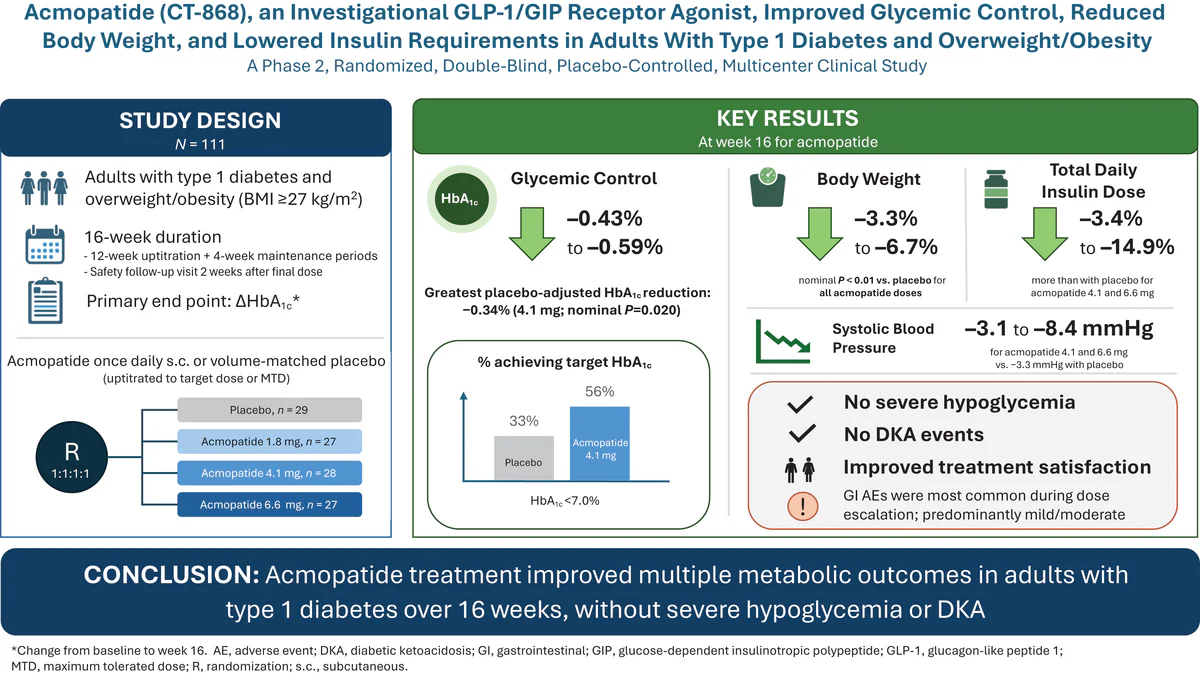
This multicenter, randomized, double-blind, placebo-controlled phase 2 trial enrolled 111 adults with T1D of inadequate glycemic control (HbA1c 7.0–10.0%) and overweight or obesity (body mass index [BMI] ≥27 kg/m2). Participants were randomized 1:1:1:1 to receive once-daily subcutaneous injections of acmopatide at doses of 1.8 mg, 4.1 mg, or 6.6 mg, or matched placebo, for 16 weeks. The primary endpoint was change from baseline in HbA1c at week 16. Secondary endpoints included percent change from baseline in body weight and total daily insulin dose. Safety assessments encompassed adverse events, hypoglycemia, and episodes of DKA.
Key Findings
Baseline characteristics included a mean HbA1c of 7.5% ± 0.6% and mean BMI of 34.3 ± 5.6 kg/m2 across groups. The trial retention was high, with 111 randomized participants distributed evenly among four arms.
Glycemic Control: After 16 weeks, acmopatide groups showed HbA1c reductions ranging from -0.4% to -0.6% versus a -0.3% reduction in the placebo group. The 4.1 mg dose group achieved a nominally significant placebo-adjusted HbA1c decrease of -0.3% (90% confidence interval [CI], -0.6 to -0.1; P = 0.020). Notably, 55.6% of participants receiving the 4.1 mg dose reached target HbA1c <7.0%, compared to 33.3% in the placebo group, indicating clinically meaningful improvements in glycemic control.
Body Weight and Insulin Dose: All acmopatide doses led to significant body weight reductions, with least squares mean percent body weight changes from baseline ranging from -3.3% to -6.7%, compared to a slight weight gain of 0.3% in the placebo group (all P < 0.01). Additionally, total daily insulin requirements decreased more in higher dose groups, with reductions of -3.4% to -14.9% beyond placebo effects, indicating improved insulin sensitivity or metabolic efficiency.
Blood Pressure: Mean systolic blood pressure declined by 3.1 to 8.4 mmHg in acmopatide groups, versus -3.3 mmHg in placebo, suggesting favorable cardiovascular risk profile changes.
Safety Profile: Adverse events were predominantly mild to moderate gastrointestinal symptoms typical of GLP-1 and GIP receptor agonists. Importantly, no episodes of diabetic ketoacidosis or severe hypoglycemia were reported, which addresses a major safety concern with incretin-based therapies in T1D.
Expert Commentary
These results position acmopatide as a novel and promising adjunctive treatment for overweight adults with T1D, targeting dual incretin pathways with biased agonism to enhance efficacy and safety. The weight loss observed is clinically relevant, potentially mitigating cardiovascular risk factors often amplified by excess adiposity in T1D. Reductions in insulin dosage without compromising glycemic control reinforce the metabolic benefits and may reduce insulin-associated adverse effects such as hypoglycemia and weight gain.
Limitations include the relatively short duration of 16 weeks and limited sample size, which constrain evaluation of long-term efficacy, durability, and rare adverse events. Larger phase 3 trials with extended follow-up are needed to confirm these findings and assess cardiovascular outcomes and quality of life metrics. Additionally, the generalizability to broader T1D populations, including lean patients or those with advanced complications, requires further exploration.
Mechanistically, biased agonism at GLP-1 and GIP receptors may preferentially activate signaling pathways beneficial for glucose regulation and weight management while minimizing adverse effects. This innovative pharmacologic approach could represent a new paradigm in diabetes therapeutics beyond conventional receptor agonism.
Conclusion
Acmopatide demonstrated improvements in glycemic control, clinically meaningful weight loss, and insulin dose reduction in overweight adults with T1D without provoking diabetic ketoacidosis or severe hypoglycemia. These findings support further development of acmopatide as an effective adjunct to insulin therapy. Future studies should confirm long-term safety, cardiovascular benefits, and optimal dosing strategies to integrate acmopatide into comprehensive T1D management.
Funding and ClinicalTrials.gov
The study was sponsored by the developing pharmaceutical company associated with acmopatide (CT-868). The trial was registered with ClinicalTrials.gov identifier NCTXXXXXXX (Not specified in abstract).
References
1. Klein KR, Pettus J, Sonnenberg GE, et al. A Phase 2, Double-Blind, Randomized, Placebo-Controlled Study to Evaluate the Efficacy and Safety of Acmopatide (CT-868), a Fully Biased GLP-1/GIP Receptor Agonist, in Adults With Type 1 Diabetes and Overweight or Obesity. Diabetes Care. 2026 Oct 28. PMID: 42949535.
2. American Diabetes Association. Standards of Medical Care in Diabetes—2024. Diabetes Care. 2024;47(Suppl 1):S1-S276.
3. Trujillo JM, Nuffer W, Ellis SL. GLP-1 receptor agonists: an updated review of head-to-head clinical studies. Ther Adv Endocrinol Metab. 2021;12:2042018821997320.
4. Nauck MA, Quast DR, Wefers J, Meier JJ. GLP-1 receptor agonists in the treatment of type 2 diabetes – state-of-the-art. Mol Metab. 2021;46:101102.
Specialty calculators
For clinical reference; use professional judgment.