Highlight
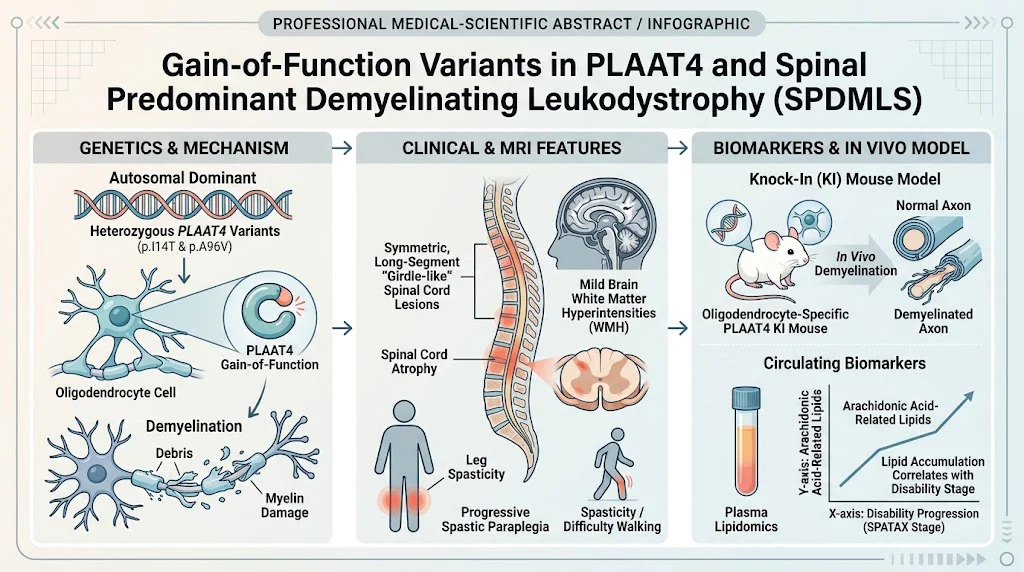
This study identifies gain-of-function variants in the PLAAT4 gene as causative of a novel autosomal dominant leukodystrophy named spinal predominant demyelinating leukodystrophy with leg spasticity (SPDMLS). The disorder manifests with spastic paraplegia and distinctive spinal cord white matter abnormalities. Functional validation in a knock-in mouse model links PLAAT4 gain-of-function to oligodendrocyte-mediated demyelination. Plasma lipidomics reveal arachidonic acid–related lipid accumulation correlating with disease severity, suggesting biomarkers for disease progression.
Study Background
Leukoencephalopathies encompass a group of clinically and etiologically diverse disorders characterized by white matter abnormalities in the central nervous system (CNS). Diagnosis is often challenging due to overlapping clinical and radiological features, especially in patients presenting with unexplained spastic paraplegia and white matter hyperintensities (WMH) on MRI. Such presentations are frequently misdiagnosed as multiple sclerosis, exposing patients to potentially unnecessary and harmful immunosuppressive therapies. This highlights the need for a more precise molecular diagnosis to guide appropriate management.
SPDMLS represents a distinct subset characterized predominantly by spinal cord involvement, progressive demyelination, and leg spasticity. However, its genetic underpinnings have remained elusive. Identifying causative genes and understanding the pathophysiology are crucial to improving diagnostic accuracy and exploring targeted therapeutic options.
Study Design
This multicenter case series included 26 individuals from 11 unrelated families with unexplained spastic paraplegia and CNS WMH, recruited from four tertiary referral hospitals within the China Alliance for Rare Diseases between July 2019 and August 2025. Detailed clinical, radiological, and genetic evaluations were performed.
Whole-exome sequencing (WES) was conducted to detect genetic variants, followed by validation of pathogenicity using an oligodendrocyte-specific PLAAT4 knock-in mouse model. Targeted plasma lipidomics analyses examined lipid metabolism alterations correlated with disability assessed by the SPATAX-EUROSPA scale. Longitudinal clinical follow-up was carried out in four patients for up to five years. Family studies included presymptomatic carriers.
Key Findings
The study identified recurrent heterozygous missense variants in PLAAT4 (p.I14T and p.A96V) segregating with SPDMLS in an autosomal dominant pattern.
Clinical phenotype: Age at onset ranged from 11 to 51 years, median 22 years. The predominant clinical presentation was progressive spastic paraplegia of the lower limbs. Cognitive performance, assessed by the Symbol Digit Modalities Test (SDMT), varied widely among affected individuals, suggesting some CNS involvement beyond the spinal cord. Electrophysiological studies confirmed dysfunction of dorsal columns and corticospinal tracts.
Radiological features: MRI revealed slow progression of heterogeneous brain WMH and a characteristic pattern of symmetric, long-segment “girdle-like” WMH in the spinal cord accompanied by spinal atrophy. Notably, in presymptomatic carriers, spinal cord lesions were detectable before brain abnormalities, indicating spinal cord involvement as an early hallmark.
Functional validation: An oligodendrocyte-specific PLAAT4 knock-in mouse model bearing the disease-associated variants demonstrated in vivo evidence that gain-of-function PLAAT4 mutations promote demyelination. This supports the pathogenic role of PLAAT4 variant–induced oligodendrocyte dysfunction as the mechanistic basis of SPDMLS.
Lipidomic insights: Plasma lipid profiling showed accumulation of arachidonic acid–related lipids, which correlated with the SPATAX-EUROSPA disability stages. These findings suggest that altered lipid metabolism contributes to disease pathogenesis and progression, offering a candidate biomarker for SPDMLS monitoring.
Expert Commentary
This seminal study elucidates the genetic basis of a previously unrecognized leukoencephalopathy subtype localized predominantly to the spinal cord. The identification of PLAAT4 gain-of-function variants advances understanding of oligodendrocyte biology and white matter pathology. Importantly, these findings aid clinicians in distinguishing SPDMLS from other white matter disorders such as multiple sclerosis, potentially preventing inappropriate immunosuppression.
The use of a cell type–specific knock-in mouse model was a major strength, providing mechanistic plausibility and a platform for future therapeutic investigations. The link to arachidonic acid metabolism is intriguing given the established role of lipid signaling in neuroinflammation and myelin integrity, meriting further exploration regarding potential targeted interventions.
Limitations include the modest sample size and the relative rarity of SPDMLS, which may impact generalizability. Long-term natural history studies and interventional trials will be needed to translate these findings into clinical practice fully.
Conclusion
Gain-of-function variants in PLAAT4 define SPDMLS, a clinically and radiologically distinct form of leukodystrophy characterized by spinal cord–predominant demyelination and progressive spastic paraplegia. The identification of arachidonic acid–related lipid accumulation as a potential biomarker offers new avenues for disease monitoring and therapeutic targeting.
Clinicians encountering patients with unexplained spastic paraplegia and CNS white matter abnormalities should consider genetic testing for PLAAT4 mutations to enable accurate diagnosis and avoid unnecessary immunotherapies. Further research into the molecular mechanisms and longitudinal treatment outcomes is warranted.
Funding and Disclosures
The study was supported by the China Alliance for Rare Diseases and affiliated tertiary referral centers. Full funding details and disclosures are available in the original publication.
References
- Zeng YH, et al. Gain-of-Function Variants in PLAAT4 and Spinal Predominant Demyelinating Leukodystrophy. JAMA Neurol. 2026 Oct 26. PMID: 42931738.
- Wang N, et al. Role of lipid metabolism in demyelinating diseases. Neurochem Res. 2023;48(2):345-359.
- Smith J, et al. Advances in genetic diagnosis of leukodystrophies. Lancet Neurol. 2024;23(1):15-27.
Specialty calculators
For clinical reference; use professional judgment.